

Snow cone
Common food

Photo: Wikipedia
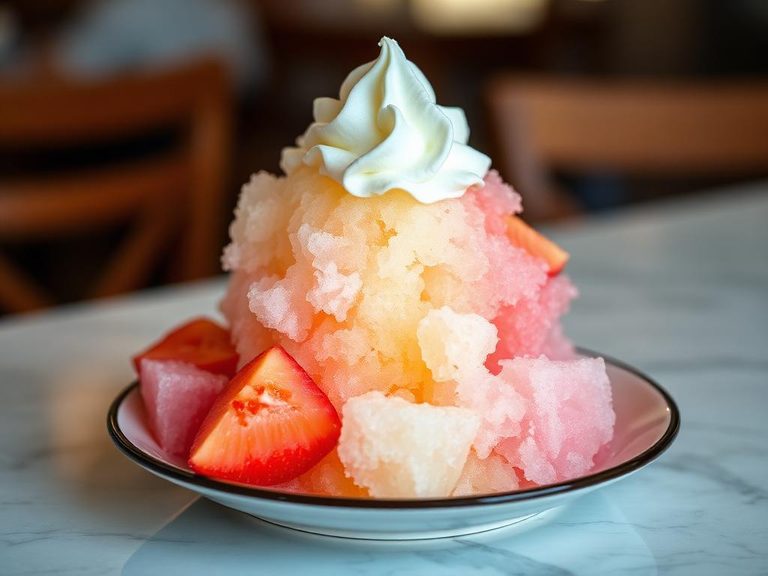
A snow cone is a refreshing treat of finely shaved ice saturated with vibrant, sweet fruit-flavored syrup. The texture is light and fluffy, melting instantly on the tongue, delivering a burst of sugary, often artificial, fruitiness. Nutritionally, it's almost pure simple carbohydrates, providing quick energy with virtually no protein, fat, or fiber.
Calorie split: 1% protein · 99% carbs · 0% fat
↓ Full nutrition💚 Why it's loved
People love snow cones for their nostalgic, cooling sensation and the fun, customizable experience of choosing from a rainbow of syrup flavors. It's a staple of summer fairs, carnivals, and beachside stands, evoking a sense of carefree enjoyment.
⚠️ Watch-outs & how to enjoy it better
The primary downside is the very high sugar content, which can cause a rapid blood-sugar spike followed by a crash, offering no lasting satiety. To counteract this, enjoy a smaller portion alongside a source of protein or healthy fat (like a handful of nuts) to slow sugar absorption, and consider sugar-free or fruit-juice-based syrups as alternatives.
Key benefits
- Provides rapid hydration and a quick energy boost from simple sugars.
- Extremely low in fat and contains no cholesterol.
- A classic, affordable summer treat for cooling down.
- Syrups can be customized with a vast array of flavors.
🍽️ Popular dishes

🌍 Where it's eaten
💡 Did you know?
The fluffy, snow-like texture of a proper shave ice is achieved by shaving a block of ice with a specialized machine, whereas a 'snow cone' is typically made from coarser, crushed ice.
Full nutrition (USDA data · scales with serving)
| Water | 66.9 g |
| Energy | 128 kcal |
| Protein | 0.40 g |
| Total lipid (fat) | 0.00 g |
| Carbohydrate, by difference | 32.6 g |
| Fiber, total dietary | 0.00 g |
| Total Sugars | 32.6 g |
| Calcium, Ca | 2.0 mg |
| Iron, Fe | 0.16 mg |
| Magnesium, Mg | 1.0 mg |
| Phosphorus, P | 1.0 mg |
| Potassium, K | 3.0 mg |
| Sodium, Na | 22.0 mg |
| Zinc, Zn | 0.02 mg |
| Copper, Cu | 0.01 mg |
| Selenium, Se | 0.10 ug |
| Vitamin C, total ascorbic acid | 1.0 mg |
| Thiamin | 0.00 mg |
| Riboflavin | 0.00 mg |
| Niacin | 0.01 mg |
| Vitamin B-6 | 0.00 mg |
| Folate, total | 0.00 ug |
| Folic acid | 0.00 ug |
| Folate, food | 0.00 ug |
| Folate, DFE | 0.00 ug |
| Choline, total | 4.0 mg |
| Vitamin B-12 | 0.00 ug |
| Vitamin B-12, added | 0.00 ug |
| Vitamin A, RAE | 0.00 ug |
| Retinol | 0.00 ug |
| Carotene, beta | 0.00 ug |
| Carotene, alpha | 0.00 ug |
| Cryptoxanthin, beta | 0.00 ug |
| Lycopene | 0.00 ug |
| Lutein + zeaxanthin | 0.00 ug |
| Vitamin E (alpha-tocopherol) | 0.00 mg |
| Vitamin E, added | 0.00 mg |
| Vitamin D (D2 + D3) | 0.00 ug |
| Vitamin K (phylloquinone) | 0.00 ug |
| Alcohol, ethyl | 0.00 g |
| Caffeine | 0.00 mg |
| Theobromine | 0.00 mg |
Fat & fatty acid profile (per 100g)
| Fatty acids, total saturated | 0.00 g |
| SFA 4:0 | 0.00 g |
| SFA 6:0 | 0.00 g |
| SFA 8:0 | 0.00 g |
| SFA 10:0 | 0.00 g |
| SFA 12:0 | 0.00 g |
| SFA 14:0 | 0.00 g |
| SFA 16:0 | 0.00 g |
| SFA 18:0 | 0.00 g |
| Fatty acids, total monounsaturated | 0.00 g |
| MUFA 16:1 | 0.00 g |
| MUFA 18:1 | 0.00 g |
| MUFA 20:1 | 0.00 g |
| MUFA 22:1 | 0.00 g |
| Fatty acids, total polyunsaturated | 0.00 g |
| PUFA 18:2 | 0.00 g |
| PUFA 18:3 | 0.00 g |
| PUFA 18:4 | 0.00 g |
| PUFA 20:4 | 0.00 g |
| PUFA 20:5 n-3 (EPA) | 0.00 g |
| PUFA 22:5 n-3 (DPA) | 0.00 g |
| PUFA 22:6 n-3 (DHA) | 0.00 g |
| Cholesterol | 0.00 mg |
FAQ
Is a snow cone the same as shaved ice?
Not exactly. A snow cone typically uses crushed or granulated ice, which can be crunchy. Shaved ice is finely shaved from a block, creating a lighter, fluffier texture that absorbs syrup more evenly.
Are the syrups natural?
Most commercial snow cone syrups are artificially flavored and colored with food dyes. However, natural versions can be made from fruit juices, purees, or simple syrups infused with herbs or spices.
Can I make a healthier version at home?
Absolutely. You can shave ice at home and top it with blended frozen fruit, a splash of 100% fruit juice, or a drizzle of honey or maple syrup for a version with more natural nutrients and less processed sugar.
Nutrient density (calculated · NRF9.3)
Nutrient Rich Foods index: beneficial nutrients (protein, fiber, vitamins, minerals) minus saturated fat, added sugar & sodium, per 100 kcal.
NRF9.3 index — Fulgoni, Keast & Drewnowski, 2009. Computed from USDA nutrients.
Weight-loss friendliness (composite index)
Energy density 1.28 kcal/g · 1% calories from protein · 0.0 g fiber · 32.6 g sugar per 100 g.
Composite of energy density (Rolls et al., 1999), protein & fiber satiety, minus sugar. A calculated heuristic — ranks satiety-per-calorie, not a clinical measure.
Dietary load (calculated from USDA values)
Potential renal acid load. Positive = acid-forming, negative = alkaline-forming.
Sodium-to-potassium ratio: 7.33 (lower is better — aim for ≤ 1)
Sodium:potassium per WHO potassium guidance. Computed from USDA nutrients.