

Snacks, granola bars, soft, uncoated, nut and raisin
Whole food · Snacks

Photo: Wikipedia
A chewy, dense bar packed with chewy raisins and crunchy nuts, bound by a sweet, oat-based matrix. It delivers a satisfying, non-crumbly texture with a balanced sweet and nutty flavor profile. Nutritionally, it is a calorie-dense energy source with moderate protein and a significant fat content from the nuts.
Calorie split: 7% protein · 54% carbs · 39% fat
↓ Full nutrition💚 Why it's loved
People love the satisfying, chewy texture and the classic combination of sweet raisins with savory, crunchy nuts. It's a go-to, no-mess snack that feels substantial and indulgent while being easy to pack for hikes, work, or school.
⚠️ Watch-outs & how to enjoy it better
The high carbohydrate and fat content can lead to blood-sugar spikes if eaten alone, and the calorie density (454 kcal/100g) requires portion awareness. For those with nut allergies, this is a major allergen risk; counteract by choosing nut-free varieties or pairing with a protein source like Greek yogurt to slow digestion.
Key benefits
- Provides quick energy from carbohydrates and fats
- Contains dietary fiber from oats, nuts, and raisins
- Offers plant-based protein from nuts and grains
- Portable and shelf-stable for on-the-go snacking
- Nuts contribute healthy unsaturated fats
🍽️ Popular dishes
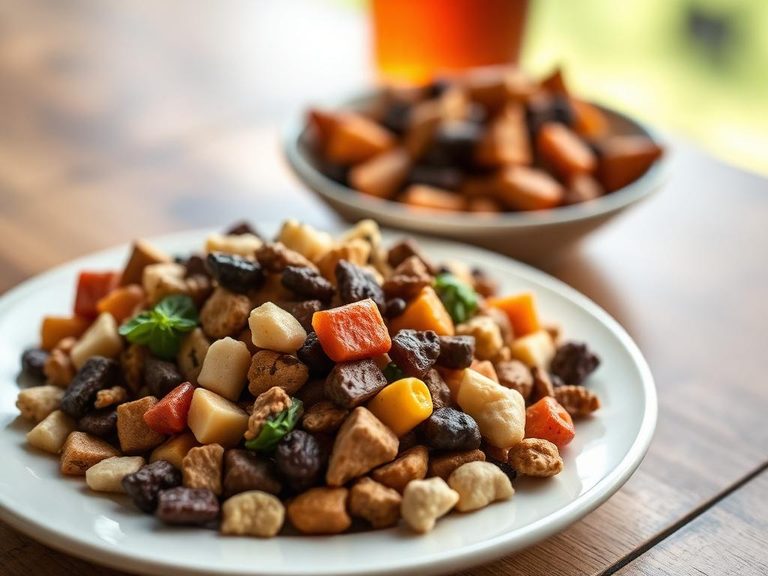
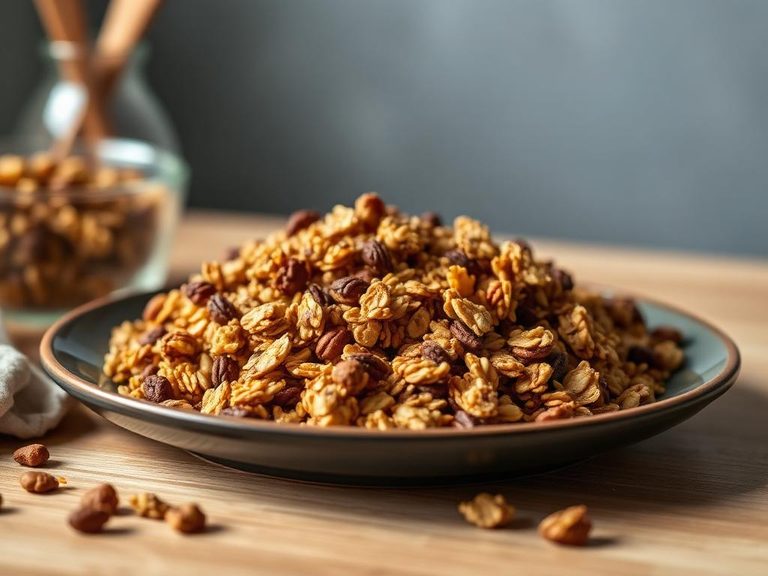
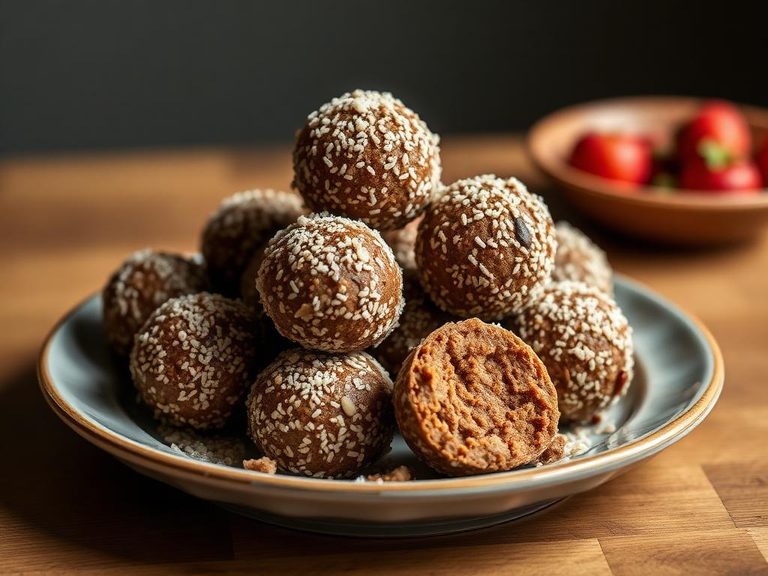


🌍 Where it's eaten
💡 Did you know?
The modern granola bar was invented in 1975 by a Sunbelt Foods employee who was trying to create a less crumbly version of granola cereal for on-the-go consumption.
Full nutrition (USDA data · scales with serving)
| Water | 6.1 g |
| Energy | 454 kcal |
| Energy | 1900 kj |
| Protein | 8.0 g |
| Total lipid (fat) | 20.4 g |
| Ash | 1.9 g |
| Carbohydrate, by difference | 63.6 g |
| Fiber, total dietary | 5.6 g |
| Calcium, Ca | 84.0 mg |
| Iron, Fe | 2.2 mg |
| Magnesium, Mg | 91.0 mg |
| Phosphorus, P | 241 mg |
| Potassium, K | 392 mg |
| Sodium, Na | 254 mg |
| Zinc, Zn | 1.6 mg |
| Copper, Cu | 0.38 mg |
| Manganese, Mn | 1.2 mg |
| Selenium, Se | 15.4 ug |
| Vitamin C, total ascorbic acid | 0.00 mg |
| Thiamin | 0.19 mg |
| Riboflavin | 0.19 mg |
| Niacin | 2.6 mg |
| Pantothenic acid | 0.43 mg |
| Vitamin B-6 | 0.12 mg |
| Folate, total | 30.0 ug |
| Folic acid | 0.00 ug |
| Folate, food | 30.0 ug |
| Folate, DFE | 30.0 ug |
| Vitamin B-12 | 0.24 ug |
| Vitamin A, RAE | 2.0 ug |
| Retinol | 0.00 ug |
| Vitamin A, IU | 41.0 iu |
Fat & fatty acid profile (per 100g)
| Fatty acids, total saturated | 9.5 g |
| SFA 6:0 | 0.06 g |
| SFA 8:0 | 0.67 g |
| SFA 10:0 | 0.53 g |
| SFA 12:0 | 4.0 g |
| SFA 14:0 | 1.5 g |
| SFA 16:0 | 2.1 g |
| SFA 18:0 | 0.66 g |
| Fatty acids, total monounsaturated | 4.2 g |
| MUFA 16:1 | 0.04 g |
| MUFA 18:1 | 4.1 g |
| MUFA 20:1 | 0.03 g |
| Fatty acids, total polyunsaturated | 5.5 g |
| PUFA 18:2 | 5.4 g |
| PUFA 18:3 | 0.17 g |
| Cholesterol | 0.00 mg |
Amino acid profile (per 100g)
| Tryptophan | 0.10 g |
| Threonine | 0.26 g |
| Isoleucine | 0.30 g |
| Leucine | 0.54 g |
| Lysine | 0.30 g |
| Methionine | 0.14 g |
| Cystine | 0.16 g |
| Phenylalanine | 0.39 g |
| Tyrosine | 0.26 g |
| Valine | 0.40 g |
| Arginine | 0.64 g |
| Histidine | 0.19 g |
| Alanine | 0.37 g |
| Aspartic acid | 0.71 g |
| Glutamic acid | 1.6 g |
| Glycine | 0.39 g |
| Proline | 0.40 g |
| Serine | 0.34 g |
FAQ
Is this snack high in sugar?
The provided data lists 0g sugar per 100g, which is unusual for a granola bar and likely refers to added sugar. The natural sugars from raisins and any sweeteners used contribute to its carbohydrate content.
Can I eat this on a low-carb diet?
With 63.6g of carbs per 100g, this is not suitable for a strict low-carb or ketogenic diet. It's better suited for active individuals needing energy.
How does the fat content affect nutrition?
The 20.4g of fat per 100g comes primarily from nuts, providing healthy unsaturated fats, but it also makes the bar calorie-dense. Eating it with fiber-rich foods can help with satiety.
Nutrient density (calculated · NRF9.3)
Nutrient Rich Foods index: beneficial nutrients (protein, fiber, vitamins, minerals) minus saturated fat, added sugar & sodium, per 100 kcal.
NRF9.3 index — Fulgoni, Keast & Drewnowski, 2009. Computed from USDA nutrients.
Weight-loss friendliness (composite index)
Energy density 4.54 kcal/g · 7% calories from protein · 5.6 g fiber · 0.0 g sugar per 100 g.
Composite of energy density (Rolls et al., 1999), protein & fiber satiety, minus sugar. A calculated heuristic — ranks satiety-per-calorie, not a clinical measure.
Dietary load (calculated from USDA values)
Potential renal acid load. Positive = acid-forming, negative = alkaline-forming.
Sodium-to-potassium ratio: 0.65 (lower is better — aim for ≤ 1)
Sodium:potassium per WHO potassium guidance. Computed from USDA nutrients.