

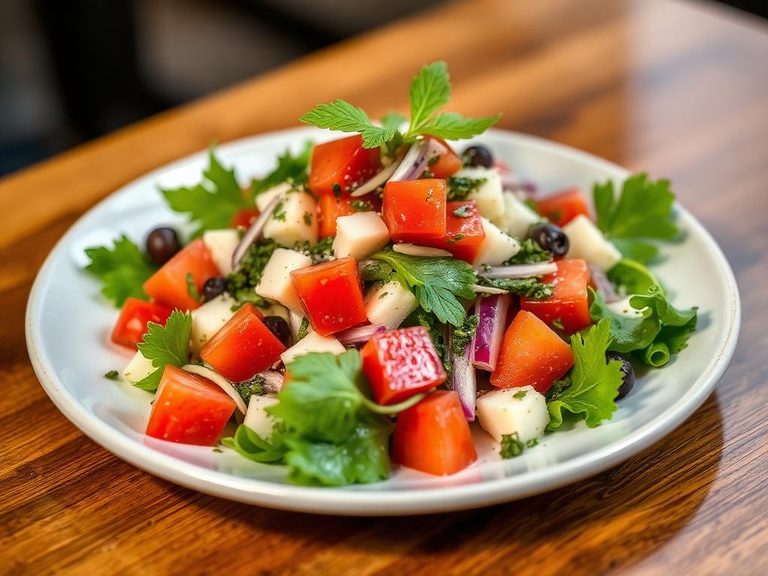
Seafood garden salad with seafood, lettuce, eggs, vegetables excluding tomato and carrots, no dressing
Common food

Photo: Wikipedia
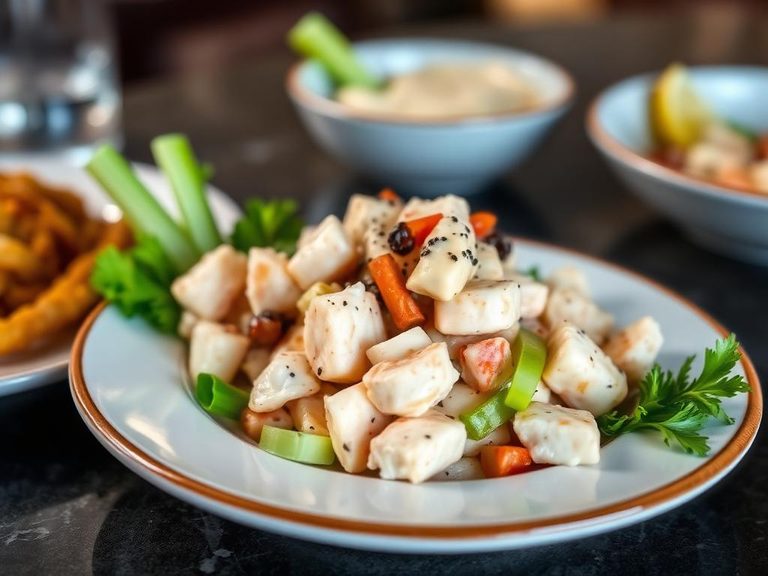
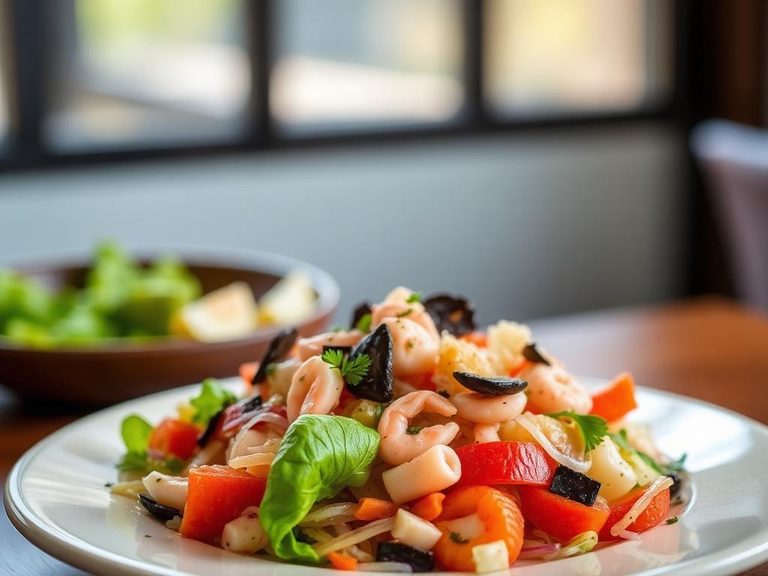
A crisp, refreshing medley of chilled seafood—typically tender shrimp, squid, or imitation crab—tossed with crunchy lettuce, sliced hard-boiled eggs, and a mix of vegetables like cucumber, bell pepper, and onion. The texture is a delightful contrast of soft seafood, creamy egg, and crisp greens, all with a clean, briny-sweet flavor profile. Nutritionally, it's a high-protein, low-calorie powerhouse, offering over 8 grams of protein per 100 grams with minimal fat and carbs.
Calorie split: 55% protein · 16% carbs · 30% fat
↓ Full nutrition💚 Why it's loved
People love it for its clean, oceanic flavors and the satisfying crunch of fresh vegetables paired with tender seafood. It's celebrated as a versatile, light meal that feels both indulgent and healthy, often featured in coastal cuisines as a refreshing starter or main course.
⚠️ Watch-outs & how to enjoy it better
The primary concern is potential allergens like shellfish, eggs, and sometimes gluten in imitation crab. Those watching sodium intake should be cautious, as seafood and prepared ingredients can be high in salt. To counteract, always ask about ingredients, choose fresh over imitation seafood, and pair with a potassium-rich food like avocado to help balance sodium.
Key benefits
- Excellent source of lean protein for muscle maintenance.
- Very low in calories, supporting weight management.
- Provides a good mix of vitamins and minerals from varied vegetables.
- Naturally low in sugar and carbohydrates.
- High in water content from vegetables and seafood, aiding hydration.
🍽️ Popular dishes
🌍 Where it's eaten
💡 Did you know?
Imitation crab, a common ingredient in many seafood salads, is primarily made from surimi—a paste of white fish (usually pollock) that was developed in Japan in the 1970s as a cost-effective alternative to crab.
Full nutrition (USDA data · scales with serving)
| Water | 86.0 g |
| Energy | 64.0 kcal |
| Protein | 8.4 g |
| Total lipid (fat) | 2.0 g |
| Carbohydrate, by difference | 2.4 g |
| Fiber, total dietary | 0.70 g |
| Total Sugars | 1.0 g |
| Calcium, Ca | 61.0 mg |
| Iron, Fe | 0.75 mg |
| Magnesium, Mg | 23.0 mg |
| Phosphorus, P | 107 mg |
| Potassium, K | 219 mg |
| Sodium, Na | 256 mg |
| Zinc, Zn | 1.2 mg |
| Copper, Cu | 0.20 mg |
| Selenium, Se | 19.3 ug |
| Vitamin C, total ascorbic acid | 9.7 mg |
| Thiamin | 0.04 mg |
| Riboflavin | 0.15 mg |
| Niacin | 0.81 mg |
| Vitamin B-6 | 0.10 mg |
| Folate, total | 38.0 ug |
| Folic acid | 0.00 ug |
| Folate, food | 38.0 ug |
| Folate, DFE | 38.0 ug |
| Choline, total | 75.3 mg |
| Vitamin B-12 | 0.79 ug |
| Vitamin B-12, added | 0.00 ug |
| Vitamin A, RAE | 119 ug |
| Retinol | 23.0 ug |
| Carotene, beta | 1156 ug |
| Carotene, alpha | 2.0 ug |
| Cryptoxanthin, beta | 3.0 ug |
| Lycopene | 0.00 ug |
| Lutein + zeaxanthin | 847 ug |
| Vitamin E (alpha-tocopherol) | 0.81 mg |
| Vitamin E, added | 0.00 mg |
| Vitamin D (D2 + D3) | 0.30 ug |
| Vitamin K (phylloquinone) | 52.3 ug |
| Alcohol, ethyl | 0.00 g |
| Caffeine | 0.00 mg |
| Theobromine | 0.00 mg |
Fat & fatty acid profile (per 100g)
| Fatty acids, total saturated | 0.58 g |
| SFA 4:0 | 0.00 g |
| SFA 6:0 | 0.00 g |
| SFA 8:0 | 0.00 g |
| SFA 10:0 | 0.00 g |
| SFA 12:0 | 0.00 g |
| SFA 14:0 | 0.01 g |
| SFA 16:0 | 0.41 g |
| SFA 18:0 | 0.15 g |
| Fatty acids, total monounsaturated | 0.67 g |
| MUFA 16:1 | 0.06 g |
| MUFA 18:1 | 0.60 g |
| MUFA 20:1 | 0.01 g |
| MUFA 22:1 | 0.00 g |
| Fatty acids, total polyunsaturated | 0.41 g |
| PUFA 18:2 | 0.21 g |
| PUFA 18:3 | 0.04 g |
| PUFA 18:4 | 0.00 g |
| PUFA 20:4 | 0.04 g |
| PUFA 20:5 n-3 (EPA) | 0.06 g |
| PUFA 22:5 n-3 (DPA) | 0.01 g |
| PUFA 22:6 n-3 (DHA) | 0.05 g |
| Cholesterol | 110 mg |
FAQ
Is this salad keto-friendly?
It can be, depending on the ingredients. The base of seafood, lettuce, and most vegetables is low-carb. Avoid adding high-sugar dressings or ingredients like imitation crab with added starches. Focus on fresh seafood and non-starchy vegetables.
How do I keep the lettuce from getting soggy?
Keep the components separate until just before serving. Wash and thoroughly dry the lettuce, and store it in a container with a paper towel. Add the dressing (if using) at the last moment.
What's the best seafood to use?
For a classic taste, use a mix of cooked shrimp and calamari rings. For a sweeter flavor, add chunks of lobster or scallops. For a budget-friendly option, imitation crab or canned tuna works well.
Nutrient density (calculated · NRF9.3)
Nutrient Rich Foods index: beneficial nutrients (protein, fiber, vitamins, minerals) minus saturated fat, added sugar & sodium, per 100 kcal.
NRF9.3 index — Fulgoni, Keast & Drewnowski, 2009. Computed from USDA nutrients.
Weight-loss friendliness (composite index)
Energy density 0.64 kcal/g · 53% calories from protein · 0.7 g fiber · 1.0 g sugar per 100 g.
Composite of energy density (Rolls et al., 1999), protein & fiber satiety, minus sugar. A calculated heuristic — ranks satiety-per-calorie, not a clinical measure.
Dietary load (calculated from USDA values)
Potential renal acid load. Positive = acid-forming, negative = alkaline-forming.
Sodium-to-potassium ratio: 1.17 (lower is better — aim for ≤ 1)
Sodium:potassium per WHO potassium guidance. Computed from USDA nutrients.