

School Lunch, pizza, cheese topping, thin crust, whole grain, frozen, cooked
Whole food · Fast Foods
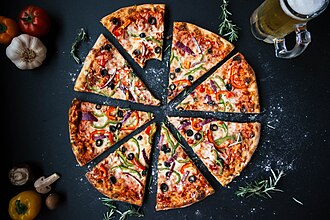
Photo: Wikipedia
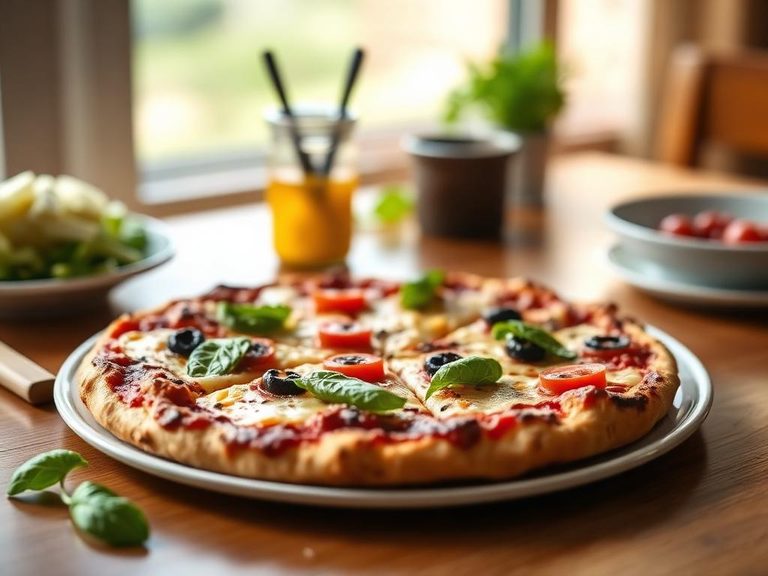
This is a pre-made, thin-crust pizza with a whole-grain base, topped primarily with cheese, designed for quick cooking from frozen. It offers a satisfyingly crisp yet chewy crust with a savory, melted cheese topping. Nutritionally, it provides a balanced mix of protein and carbohydrates with a notable fiber boost from the whole grain.
Calorie split: 21% protein · 51% carbs · 29% fat
↓ Full nutrition💚 Why it's loved
People love it for its comforting, savory cheese flavor and the convenience of a hot, satisfying meal ready in minutes. It's a versatile canvas that can be customized with extra toppings to suit any taste.
⚠️ Watch-outs & how to enjoy it better
The primary concern is its sodium content, common in processed and frozen foods, which can contribute to high blood pressure. Those monitoring blood sugar should be mindful of portion size, as the refined carbs can cause spikes. To counteract, pair it with a large side salad or steamed vegetables to increase volume and fiber, and consider adding a lean protein like grilled chicken to improve satiety.
Key benefits
- Whole-grain crust adds dietary fiber for digestive health
- Provides a good source of protein from cheese and grain
- Convenient, quick-cook meal solution
- Offers a balanced energy source from complex carbs
🍽️ Popular dishes

🌍 Where it's eaten
💡 Did you know?
The concept of a frozen pizza was patented in 1950 by Rose Totino, who later sold her company to Pillsbury, revolutionizing the frozen food aisle.
Full nutrition (USDA data · scales with serving)
| Water | 45.6 g |
| Energy | 247 kcal |
| Energy | 1035 kj |
| Protein | 12.7 g |
| Total lipid (fat) | 7.9 g |
| Ash | 2.4 g |
| Carbohydrate, by difference | 31.3 g |
| Fiber, total dietary | 4.0 g |
| Total Sugars | 7.1 g |
| Calcium, Ca | 218 mg |
| Iron, Fe | 2.5 mg |
| Magnesium, Mg | 51.0 mg |
| Phosphorus, P | 316 mg |
| Potassium, K | 348 mg |
| Sodium, Na | 421 mg |
| Zinc, Zn | 2.0 mg |
| Copper, Cu | 0.10 mg |
| Manganese, Mn | 0.31 mg |
| Selenium, Se | 22.7 ug |
| Vitamin C, total ascorbic acid | 0.00 mg |
| Thiamin | 0.28 mg |
| Riboflavin | 0.35 mg |
| Niacin | 3.0 mg |
| Vitamin B-6 | 0.16 mg |
| Folate, total | 54.0 ug |
| Folic acid | 34.0 ug |
| Folate, food | 19.0 ug |
| Folate, DFE | 78.0 ug |
| Choline, total | 19.0 mg |
| Vitamin B-12 | 1.5 ug |
| Vitamin B-12, added | 0.00 ug |
| Vitamin A, RAE | 66.0 ug |
| Retinol | 59.0 ug |
| Carotene, beta | 87.0 ug |
| Carotene, alpha | 0.00 ug |
| Cryptoxanthin, beta | 0.00 ug |
| Vitamin A, IU | 341 iu |
| Lycopene | 2027 ug |
| Lutein + zeaxanthin | 31.0 ug |
| Vitamin E (alpha-tocopherol) | 0.75 mg |
| Vitamin E, added | 0.00 mg |
| Vitamin D (D2 + D3), International Units | 0.00 iu |
| Vitamin D (D2 + D3) | 0.00 ug |
| Vitamin K (phylloquinone) | 4.2 ug |
| Alcohol, ethyl | 0.00 g |
| Caffeine | 0.00 mg |
| Theobromine | 0.00 mg |
Fat & fatty acid profile (per 100g)
| Fatty acids, total saturated | 4.0 g |
| SFA 4:0 | 0.14 g |
| SFA 6:0 | 0.12 g |
| SFA 8:0 | 0.07 g |
| SFA 10:0 | 0.17 g |
| SFA 12:0 | 0.20 g |
| SFA 14:0 | 0.64 g |
| SFA 16:0 | 1.9 g |
| SFA 18:0 | 0.74 g |
| Fatty acids, total monounsaturated | 1.8 g |
| MUFA 16:1 | 0.10 g |
| MUFA 18:1 | 1.7 g |
| MUFA 20:1 | 0.01 g |
| MUFA 22:1 | 0.00 g |
| Fatty acids, total polyunsaturated | 0.74 g |
| PUFA 18:2 | 0.66 g |
| PUFA 18:3 | 0.07 g |
| PUFA 18:4 | 0.00 g |
| PUFA 20:4 | 0.01 g |
| PUFA 20:5 n-3 (EPA) | 0.00 g |
| PUFA 22:5 n-3 (DPA) | 0.00 g |
| PUFA 22:6 n-3 (DHA) | 0.00 g |
| Cholesterol | 12.0 mg |
FAQ
Is whole-grain crust significantly healthier than regular crust?
Yes, it typically contains more fiber, vitamins, and minerals from the intact grain kernel, which can aid digestion and provide more sustained energy.
How can I make a frozen cheese pizza healthier?
Add your own toppings like vegetables (bell peppers, spinach, mushrooms) before baking, serve with a side salad, and practice portion control.
Why is the crust 'thin'?
A thin crust cooks quickly and evenly from frozen, ensuring a crisp texture without becoming soggy, and it reduces the overall carbohydrate load per slice compared to a thick crust.
Nutrient density (calculated · NRF9.3)
Nutrient Rich Foods index: beneficial nutrients (protein, fiber, vitamins, minerals) minus saturated fat, added sugar & sodium, per 100 kcal.
NRF9.3 index — Fulgoni, Keast & Drewnowski, 2009. Computed from USDA nutrients.
Weight-loss friendliness (composite index)
Energy density 2.47 kcal/g · 21% calories from protein · 4.0 g fiber · 7.1 g sugar per 100 g.
Composite of energy density (Rolls et al., 1999), protein & fiber satiety, minus sugar. A calculated heuristic — ranks satiety-per-calorie, not a clinical measure.
Dietary load (calculated from USDA values)
Potential renal acid load. Positive = acid-forming, negative = alkaline-forming.
Sodium-to-potassium ratio: 1.21 (lower is better — aim for ≤ 1)
Sodium:potassium per WHO potassium guidance. Computed from USDA nutrients.