

Sausage and peppers, no sauce
Common food

Photo: Wikipedia
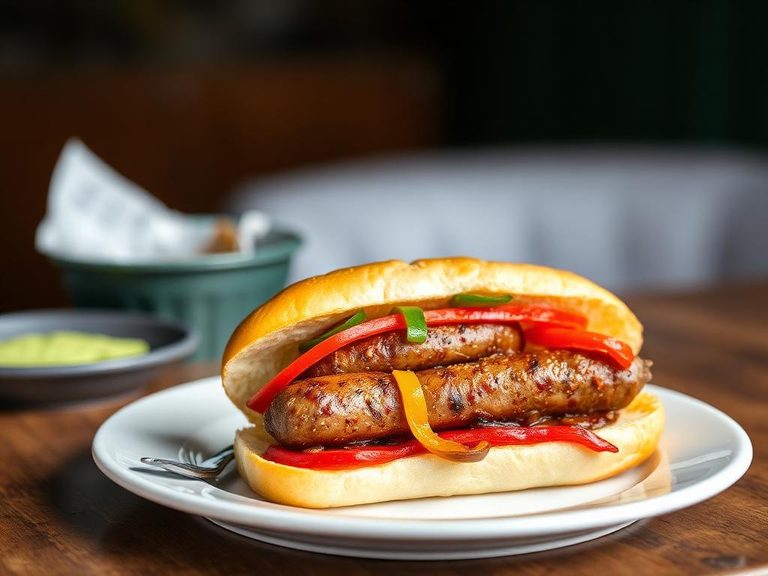
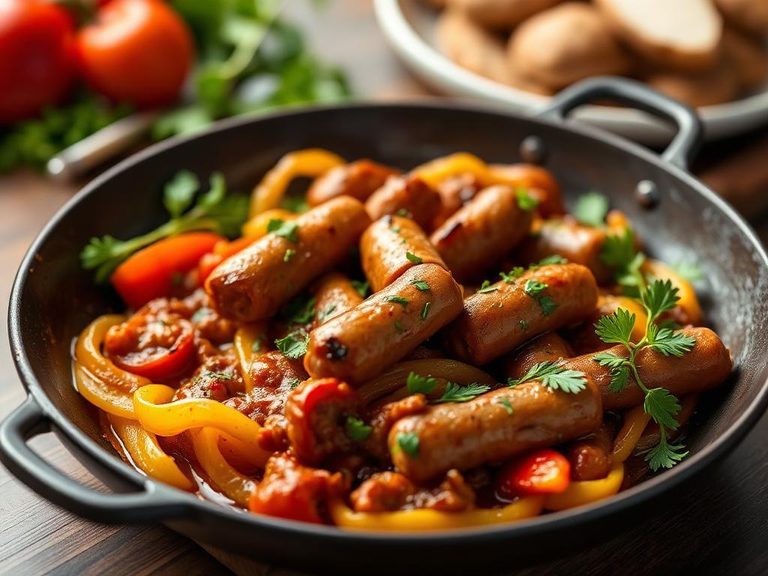
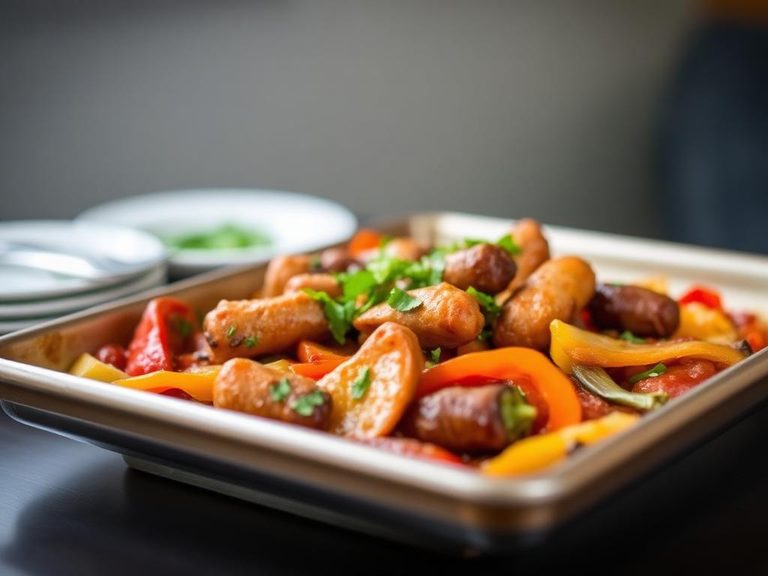
Sausage and peppers, served without sauce, is a hearty, savory skillet staple where juicy, spiced sausage links are pan-seared alongside strips of sweet bell peppers and onions until caramelized and slightly charred. The dish delivers a satisfying contrast of textures—the snappy, fatty bite of the sausage against the soft, sweet peppers—and a rich, savory flavor profile from the rendered sausage fat and Maillard browning. Nutritionally, it's a high-fat, high-protein meal with minimal carbohydrates, making it a dense source of energy.
Calorie split: 23% protein · 5% carbs · 72% fat
↓ Full nutrition💚 Why it's loved
People love it for its robust, savory flavor and satisfying heartiness, often enjoying it as a quick weeknight dinner or a casual weekend meal. It's deeply embedded in Italian-American culture, where it's a beloved staple at street fairs, family gatherings, and sandwich shops.
⚠️ Watch-outs & how to enjoy it better
The dish is high in saturated fat and sodium, which may be a concern for those monitoring heart health or blood pressure. To mitigate, choose leaner turkey or chicken sausages, drain excess fat after cooking, and pair with a large, fiber-rich side salad or steamed vegetables to increase satiety and nutrient balance without adding more fat or salt.
Key benefits
- Excellent source of complete protein for muscle maintenance.
- Provides significant energy from dietary fats.
- Contains vitamin C and antioxidants from bell peppers.
- Very low in carbohydrates and sugars.
- Simple, one-pan preparation with minimal ingredients.
🍽️ Popular dishes
🌍 Where it's eaten
💡 Did you know?
The classic 'Sausage and Pepper Sub' is a quintessential Italian-American invention, popularized by street vendors at events like the Feast of San Gennaro in New York City, where it's served on a soft roll, often with onions and sometimes a splash of vinegar.
Full nutrition (USDA data · scales with serving)
| Water | 60.9 g |
| Energy | 247 kcal |
| Protein | 14.0 g |
| Total lipid (fat) | 19.9 g |
| Carbohydrate, by difference | 3.3 g |
| Fiber, total dietary | 0.30 g |
| Total Sugars | 1.9 g |
| Calcium, Ca | 11.0 mg |
| Iron, Fe | 1.1 mg |
| Magnesium, Mg | 16.0 mg |
| Phosphorus, P | 109 mg |
| Potassium, K | 263 mg |
| Sodium, Na | 551 mg |
| Zinc, Zn | 1.9 mg |
| Copper, Cu | 0.07 mg |
| Selenium, Se | 15.4 ug |
| Vitamin C, total ascorbic acid | 15.4 mg |
| Thiamin | 0.23 mg |
| Riboflavin | 0.19 mg |
| Niacin | 4.0 mg |
| Vitamin B-6 | 0.28 mg |
| Folate, total | 3.0 ug |
| Folic acid | 0.00 ug |
| Folate, food | 3.0 ug |
| Folate, DFE | 3.0 ug |
| Choline, total | 54.9 mg |
| Vitamin B-12 | 0.76 ug |
| Vitamin B-12, added | 0.00 ug |
| Vitamin A, RAE | 19.0 ug |
| Retinol | 14.0 ug |
| Carotene, beta | 55.0 ug |
| Carotene, alpha | 5.0 ug |
| Cryptoxanthin, beta | 2.0 ug |
| Lycopene | 0.00 ug |
| Lutein + zeaxanthin | 89.0 ug |
| Vitamin E (alpha-tocopherol) | 0.73 mg |
| Vitamin E, added | 0.00 mg |
| Vitamin D (D2 + D3) | 0.80 ug |
| Vitamin K (phylloquinone) | 2.4 ug |
| Alcohol, ethyl | 0.00 g |
| Caffeine | 0.00 mg |
| Theobromine | 0.00 mg |
Fat & fatty acid profile (per 100g)
| Fatty acids, total saturated | 6.9 g |
| SFA 4:0 | 0.01 g |
| SFA 6:0 | 0.00 g |
| SFA 8:0 | 0.00 g |
| SFA 10:0 | 0.01 g |
| SFA 12:0 | 0.01 g |
| SFA 14:0 | 0.25 g |
| SFA 16:0 | 4.3 g |
| SFA 18:0 | 2.2 g |
| Fatty acids, total monounsaturated | 8.8 g |
| MUFA 16:1 | 0.44 g |
| MUFA 18:1 | 8.2 g |
| MUFA 20:1 | 0.23 g |
| MUFA 22:1 | 0.01 g |
| Fatty acids, total polyunsaturated | 3.8 g |
| PUFA 18:2 | 3.3 g |
| PUFA 18:3 | 0.14 g |
| PUFA 18:4 | 0.00 g |
| PUFA 20:4 | 0.10 g |
| PUFA 20:5 n-3 (EPA) | 0.00 g |
| PUFA 22:5 n-3 (DPA) | 0.02 g |
| PUFA 22:6 n-3 (DHA) | 0.00 g |
| Cholesterol | 61.0 mg |
FAQ
Is this dish gluten-free?
The core ingredients (sausage and peppers) are typically gluten-free, but always check sausage labels for fillers or binders that may contain wheat. Use certified gluten-free sausages to be certain.
Can I make this ahead of time?
Yes, it reheats well in a skillet over medium heat to re-crisp the sausage and peppers, or in the microwave. Store leftovers in an airtight container in the refrigerator for up to 3 days.
What's the best sausage to use?
Italian sausage (sweet, mild, or hot) is traditional. For a leaner option, use turkey or chicken sausage. The fat content of the sausage will determine how much oil you need to add to the pan.
Nutrient density (calculated · NRF9.3)
Nutrient Rich Foods index: beneficial nutrients (protein, fiber, vitamins, minerals) minus saturated fat, added sugar & sodium, per 100 kcal.
NRF9.3 index — Fulgoni, Keast & Drewnowski, 2009. Computed from USDA nutrients.
Weight-loss friendliness (composite index)
Energy density 2.47 kcal/g · 23% calories from protein · 0.3 g fiber · 1.9 g sugar per 100 g.
Composite of energy density (Rolls et al., 1999), protein & fiber satiety, minus sugar. A calculated heuristic — ranks satiety-per-calorie, not a clinical measure.
Dietary load (calculated from USDA values)
Potential renal acid load. Positive = acid-forming, negative = alkaline-forming.
Sodium-to-potassium ratio: 2.10 (lower is better — aim for ≤ 1)
Sodium:potassium per WHO potassium guidance. Computed from USDA nutrients.