

Pasta with sauce, meatless, school lunch
Common food
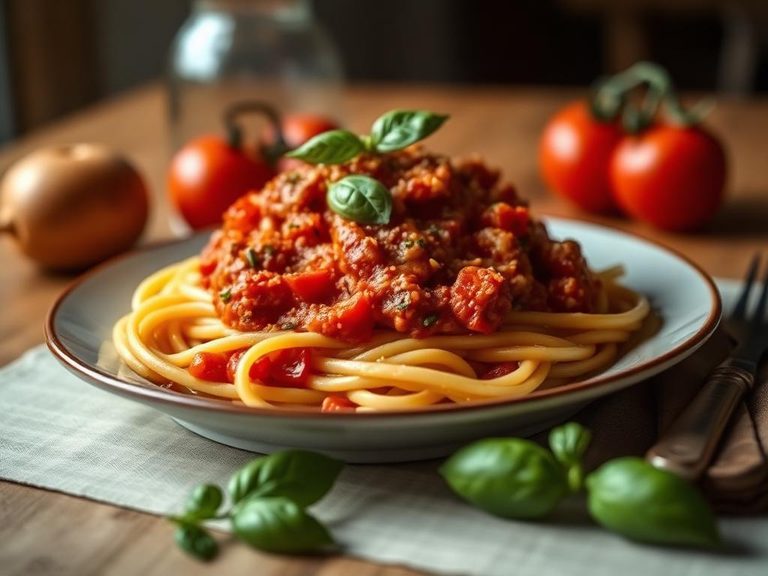
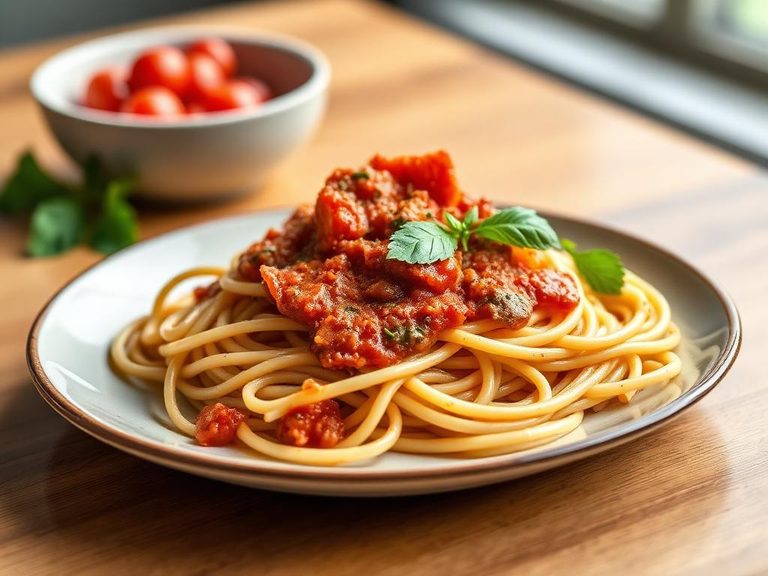
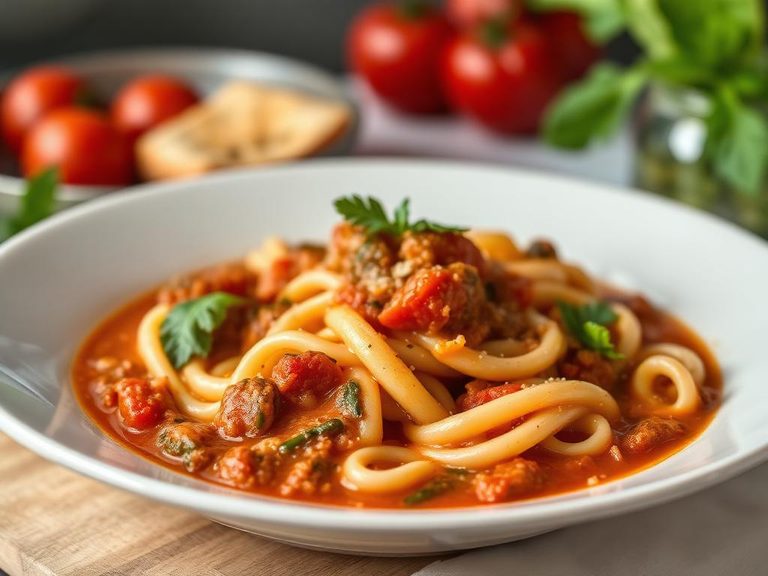
This is the quintessential school cafeteria staple: soft pasta spirals or shapes coated in a mild, tomato-based sauce, served meatless. It has a soft, slightly chewy texture with a sweet, tangy flavor profile designed to appeal to young palates. Nutritionally, it is a low-calorie, carbohydrate-dense option that provides quick energy, though it is relatively low in protein and fat.
Calorie split: 14% protein · 72% carbs · 13% fat
↓ Full nutrition💚 Why it's loved
People love it for its comforting, familiar taste and the simple, satisfying combination of pasta and tomato sauce. It's a versatile base that can be customized with spices or extra veggies, and it evokes a sense of nostalgia for many who grew up eating it in school cafeterias.
⚠️ Watch-outs & how to enjoy it better
The dish can be high in sodium and may cause blood-sugar spikes due to its refined carbohydrate content. To counteract this, pair it with a source of protein (like beans or cheese) and healthy fat (like olive oil or avocado) to slow digestion, and consider adding a side of vegetables for extra fiber and nutrients.
Key benefits
- Provides quick, easily digestible energy from complex carbohydrates
- Low in fat, making it a lighter meal option
- Good source of dietary fiber for digestive health
- Typically low in calories, suitable for portion-controlled meals
- Often fortified with iron and B vitamins in school settings
🍽️ Popular dishes
🌍 Where it's eaten
💡 Did you know?
The classic school lunch pasta sauce often contains a small amount of sugar to balance the acidity of tomatoes, a practice that dates back to early 20th-century American school lunch programs aiming to make meals more palatable to children.
Full nutrition (USDA data · scales with serving)
| Water | 74.0 g |
| Energy | 102 kcal |
| Protein | 3.8 g |
| Total lipid (fat) | 1.6 g |
| Carbohydrate, by difference | 19.4 g |
| Fiber, total dietary | 2.9 g |
| Total Sugars | 3.0 g |
| Calcium, Ca | 20.0 mg |
| Iron, Fe | 1.3 mg |
| Magnesium, Mg | 37.0 mg |
| Phosphorus, P | 82.0 mg |
| Potassium, K | 203 mg |
| Sodium, Na | 88.0 mg |
| Zinc, Zn | 0.79 mg |
| Copper, Cu | 0.15 mg |
| Selenium, Se | 19.3 ug |
| Vitamin C, total ascorbic acid | 1.0 mg |
| Thiamin | 0.09 mg |
| Riboflavin | 0.08 mg |
| Niacin | 3.5 mg |
| Vitamin B-6 | 0.13 mg |
| Folate, total | 17.0 ug |
| Folic acid | 0.00 ug |
| Folate, food | 17.0 ug |
| Folate, DFE | 17.0 ug |
| Choline, total | 9.9 mg |
| Vitamin B-12 | 0.00 ug |
| Vitamin B-12, added | 0.00 ug |
| Vitamin A, RAE | 16.0 ug |
| Retinol | 0.00 ug |
| Carotene, beta | 188 ug |
| Carotene, alpha | 0.00 ug |
| Cryptoxanthin, beta | 0.00 ug |
| Lycopene | 6087 ug |
| Lutein + zeaxanthin | 140 ug |
| Vitamin E (alpha-tocopherol) | 1.3 mg |
| Vitamin E, added | 0.00 mg |
| Vitamin D (D2 + D3) | 0.00 ug |
| Vitamin K (phylloquinone) | 7.0 ug |
| Alcohol, ethyl | 0.00 g |
| Caffeine | 0.00 mg |
| Theobromine | 0.00 mg |
Fat & fatty acid profile (per 100g)
| Fatty acids, total saturated | 0.21 g |
| SFA 4:0 | 0.00 g |
| SFA 6:0 | 0.00 g |
| SFA 8:0 | 0.00 g |
| SFA 10:0 | 0.00 g |
| SFA 12:0 | 0.00 g |
| SFA 14:0 | 0.00 g |
| SFA 16:0 | 0.16 g |
| SFA 18:0 | 0.03 g |
| Fatty acids, total monounsaturated | 0.27 g |
| MUFA 16:1 | 0.00 g |
| MUFA 18:1 | 0.26 g |
| MUFA 20:1 | 0.01 g |
| MUFA 22:1 | 0.00 g |
| Fatty acids, total polyunsaturated | 0.54 g |
| PUFA 18:2 | 0.48 g |
| PUFA 18:3 | 0.06 g |
| PUFA 18:4 | 0.00 g |
| PUFA 20:4 | 0.00 g |
| PUFA 20:5 n-3 (EPA) | 0.00 g |
| PUFA 22:5 n-3 (DPA) | 0.00 g |
| PUFA 22:6 n-3 (DHA) | 0.00 g |
| Cholesterol | 1.0 mg |
FAQ
Is this pasta dish gluten-free?
No, traditional pasta is made from wheat flour, which contains gluten. Gluten-free versions use alternative flours like rice or corn.
Can this be made vegan?
Yes, if the sauce is made without dairy or meat products, it is naturally vegan. Check for added cheese or butter in school versions.
How can I increase the protein content?
Add beans, lentils, or tofu to the sauce, or serve with a side of grilled chicken or fish.
Is this suitable for a low-carb diet?
No, pasta is high in carbohydrates. Consider using zucchini noodles or spaghetti squash as a low-carb alternative.
Nutrient density (calculated · NRF9.3)
Nutrient Rich Foods index: beneficial nutrients (protein, fiber, vitamins, minerals) minus saturated fat, added sugar & sodium, per 100 kcal.
NRF9.3 index — Fulgoni, Keast & Drewnowski, 2009. Computed from USDA nutrients.
Weight-loss friendliness (composite index)
Energy density 1.02 kcal/g · 15% calories from protein · 2.9 g fiber · 3.0 g sugar per 100 g.
Composite of energy density (Rolls et al., 1999), protein & fiber satiety, minus sugar. A calculated heuristic — ranks satiety-per-calorie, not a clinical measure.
Dietary load (calculated from USDA values)
Potential renal acid load. Positive = acid-forming, negative = alkaline-forming.
Sodium-to-potassium ratio: 0.43 (lower is better — aim for ≤ 1)
Sodium:potassium per WHO potassium guidance. Computed from USDA nutrients.