

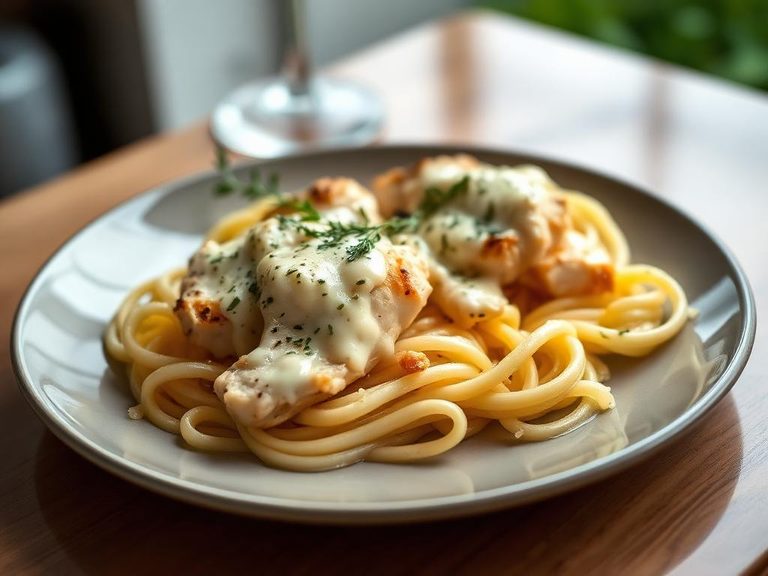
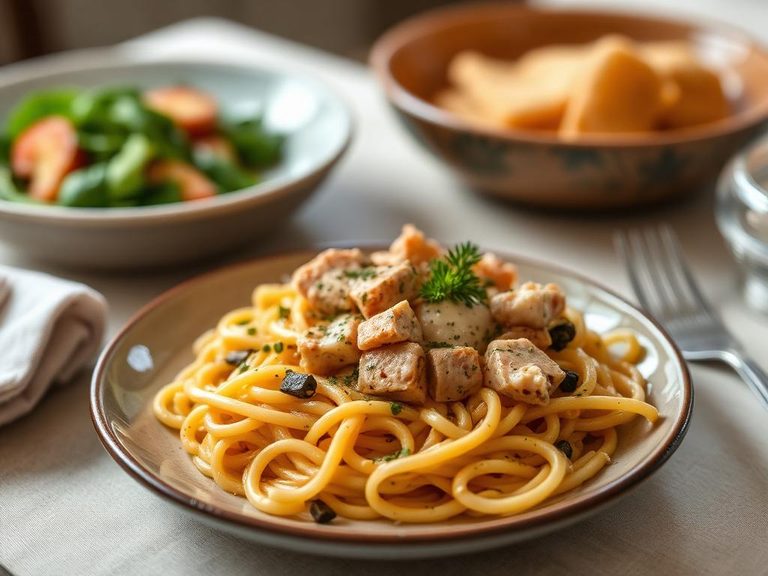
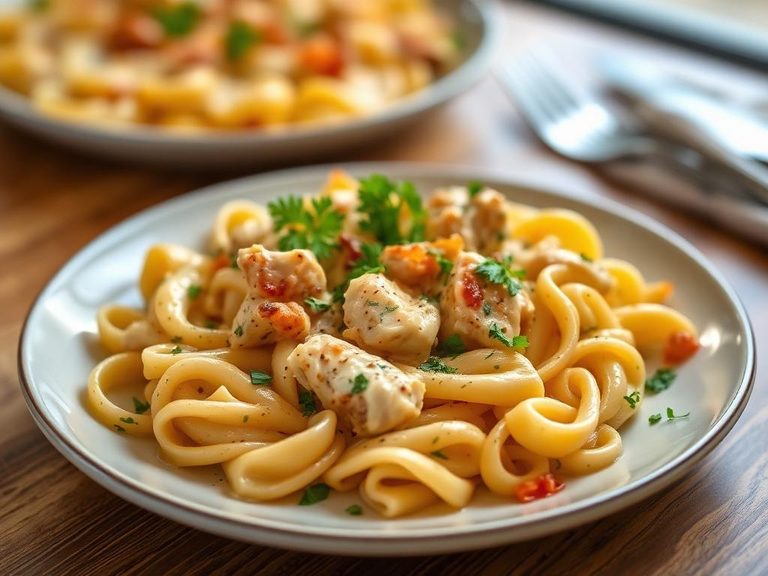
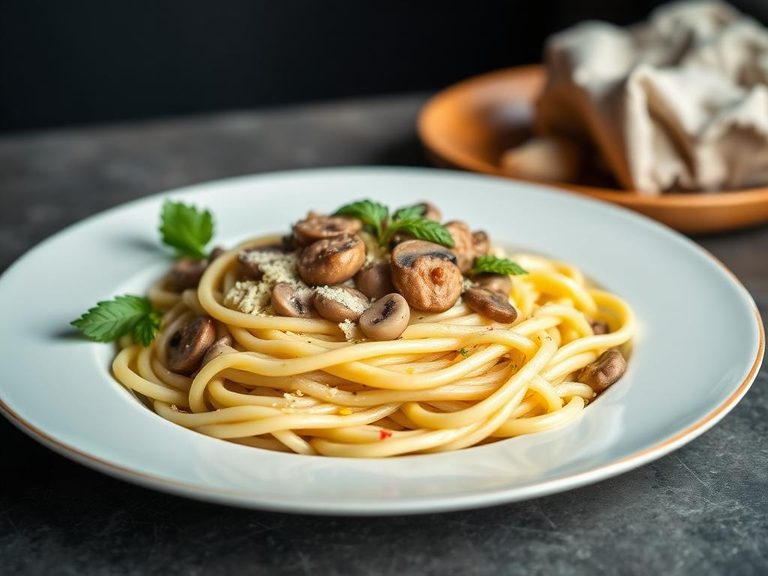
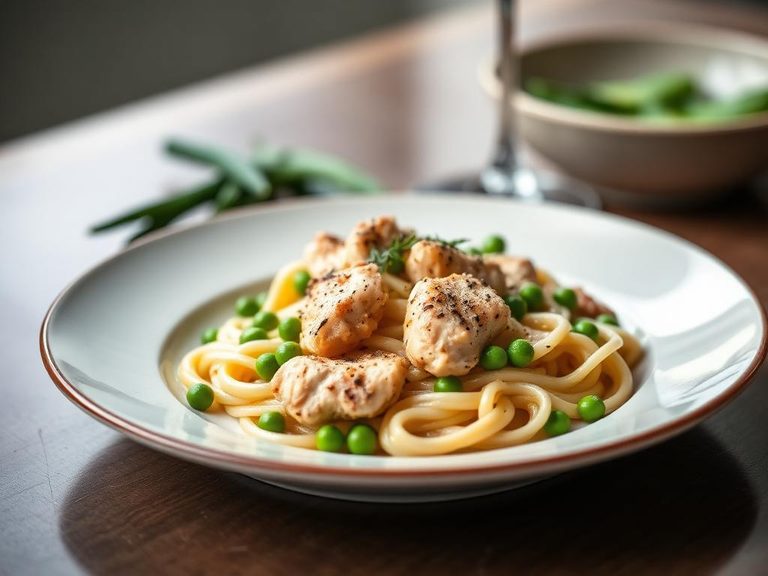
Pasta with cream sauce, poultry, and added vegetables, home recipe
Common food
A comforting plate of pasta cloaked in a velvety cream sauce, studded with tender pieces of poultry and vibrant, garden-fresh vegetables. Each bite offers a rich, savory flavor with a satisfying contrast between the al dente pasta and the smooth, luscious coating. Nutritionally, it's a balanced one-pot meal, providing a good mix of protein and carbs for energy without excessive calories.
Calorie split: 17% protein · 47% carbs · 35% fat
↓ Full nutrition💚 Why it's loved
People adore this dish for its ultimate comfort factor—the creamy sauce feels indulgent while the vegetables and poultry make it a satisfying, complete meal. It's also incredibly versatile, easily adapted to whatever is in the fridge or to suit different dietary preferences.
⚠️ Watch-outs & how to enjoy it better
The cream sauce can be high in saturated fat and calories if made with heavy cream, and the dish may lack sufficient fiber if white pasta and few vegetables are used. Those monitoring blood sugar should be mindful of the refined carbs. To counteract, use whole-wheat or legume-based pasta, lighten the sauce with Greek yogurt or blended cauliflower, and ensure vegetables make up at least half the plate.
Key benefits
- Good source of lean protein from poultry
- Provides complex carbohydrates for sustained energy
- Vegetables add essential vitamins and fiber
- Balanced macronutrient profile for a complete meal
- Highly customizable to include seasonal produce
🍽️ Popular dishes
🌍 Where it's eaten
💡 Did you know?
The classic Alfredo sauce, often associated with this style of pasta, was invented in Rome by Alfredo di Lelio, who famously prepared it tableside with butter and Parmigiano-Reggiano to entice his pregnant wife to eat.
Full nutrition (USDA data · scales with serving)
| Water | 70.2 g |
| Energy | 146 kcal |
| Protein | 6.3 g |
| Total lipid (fat) | 5.7 g |
| Carbohydrate, by difference | 17.0 g |
| Fiber, total dietary | 1.1 g |
| Total Sugars | 0.86 g |
| Calcium, Ca | 26.0 mg |
| Iron, Fe | 0.80 mg |
| Magnesium, Mg | 14.0 mg |
| Phosphorus, P | 73.0 mg |
| Potassium, K | 89.0 mg |
| Sodium, Na | 199 mg |
| Zinc, Zn | 0.59 mg |
| Copper, Cu | 0.08 mg |
| Selenium, Se | 17.5 ug |
| Vitamin C, total ascorbic acid | 4.2 mg |
| Thiamin | 0.16 mg |
| Riboflavin | 0.13 mg |
| Niacin | 1.9 mg |
| Vitamin B-6 | 0.08 mg |
| Folate, total | 42.0 ug |
| Folic acid | 34.0 ug |
| Folate, food | 8.0 ug |
| Folate, DFE | 66.0 ug |
| Choline, total | 12.6 mg |
| Vitamin B-12 | 0.12 ug |
| Vitamin B-12, added | 0.00 ug |
| Vitamin A, RAE | 46.0 ug |
| Retinol | 42.0 ug |
| Carotene, beta | 38.0 ug |
| Carotene, alpha | 1.0 ug |
| Cryptoxanthin, beta | 9.0 ug |
| Lycopene | 0.00 ug |
| Lutein + zeaxanthin | 51.0 ug |
| Vitamin E (alpha-tocopherol) | 0.19 mg |
| Vitamin E, added | 0.00 mg |
| Vitamin D (D2 + D3) | 0.20 ug |
| Vitamin K (phylloquinone) | 0.80 ug |
| Alcohol, ethyl | 0.00 g |
| Caffeine | 0.00 mg |
| Theobromine | 0.00 mg |
Fat & fatty acid profile (per 100g)
| Fatty acids, total saturated | 2.8 g |
| SFA 4:0 | 0.10 g |
| SFA 6:0 | 0.08 g |
| SFA 8:0 | 0.05 g |
| SFA 10:0 | 0.11 g |
| SFA 12:0 | 0.14 g |
| SFA 14:0 | 0.42 g |
| SFA 16:0 | 1.4 g |
| SFA 18:0 | 0.46 g |
| Fatty acids, total monounsaturated | 1.2 g |
| MUFA 16:1 | 0.10 g |
| MUFA 18:1 | 1.2 g |
| MUFA 20:1 | 0.01 g |
| MUFA 22:1 | 0.00 g |
| Fatty acids, total polyunsaturated | 0.55 g |
| PUFA 18:2 | 0.43 g |
| PUFA 18:3 | 0.04 g |
| PUFA 18:4 | 0.00 g |
| PUFA 20:4 | 0.01 g |
| PUFA 20:5 n-3 (EPA) | 0.00 g |
| PUFA 22:5 n-3 (DPA) | 0.00 g |
| PUFA 22:6 n-3 (DHA) | 0.00 g |
| Cholesterol | 22.0 mg |
FAQ
How can I make the cream sauce lighter?
You can substitute part or all of the heavy cream with a blend of low-fat milk and cornstarch, use pureed silken tofu, or blend steamed cauliflower or white beans for a creamy, nutrient-dense base.
What vegetables work best in this dish?
Quick-cooking vegetables like spinach, peas, asparagus tips, and cherry tomatoes are excellent. Heartier ones like broccoli, zucchini, or bell peppers should be sautéed or blanched first to ensure they are tender.
Can this dish be made ahead?
Yes, but the pasta may absorb the sauce. Store components separately if possible, or toss the cooked pasta with a little oil before combining. Reheat gently with a splash of milk or broth to restore creaminess.
Nutrient density (calculated · NRF9.3)
Nutrient Rich Foods index: beneficial nutrients (protein, fiber, vitamins, minerals) minus saturated fat, added sugar & sodium, per 100 kcal.
NRF9.3 index — Fulgoni, Keast & Drewnowski, 2009. Computed from USDA nutrients.
Weight-loss friendliness (composite index)
Energy density 1.46 kcal/g · 17% calories from protein · 1.1 g fiber · 0.9 g sugar per 100 g.
Composite of energy density (Rolls et al., 1999), protein & fiber satiety, minus sugar. A calculated heuristic — ranks satiety-per-calorie, not a clinical measure.
Dietary load (calculated from USDA values)
Potential renal acid load. Positive = acid-forming, negative = alkaline-forming.
Sodium-to-potassium ratio: 2.24 (lower is better — aim for ≤ 1)
Sodium:potassium per WHO potassium guidance. Computed from USDA nutrients.