

Onion rings, breaded, par fried, frozen, unprepared
Whole food · Vegetables and Vegetable Products
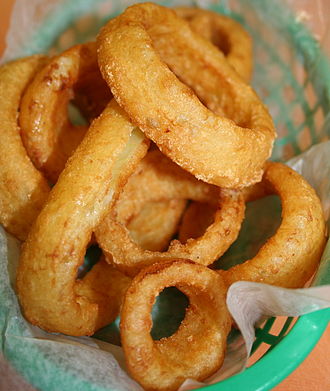
Photo: Wikipedia
These are pre-sliced onion rings, coated in a seasoned batter or breadcrumb mix, and partially fried before being frozen for later cooking. They offer a satisfying crunch on the outside with a soft, sweet onion interior. Nutritionally, they are a calorie-dense, carbohydrate-rich food with a notable fat content from the par-frying process.
Calorie split: 5% protein · 47% carbs · 49% fat
↓ Full nutrition💚 Why it's loved
People love them for the irresistible contrast of a crispy, savory coating and the mild, sweet flavor of cooked onion. They are a beloved, nostalgic comfort food and a versatile side dish for casual meals.
⚠️ Watch-outs & how to enjoy it better
The high carbohydrate and fat content can contribute to blood-sugar spikes and excess calorie intake, especially when deep-fried. To counteract this, bake or air-fry them to reduce added oil, practice portion control by pairing with a lean protein and non-starchy vegetables, and check labels for sodium content.
Key benefits
- Provides a quick source of energy from carbohydrates
- Contains some dietary fiber from the onion and breading
- Offers a small amount of plant-based protein
- Convenient and consistent for home preparation
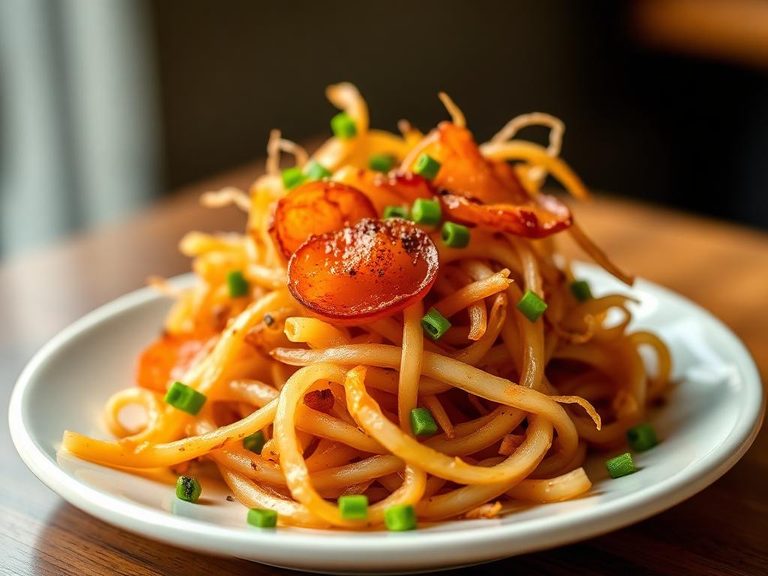
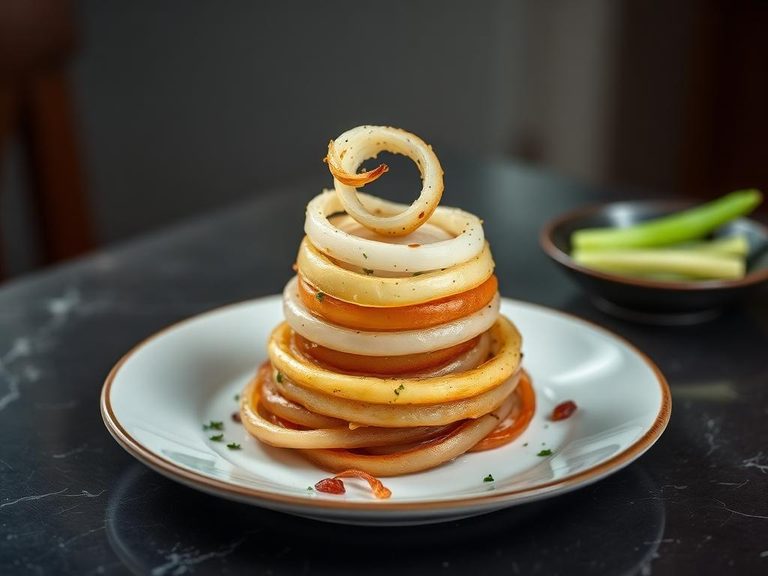
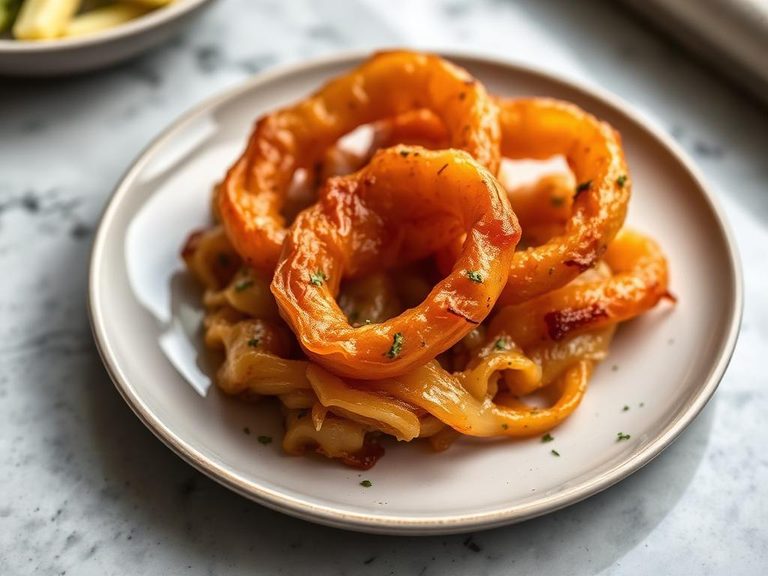
🍽️ Popular dishes


🌍 Where it's eaten
💡 Did you know?
The onion ring is a relatively modern invention, with the first known recipe published in a 1933 cookbook titled 'The Deep South Cook Book'.
Full nutrition (USDA data · scales with serving)
| Water | 51.2 g |
| Energy | 258 kcal |
| Energy | 1079 kj |
| Protein | 3.1 g |
| Total lipid (fat) | 14.1 g |
| Ash | 1.0 g |
| Carbohydrate, by difference | 30.5 g |
| Fiber, total dietary | 1.8 g |
| Calcium, Ca | 46.0 mg |
| Iron, Fe | 0.93 mg |
| Magnesium, Mg | 14.0 mg |
| Phosphorus, P | 49.0 mg |
| Potassium, K | 190 mg |
| Sodium, Na | 246 mg |
| Zinc, Zn | 0.36 mg |
| Copper, Cu | 0.07 mg |
| Manganese, Mn | 0.30 mg |
| Selenium, Se | 2.4 ug |
| Fluoride, F | 55.0 ug |
| Vitamin C, total ascorbic acid | 4.6 mg |
| Thiamin | 0.10 mg |
| Riboflavin | 0.08 mg |
| Niacin | 0.69 mg |
| Pantothenic acid | 0.24 mg |
| Vitamin B-6 | 0.13 mg |
| Folate, total | 48.0 ug |
| Folic acid | 29.0 ug |
| Folate, food | 19.0 ug |
| Folate, DFE | 68.0 ug |
| Vitamin B-12 | 0.00 ug |
| Vitamin A, RAE | 0.00 ug |
| Retinol | 0.00 ug |
| Vitamin A, IU | 0.00 iu |
| Vitamin D (D2 + D3), International Units | 0.00 iu |
| Vitamin D (D2 + D3) | 0.00 ug |
Fat & fatty acid profile (per 100g)
| Fatty acids, total saturated | 4.5 g |
| SFA 14:0 | 0.11 g |
| SFA 16:0 | 2.7 g |
| SFA 18:0 | 1.7 g |
| Fatty acids, total monounsaturated | 5.7 g |
| MUFA 16:1 | 0.19 g |
| MUFA 18:1 | 5.5 g |
| Fatty acids, total polyunsaturated | 2.7 g |
| PUFA 18:2 | 2.5 g |
| PUFA 18:3 | 0.15 g |
| Cholesterol | 0.00 mg |
Amino acid profile (per 100g)
| Tryptophan | 0.04 g |
| Threonine | 0.09 g |
| Isoleucine | 0.13 g |
| Leucine | 0.21 g |
| Lysine | 0.09 g |
| Methionine | 0.05 g |
| Cystine | 0.06 g |
| Phenylalanine | 0.14 g |
| Tyrosine | 0.09 g |
| Valine | 0.13 g |
| Arginine | 0.19 g |
| Histidine | 0.06 g |
| Alanine | 0.10 g |
| Aspartic acid | 0.14 g |
| Glutamic acid | 0.97 g |
| Glycine | 0.12 g |
| Proline | 0.31 g |
| Serine | 0.15 g |
FAQ
What's the difference between par-fried and fully fried?
Par-fried means the rings are cooked in oil for a short time to set the coating and partially cook the onion. They are then frozen and require a final cook (baking, air-frying, or deep-frying) at home to become fully hot and crispy.
Can I make these healthier?
Yes. The best method is to use an air fryer or oven, which achieves crispiness with little to no added oil. Avoid deep-frying them a second time at home.
Why are they frozen before being fully cooked?
This process locks in freshness, ensures a consistent texture, and allows for quick, convenient preparation at home or in restaurants while maintaining the structural integrity of the coating.
Nutrient density (calculated · NRF9.3)
Nutrient Rich Foods index: beneficial nutrients (protein, fiber, vitamins, minerals) minus saturated fat, added sugar & sodium, per 100 kcal.
NRF9.3 index — Fulgoni, Keast & Drewnowski, 2009. Computed from USDA nutrients.
Weight-loss friendliness (composite index)
Energy density 2.58 kcal/g · 5% calories from protein · 1.8 g fiber · 0.0 g sugar per 100 g.
Composite of energy density (Rolls et al., 1999), protein & fiber satiety, minus sugar. A calculated heuristic — ranks satiety-per-calorie, not a clinical measure.
Dietary load (calculated from USDA values)
Potential renal acid load. Positive = acid-forming, negative = alkaline-forming.
Sodium-to-potassium ratio: 1.29 (lower is better — aim for ≤ 1)
Sodium:potassium per WHO potassium guidance. Computed from USDA nutrients.