

Macaroni or noodles with cheese, Easy Mac type
Common food
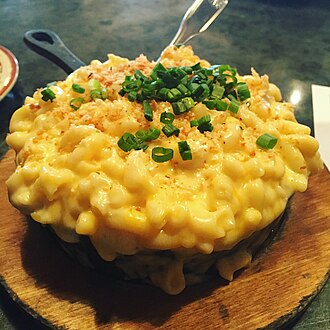
Photo: Wikipedia
This is the quintessential comfort food in a cup: tender, pre-cooked macaroni or noodles enveloped in a creamy, salty, powdered cheese sauce. The texture is soft and slightly chewy, with a rich, savory flavor that is instantly recognizable and deeply nostalgic. Nutritionally, it's a low-calorie, high-carb snack that provides quick energy but minimal protein or fiber.
Calorie split: 12% protein · 73% carbs · 15% fat
↓ Full nutrition💚 Why it's loved
People love it for its unparalleled convenience and the comforting, familiar taste of creamy, salty cheese that evokes childhood memories. Its mild flavor and soft texture make it a universally appealing comfort food that can be eaten on its own or as a quick side dish.
⚠️ Watch-outs & how to enjoy it better
The high carbohydrate content and lack of fiber can lead to rapid blood-sugar spikes, making it less suitable for those managing blood sugar. To counteract this, pair it with a source of protein (like chicken or beans) or healthy fat (like avocado) to slow digestion. It is also often high in sodium, so be mindful of portion sizes and consider rinsing the noodles if you're sodium-sensitive. The powdered cheese sauce is a common allergen (dairy) and may contain artificial additives.
Key benefits
- Provides a quick source of energy from carbohydrates
- Extremely low in fat per serving
- Very convenient and fast to prepare (just add hot water)
- Low in calories, making it a light snack option
- Inexpensive and widely available pantry staple
🍽️ Popular dishes
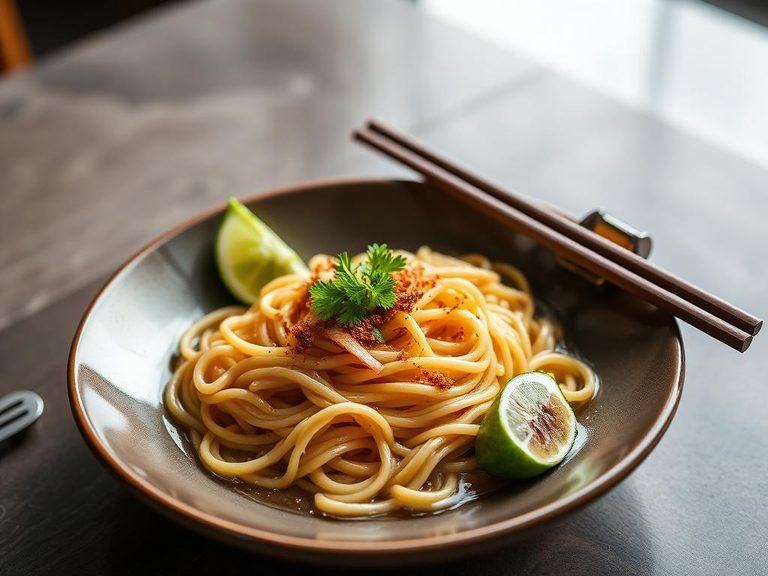
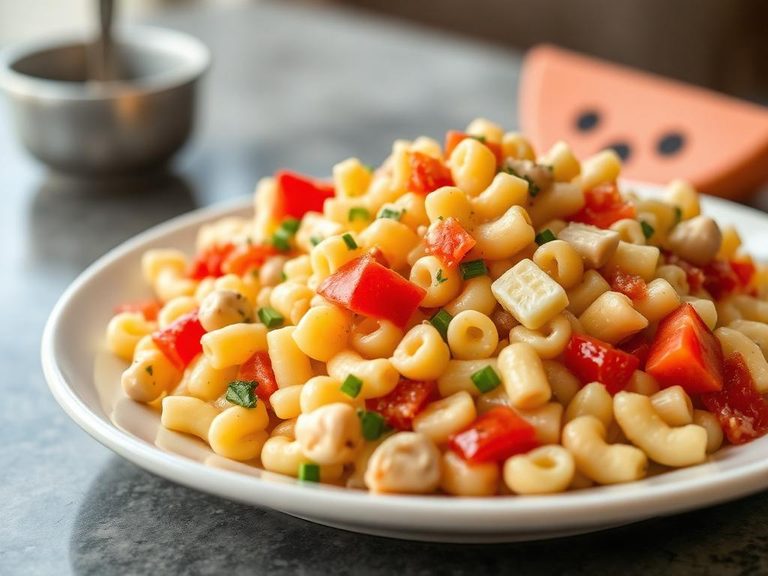
🌍 Where it's eaten
💡 Did you know?
The first boxed macaroni and cheese was introduced by Kraft in 1937, during the Great Depression, and sold for 19 cents per box, feeding four people.
Full nutrition (USDA data · scales with serving)
| Water | 73.8 g |
| Energy | 110 kcal |
| Protein | 3.3 g |
| Total lipid (fat) | 1.9 g |
| Carbohydrate, by difference | 20.1 g |
| Fiber, total dietary | 0.50 g |
| Total Sugars | 2.3 g |
| Calcium, Ca | 95.0 mg |
| Iron, Fe | 0.67 mg |
| Magnesium, Mg | 15.0 mg |
| Phosphorus, P | 93.0 mg |
| Potassium, K | 99.0 mg |
| Sodium, Na | 259 mg |
| Zinc, Zn | 0.36 mg |
| Copper, Cu | 0.06 mg |
| Selenium, Se | 13.5 ug |
| Vitamin C, total ascorbic acid | 0.00 mg |
| Thiamin | 0.24 mg |
| Riboflavin | 0.16 mg |
| Niacin | 0.99 mg |
| Vitamin B-6 | 0.04 mg |
| Folate, total | 41.0 ug |
| Folic acid | 37.0 ug |
| Folate, food | 3.0 ug |
| Folate, DFE | 66.0 ug |
| Choline, total | 9.7 mg |
| Vitamin B-12 | 0.22 ug |
| Vitamin B-12, added | 0.00 ug |
| Vitamin A, RAE | 27.0 ug |
| Retinol | 26.0 ug |
| Carotene, beta | 1.0 ug |
| Carotene, alpha | 0.00 ug |
| Cryptoxanthin, beta | 0.00 ug |
| Lycopene | 0.00 ug |
| Lutein + zeaxanthin | 4.0 ug |
| Vitamin E (alpha-tocopherol) | 0.04 mg |
| Vitamin E, added | 0.00 mg |
| Vitamin D (D2 + D3) | 0.00 ug |
| Vitamin K (phylloquinone) | 0.10 ug |
| Alcohol, ethyl | 0.00 g |
| Caffeine | 0.00 mg |
| Theobromine | 0.00 mg |
Fat & fatty acid profile (per 100g)
| Fatty acids, total saturated | 0.80 g |
| SFA 4:0 | 0.00 g |
| SFA 6:0 | 0.00 g |
| SFA 8:0 | 0.00 g |
| SFA 10:0 | 0.00 g |
| SFA 12:0 | 0.00 g |
| SFA 14:0 | 0.11 g |
| SFA 16:0 | 0.54 g |
| SFA 18:0 | 0.15 g |
| Fatty acids, total monounsaturated | 0.46 g |
| MUFA 16:1 | 0.00 g |
| MUFA 18:1 | 0.46 g |
| MUFA 20:1 | 0.00 g |
| MUFA 22:1 | 0.00 g |
| Fatty acids, total polyunsaturated | 0.56 g |
| PUFA 18:2 | 0.56 g |
| PUFA 18:3 | 0.00 g |
| PUFA 18:4 | 0.00 g |
| PUFA 20:4 | 0.00 g |
| PUFA 20:5 n-3 (EPA) | 0.00 g |
| PUFA 22:5 n-3 (DPA) | 0.00 g |
| PUFA 22:6 n-3 (DHA) | 0.00 g |
| Cholesterol | 2.0 mg |
FAQ
Is this food healthy?
It's a low-calorie, high-carb food that can be part of a balanced diet in moderation, but it lacks significant protein, fiber, and micronutrients. Pairing it with vegetables or lean protein can make it a more balanced meal.
Can I make it healthier?
Yes, you can add vegetables like broccoli or spinach, stir in some canned tuna or chicken, or use a whole-grain pasta version to increase fiber and protein content.
Is it suitable for vegetarians?
Most boxed mac and cheese is vegetarian, but it's always best to check the label for any animal-derived ingredients like rennet in the cheese powder.
How long does it last after cooking?
Once prepared, it should be stored in an airtight container in the refrigerator and consumed within 3-4 days for best quality and safety.
Nutrient density (calculated · NRF9.3)
Nutrient Rich Foods index: beneficial nutrients (protein, fiber, vitamins, minerals) minus saturated fat, added sugar & sodium, per 100 kcal.
NRF9.3 index — Fulgoni, Keast & Drewnowski, 2009. Computed from USDA nutrients.
Weight-loss friendliness (composite index)
Energy density 1.10 kcal/g · 12% calories from protein · 0.5 g fiber · 2.3 g sugar per 100 g.
Composite of energy density (Rolls et al., 1999), protein & fiber satiety, minus sugar. A calculated heuristic — ranks satiety-per-calorie, not a clinical measure.
Dietary load (calculated from USDA values)
Potential renal acid load. Positive = acid-forming, negative = alkaline-forming.
Sodium-to-potassium ratio: 2.62 (lower is better — aim for ≤ 1)
Sodium:potassium per WHO potassium guidance. Computed from USDA nutrients.