

Macaroni or noodles, creamed, with cheese
Common food
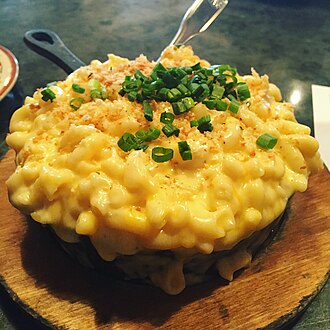
Photo: Wikipedia
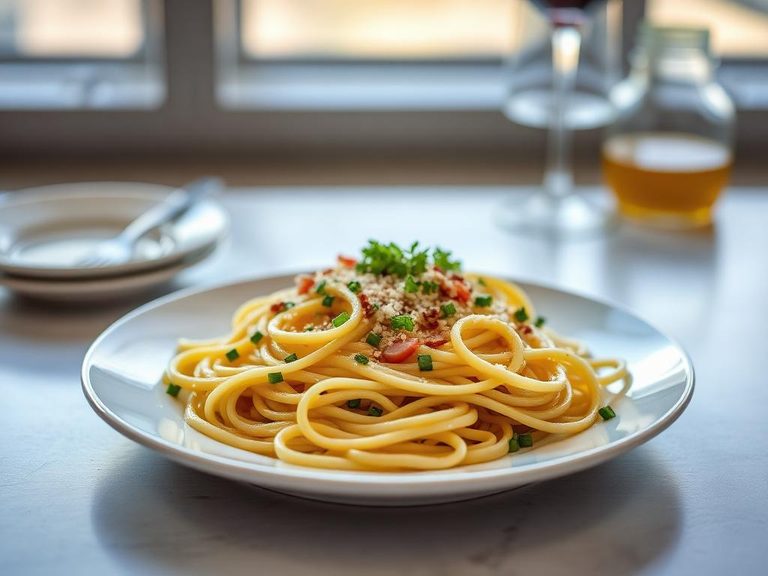
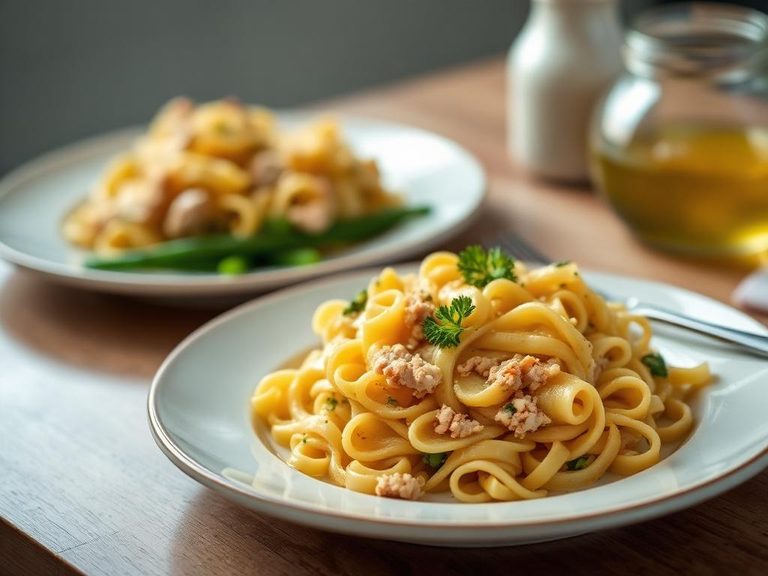
This is a classic comfort dish of macaroni pasta enveloped in a rich, creamy cheese sauce, offering a velvety texture with a savory, umami-rich flavor. Nutritionally, it provides a moderate calorie source with a balance of carbohydrates for energy, a touch of protein, and a notable amount of fat from the cheese sauce.
Calorie split: 12% protein · 56% carbs · 32% fat
↓ Full nutrition💚 Why it's loved
People adore it for its deeply comforting, creamy, and cheesy flavor that evokes nostalgia and warmth. It's a versatile base that can be a simple side dish or a hearty main, loved by both children and adults.
⚠️ Watch-outs & how to enjoy it better
The dish can be high in saturated fat and sodium, and its refined carbohydrates may cause blood-sugar spikes. To counteract this, pair it with a fiber-rich vegetable like steamed broccoli or a simple green salad, and practice portion control by using it as a side rather than the main event.
Key benefits
- Good source of quick energy from carbohydrates.
- Provides some protein for muscle maintenance.
- Contains calcium from cheese for bone health.
- Offers a comforting, satisfying meal.
🍽️ Popular dishes
🌍 Where it's eaten
💡 Did you know?
The earliest known published recipe for macaroni and cheese appeared in 1769 in a cookbook called 'The Experienced English Housekeeper' by Elizabeth Raffald.
Full nutrition (USDA data · scales with serving)
| Water | 66.8 g |
| Energy | 158 kcal |
| Protein | 4.7 g |
| Total lipid (fat) | 5.5 g |
| Carbohydrate, by difference | 22.0 g |
| Fiber, total dietary | 1.3 g |
| Total Sugars | 0.68 g |
| Calcium, Ca | 26.0 mg |
| Iron, Fe | 0.90 mg |
| Magnesium, Mg | 14.0 mg |
| Phosphorus, P | 56.0 mg |
| Potassium, K | 43.0 mg |
| Sodium, Na | 260 mg |
| Zinc, Zn | 0.45 mg |
| Copper, Cu | 0.07 mg |
| Selenium, Se | 19.2 ug |
| Vitamin C, total ascorbic acid | 0.10 mg |
| Thiamin | 0.18 mg |
| Riboflavin | 0.12 mg |
| Niacin | 1.2 mg |
| Vitamin B-6 | 0.04 mg |
| Folate, total | 49.0 ug |
| Folic acid | 44.0 ug |
| Folate, food | 5.0 ug |
| Folate, DFE | 79.0 ug |
| Choline, total | 6.5 mg |
| Vitamin B-12 | 0.02 ug |
| Vitamin B-12, added | 0.00 ug |
| Vitamin A, RAE | 44.0 ug |
| Retinol | 44.0 ug |
| Carotene, beta | 2.0 ug |
| Carotene, alpha | 0.00 ug |
| Cryptoxanthin, beta | 0.00 ug |
| Lycopene | 0.00 ug |
| Lutein + zeaxanthin | 5.0 ug |
| Vitamin E (alpha-tocopherol) | 0.14 mg |
| Vitamin E, added | 0.00 mg |
| Vitamin D (D2 + D3) | 0.20 ug |
| Vitamin K (phylloquinone) | 0.40 ug |
| Alcohol, ethyl | 0.00 g |
| Caffeine | 0.00 mg |
| Theobromine | 0.00 mg |
Fat & fatty acid profile (per 100g)
| Fatty acids, total saturated | 2.9 g |
| SFA 4:0 | 0.10 g |
| SFA 6:0 | 0.08 g |
| SFA 8:0 | 0.05 g |
| SFA 10:0 | 0.12 g |
| SFA 12:0 | 0.15 g |
| SFA 14:0 | 0.46 g |
| SFA 16:0 | 1.4 g |
| SFA 18:0 | 0.45 g |
| Fatty acids, total monounsaturated | 1.1 g |
| MUFA 16:1 | 0.08 g |
| MUFA 18:1 | 1.1 g |
| MUFA 20:1 | 0.01 g |
| MUFA 22:1 | 0.00 g |
| Fatty acids, total polyunsaturated | 0.43 g |
| PUFA 18:2 | 0.32 g |
| PUFA 18:3 | 0.03 g |
| PUFA 18:4 | 0.00 g |
| PUFA 20:4 | 0.01 g |
| PUFA 20:5 n-3 (EPA) | 0.00 g |
| PUFA 22:5 n-3 (DPA) | 0.00 g |
| PUFA 22:6 n-3 (DHA) | 0.00 g |
| Cholesterol | 14.0 mg |
FAQ
Is this dish gluten-free?
Traditional macaroni is made from wheat pasta, so it contains gluten. Gluten-free versions can be made using pasta from rice, corn, or legumes.
Can I make it healthier?
Yes. Use whole-wheat or legume-based pasta for more fiber and protein. You can also incorporate pureed vegetables like butternut squash or cauliflower into the cheese sauce to boost nutrients and reduce fat.
Why is it so high in calories?
The calorie density comes primarily from the combination of refined pasta (carbohydrates) and a cheese sauce made with fat (butter, milk, cheese). Using lower-fat dairy and increasing the vegetable content can help.
Nutrient density (calculated · NRF9.3)
Nutrient Rich Foods index: beneficial nutrients (protein, fiber, vitamins, minerals) minus saturated fat, added sugar & sodium, per 100 kcal.
NRF9.3 index — Fulgoni, Keast & Drewnowski, 2009. Computed from USDA nutrients.
Weight-loss friendliness (composite index)
Energy density 1.58 kcal/g · 12% calories from protein · 1.3 g fiber · 0.7 g sugar per 100 g.
Composite of energy density (Rolls et al., 1999), protein & fiber satiety, minus sugar. A calculated heuristic — ranks satiety-per-calorie, not a clinical measure.
Dietary load (calculated from USDA values)
Potential renal acid load. Positive = acid-forming, negative = alkaline-forming.
Sodium-to-potassium ratio: 6.05 (lower is better — aim for ≤ 1)
Sodium:potassium per WHO potassium guidance. Computed from USDA nutrients.