

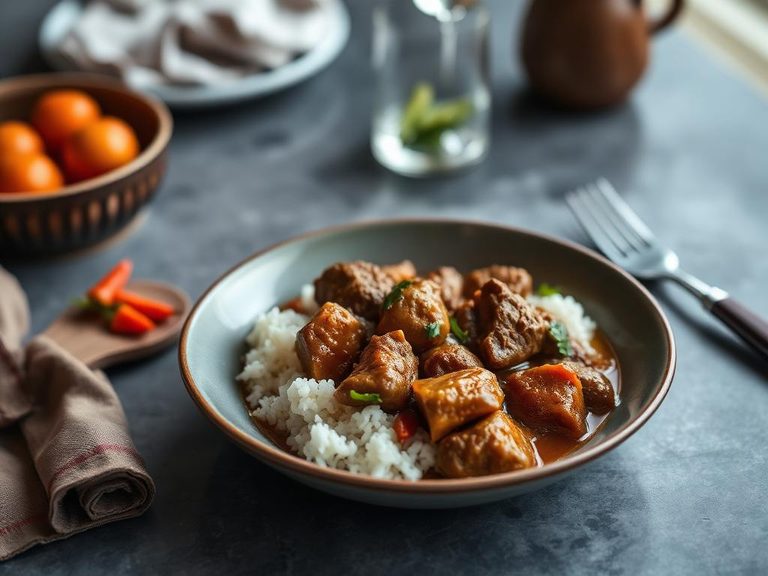
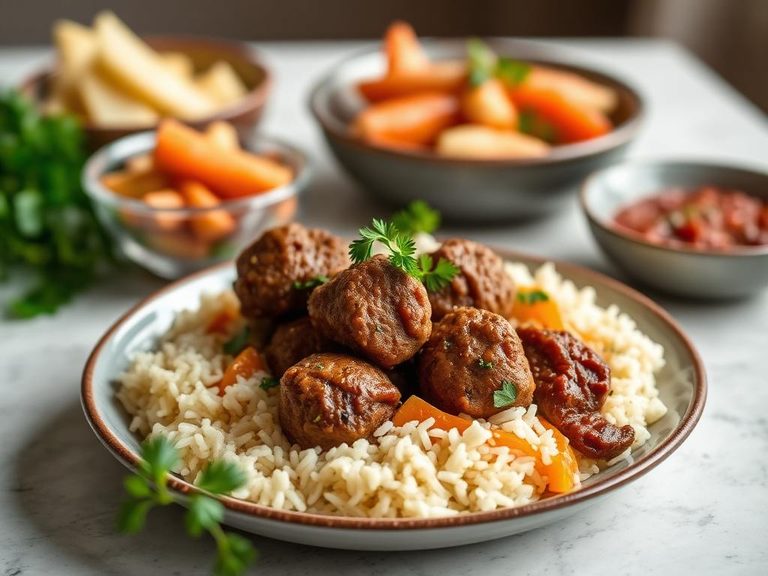
Lamb or mutton, rice, and vegetables including carrots, broccoli, and/or dark-green leafy; tomato-based sauce
Common food
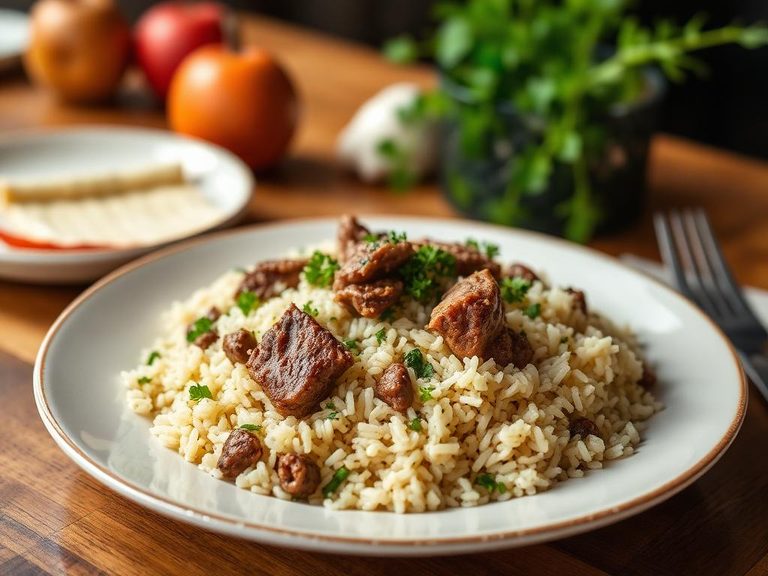
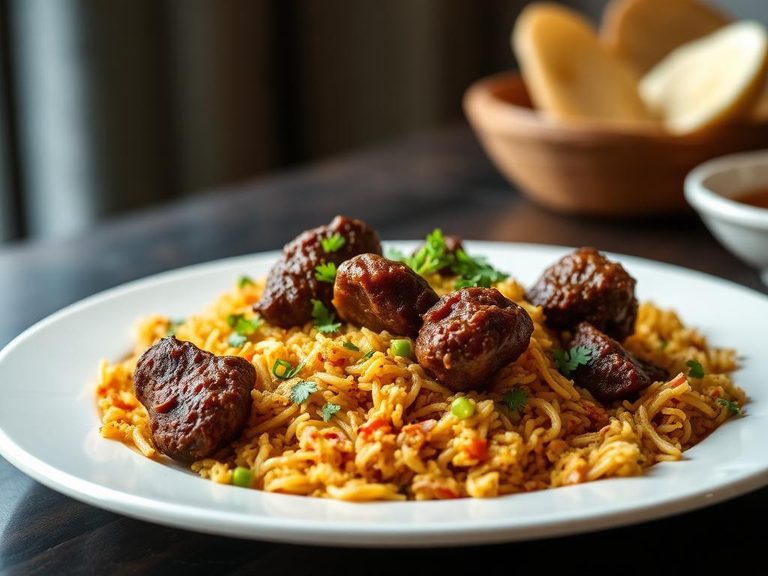
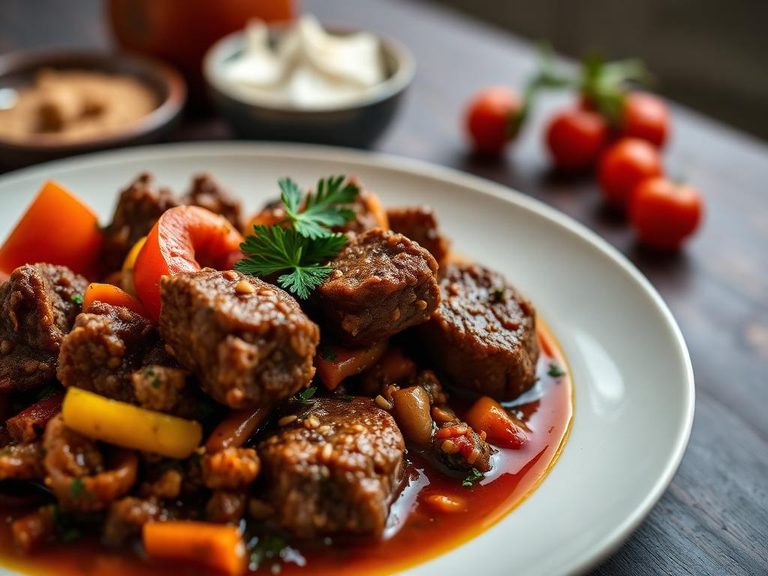
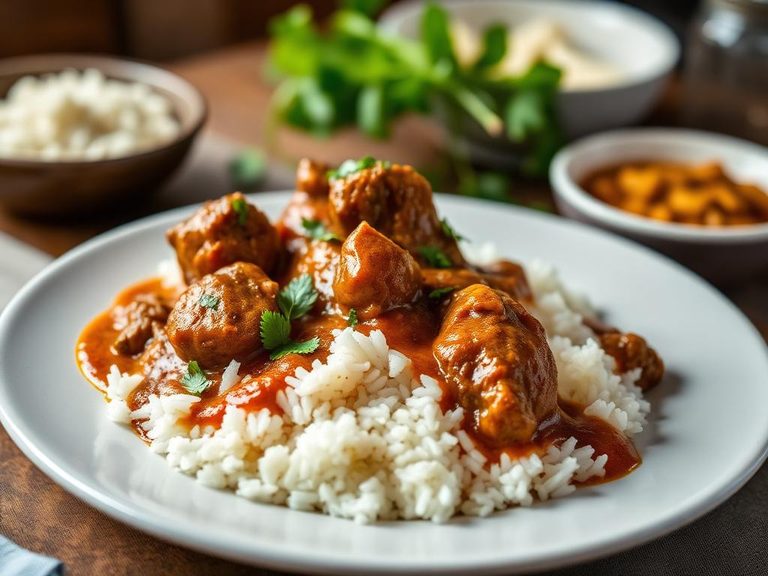
This is a hearty, savory one-pot dish of tender lamb or mutton simmered with rice and vegetables like carrots, broccoli, or dark greens in a rich, tangy tomato-based sauce. The texture is comforting and cohesive, with the meat offering a satisfying chew against the soft rice and tender-crisp vegetables. It's a nutritionally balanced meal, providing a solid source of protein (5.13g) and complex carbohydrates (15.15g) for sustained energy, all at a moderate 130 calories per 100g.
Calorie split: 16% protein · 47% carbs · 37% fat
↓ Full nutrition💚 Why it's loved
People love this dish for its deep, savory umami flavor from the lamb and tomato sauce, which melds beautifully with the earthy vegetables and fluffy rice. It's a beloved comfort food across many cultures, celebrated for its versatility and ability to feed a crowd with a single, nourishing pot.
⚠️ Watch-outs & how to enjoy it better
The tomato-based sauce can be high in sodium, and the dish may cause blood-sugar spikes if portion sizes of rice are large. To counteract this, pair it with a side of plain yogurt or a drizzle of olive oil to slow digestion, and practice portion control by filling half your plate with the vegetables and meat. For those sensitive to oxalates in dark greens, choose broccoli or carrots instead, and ensure the greens are cooked to reduce oxalate content.
Key benefits
- Excellent source of complete protein for muscle maintenance.
- Rich in complex carbohydrates for steady energy release.
- Contains fiber and vitamins from the included vegetables.
- Balanced macronutrient profile for a satisfying, complete meal.
- Tomato sauce provides lycopene, a potent antioxidant.
🍽️ Popular dishes
🌍 Where it's eaten
💡 Did you know?
The slow-cooking method for lamb in tomato-based sauces, like in tagines, can break down tough collagen into gelatin, making the meat exceptionally tender and the sauce richly flavorful without needing added thickeners.
Full nutrition (USDA data · scales with serving)
| Water | 73.0 g |
| Energy | 130 kcal |
| Protein | 5.1 g |
| Total lipid (fat) | 5.3 g |
| Carbohydrate, by difference | 15.2 g |
| Fiber, total dietary | 1.1 g |
| Total Sugars | 1.5 g |
| Calcium, Ca | 17.0 mg |
| Iron, Fe | 1.1 mg |
| Magnesium, Mg | 15.0 mg |
| Phosphorus, P | 59.0 mg |
| Potassium, K | 166 mg |
| Sodium, Na | 316 mg |
| Zinc, Zn | 0.93 mg |
| Copper, Cu | 0.09 mg |
| Selenium, Se | 7.2 ug |
| Vitamin C, total ascorbic acid | 5.7 mg |
| Thiamin | 0.10 mg |
| Riboflavin | 0.07 mg |
| Niacin | 1.9 mg |
| Vitamin B-6 | 0.10 mg |
| Folate, total | 37.0 ug |
| Folic acid | 25.0 ug |
| Folate, food | 12.0 ug |
| Folate, DFE | 54.0 ug |
| Choline, total | 18.3 mg |
| Vitamin B-12 | 0.34 ug |
| Vitamin B-12, added | 0.00 ug |
| Vitamin A, RAE | 86.0 ug |
| Retinol | 0.00 ug |
| Carotene, beta | 854 ug |
| Carotene, alpha | 333 ug |
| Cryptoxanthin, beta | 1.0 ug |
| Lycopene | 3719 ug |
| Lutein + zeaxanthin | 164 ug |
| Vitamin E (alpha-tocopherol) | 1.1 mg |
| Vitamin E, added | 0.00 mg |
| Vitamin D (D2 + D3) | 0.00 ug |
| Vitamin K (phylloquinone) | 12.7 ug |
| Alcohol, ethyl | 0.00 g |
| Caffeine | 0.00 mg |
| Theobromine | 0.00 mg |
Fat & fatty acid profile (per 100g)
| Fatty acids, total saturated | 1.5 g |
| SFA 4:0 | 0.00 g |
| SFA 6:0 | 0.00 g |
| SFA 8:0 | 0.00 g |
| SFA 10:0 | 0.01 g |
| SFA 12:0 | 0.01 g |
| SFA 14:0 | 0.11 g |
| SFA 16:0 | 0.86 g |
| SFA 18:0 | 0.45 g |
| Fatty acids, total monounsaturated | 2.2 g |
| MUFA 16:1 | 0.09 g |
| MUFA 18:1 | 2.0 g |
| MUFA 20:1 | 0.01 g |
| MUFA 22:1 | 0.00 g |
| Fatty acids, total polyunsaturated | 1.2 g |
| PUFA 18:2 | 1.00 g |
| PUFA 18:3 | 0.15 g |
| PUFA 18:4 | 0.00 g |
| PUFA 20:4 | 0.01 g |
| PUFA 20:5 n-3 (EPA) | 0.00 g |
| PUFA 22:5 n-3 (DPA) | 0.00 g |
| PUFA 22:6 n-3 (DHA) | 0.00 g |
| Cholesterol | 13.0 mg |
FAQ
Is this dish high in fat?
With 5.31g of fat per 100g, it's moderate. The fat primarily comes from the lamb, which can be trimmed for a leaner version, and the cooking oil used in the sauce.
Can I make this dish vegetarian?
Yes, you can substitute the lamb with chickpeas, lentils, or a plant-based meat alternative, and use vegetable broth to maintain the rich flavor profile.
How can I reduce the sodium content?
Use low-sodium tomato sauce or paste, and season with herbs like cumin, coriander, and turmeric instead of salt. You can also rinse canned vegetables to reduce their sodium content.
Nutrient density (calculated · NRF9.3)
Nutrient Rich Foods index: beneficial nutrients (protein, fiber, vitamins, minerals) minus saturated fat, added sugar & sodium, per 100 kcal.
NRF9.3 index — Fulgoni, Keast & Drewnowski, 2009. Computed from USDA nutrients.
Weight-loss friendliness (composite index)
Energy density 1.30 kcal/g · 16% calories from protein · 1.1 g fiber · 1.5 g sugar per 100 g.
Composite of energy density (Rolls et al., 1999), protein & fiber satiety, minus sugar. A calculated heuristic — ranks satiety-per-calorie, not a clinical measure.
Dietary load (calculated from USDA values)
Potential renal acid load. Positive = acid-forming, negative = alkaline-forming.
Sodium-to-potassium ratio: 1.90 (lower is better — aim for ≤ 1)
Sodium:potassium per WHO potassium guidance. Computed from USDA nutrients.