

Kefir
Common food
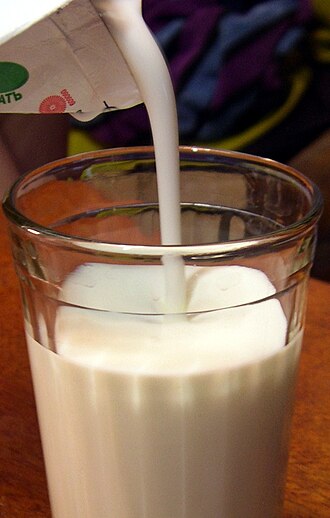
Photo: Wikipedia
Kefir is a tangy, effervescent fermented milk drink with a thin, drinkable consistency and a complex, slightly sour flavor profile. Its nutritional power lies in its dense concentration of probiotics and protein, offering a potent boost for gut health and digestion with minimal calories. This ancient elixir is essentially a living food, teeming with beneficial bacteria and yeasts that transform simple milk into a nutritional powerhouse.
Calorie split: 27% protein · 57% carbs · 16% fat
↓ Full nutrition💚 Why it's loved
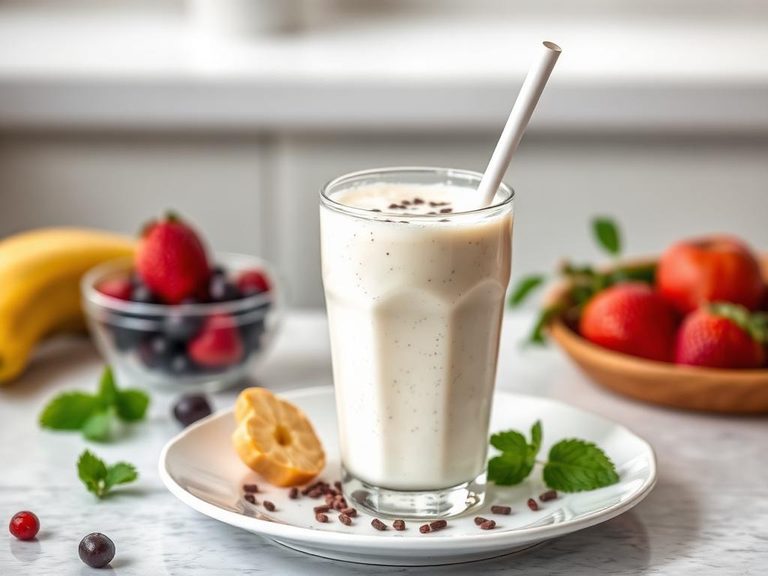
People adore kefir for its unique, complex tang that can be both refreshing and satisfying, often likened to a drinkable yogurt with a subtle fizz. Its versatility is a huge draw, as it can be consumed plain, blended into smoothies, used as a base for dressings, or even fermented into a tangy cheese, making it a staple in health-conscious and traditional kitchens alike.
⚠️ Watch-outs & how to enjoy it better
The strong, sour taste can be off-putting to those unaccustomed to fermented foods, and its effervescence might cause mild bloating or gas initially for some. For individuals with severe dairy allergies or a history of yeast overgrowth, kefir should be approached with caution; starting with a small portion (e.g., 50g) and pairing it with a non-dairy fat source like avocado can help mitigate digestive discomfort.
Key benefits
- Rich in diverse probiotics for gut microbiome health
- Good source of protein and calcium for bone and muscle support
- Naturally lower in lactose than milk due to fermentation
- Contains bioactive compounds that may support immune function
🍽️ Popular dishes



🌍 Where it's eaten
💡 Did you know?
The word 'kefir' is believed to derive from the Turkish word 'keyif,' meaning 'feeling good' after eating, reflecting its long history as a health-promoting food.
Full nutrition (USDA data · scales with serving)
| Water | 87.3 g |
| Energy | 52.0 kcal |
| Protein | 3.6 g |
| Total lipid (fat) | 0.96 g |
| Carbohydrate, by difference | 7.5 g |
| Fiber, total dietary | 0.00 g |
| Total Sugars | 6.9 g |
| Calcium, Ca | 124 mg |
| Iron, Fe | 0.04 mg |
| Magnesium, Mg | 12.0 mg |
| Phosphorus, P | 100 mg |
| Potassium, K | 159 mg |
| Sodium, Na | 38.0 mg |
| Zinc, Zn | 0.45 mg |
| Copper, Cu | 0.01 mg |
| Selenium, Se | 3.6 ug |
| Vitamin C, total ascorbic acid | 0.80 mg |
| Thiamin | 0.03 mg |
| Riboflavin | 0.17 mg |
| Niacin | 0.13 mg |
| Vitamin B-6 | 0.06 mg |
| Folate, total | 18.0 ug |
| Folic acid | 0.00 ug |
| Folate, food | 18.0 ug |
| Folate, DFE | 18.0 ug |
| Choline, total | 15.2 mg |
| Vitamin B-12 | 0.30 ug |
| Vitamin B-12, added | 0.00 ug |
| Vitamin A, RAE | 174 ug |
| Retinol | 174 ug |
| Carotene, beta | 2.0 ug |
| Carotene, alpha | 0.00 ug |
| Cryptoxanthin, beta | 0.00 ug |
| Lycopene | 0.00 ug |
| Lutein + zeaxanthin | 0.00 ug |
| Vitamin E (alpha-tocopherol) | 0.04 mg |
| Vitamin E, added | 0.00 mg |
| Vitamin D (D2 + D3) | 1.0 ug |
| Vitamin K (phylloquinone) | 0.60 ug |
| Alcohol, ethyl | 0.00 g |
| Caffeine | 0.00 mg |
| Theobromine | 0.00 mg |
Fat & fatty acid profile (per 100g)
| Fatty acids, total saturated | 0.60 g |
| SFA 4:0 | 0.03 g |
| SFA 6:0 | 0.02 g |
| SFA 8:0 | 0.01 g |
| SFA 10:0 | 0.02 g |
| SFA 12:0 | 0.03 g |
| SFA 14:0 | 0.09 g |
| SFA 16:0 | 0.28 g |
| SFA 18:0 | 0.11 g |
| Fatty acids, total monounsaturated | 0.29 g |
| MUFA 16:1 | 0.02 g |
| MUFA 18:1 | 0.25 g |
| MUFA 20:1 | 0.00 g |
| MUFA 22:1 | 0.00 g |
| Fatty acids, total polyunsaturated | 0.05 g |
| PUFA 18:2 | 0.04 g |
| PUFA 18:3 | 0.01 g |
| PUFA 18:4 | 0.00 g |
| PUFA 20:4 | 0.00 g |
| PUFA 20:5 n-3 (EPA) | 0.00 g |
| PUFA 22:5 n-3 (DPA) | 0.00 g |
| PUFA 22:6 n-3 (DHA) | 0.00 g |
| Cholesterol | 5.0 mg |
FAQ
Is kefir the same as yogurt?
No, while both are fermented dairy, kefir uses a complex mix of bacteria and yeasts (kefir grains) and is typically thinner and more effervescent. Yogurt uses only bacterial cultures and is generally thicker and less tangy.
Can I make kefir at home?
Yes, you can make kefir by adding kefir grains (a symbiotic culture of bacteria and yeast) to milk and letting it ferment at room temperature for 24-48 hours. It's a simple, rewarding process that yields fresh, probiotic-rich kefir.
Is kefir suitable for lactose-intolerant people?
Many lactose-intolerant individuals can tolerate kefir because the fermentation process breaks down most of the lactose. However, sensitivity varies, so starting with a small amount is recommended.
Nutrient density (calculated · NRF9.3)
Nutrient Rich Foods index: beneficial nutrients (protein, fiber, vitamins, minerals) minus saturated fat, added sugar & sodium, per 100 kcal.
NRF9.3 index — Fulgoni, Keast & Drewnowski, 2009. Computed from USDA nutrients.
Weight-loss friendliness (composite index)
Energy density 0.52 kcal/g · 28% calories from protein · 0.0 g fiber · 6.9 g sugar per 100 g.
Composite of energy density (Rolls et al., 1999), protein & fiber satiety, minus sugar. A calculated heuristic — ranks satiety-per-calorie, not a clinical measure.
Dietary load (calculated from USDA values)
Potential renal acid load. Positive = acid-forming, negative = alkaline-forming.
Sodium-to-potassium ratio: 0.24 (lower is better — aim for ≤ 1)
Sodium:potassium per WHO potassium guidance. Computed from USDA nutrients.