

Italian Ice, no sugar added
Common food

Photo: Wikipedia
Italian Ice, no sugar added, is a refreshing, dairy-free frozen dessert with a smooth, slightly icy texture and a clean, fruit-forward flavor. It delivers a light, palate-cleansing experience without the heavy creaminess of ice cream. At just 24 kcal per 100g, it's a notably low-calorie treat that relies on natural fruit flavors and sugar alternatives for sweetness.
Calorie split: 0% protein · 100% carbs · 0% fat
↓ Full nutrition💚 Why it's loved
People love it for its pure, intense fruit flavors and its ability to satisfy a sweet craving without heaviness. Its versatility makes it a popular palate cleanser between courses or a simple, nostalgic summertime snack.
⚠️ Watch-outs & how to enjoy it better
The primary downside is its lack of protein, fiber, or healthy fats, meaning it offers little satiety and could lead to consuming other snacks soon after. For those monitoring blood sugar, while it has no added sugar, the natural sugars and sugar alcohols used can still affect some individuals. To counteract this, pair a small portion with a handful of nuts or a piece of cheese to add protein and fat, slowing digestion and promoting fullness.
Key benefits
- Very low in calories (24 kcal per 100g)
- Fat-free and cholesterol-free
- Contains no added sugars
- Dairy-free, suitable for lactose-intolerant diets
- Provides quick, light refreshment
🍽️ Popular dishes
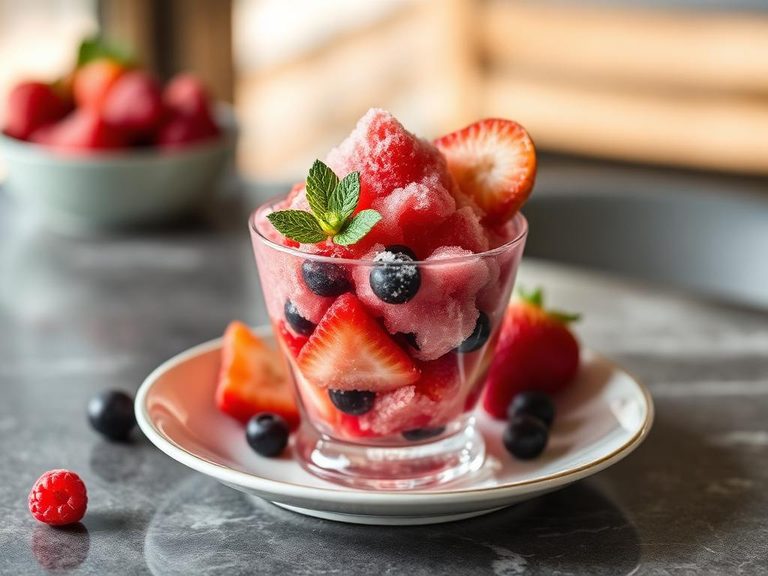
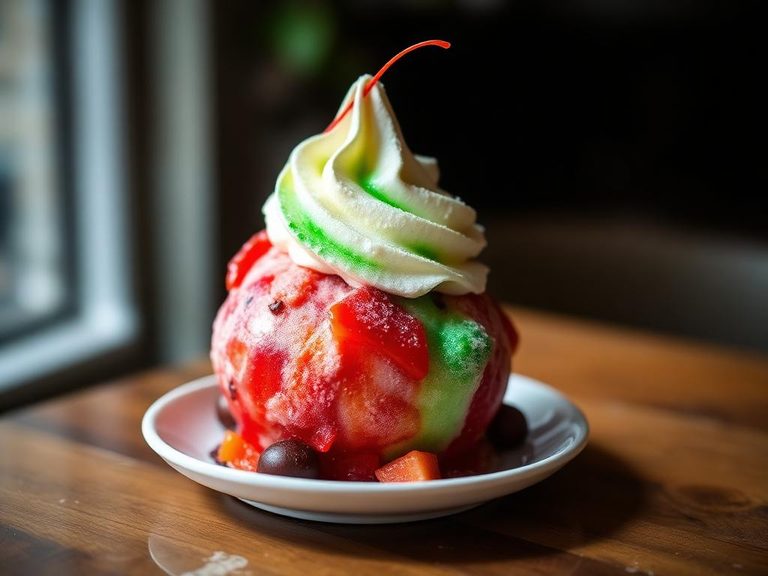
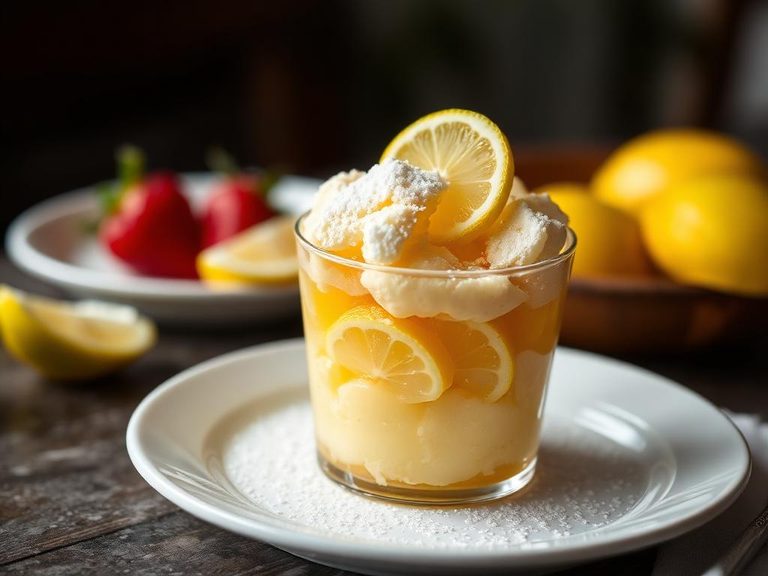
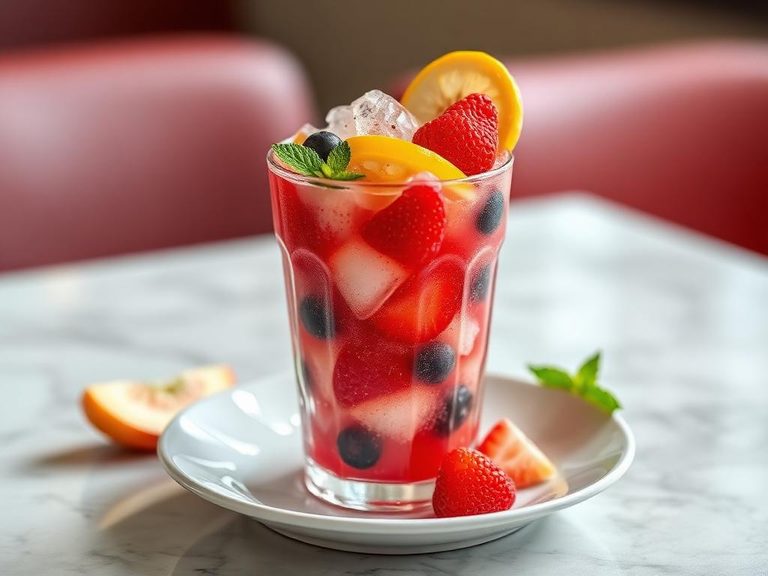
🌍 Where it's eaten
💡 Did you know?
The traditional Italian version, granita, has a coarser, more crystalline texture than its smoother American cousin and is famously eaten with a small spoon, not a straw.
Full nutrition (USDA data · scales with serving)
| Water | 94.0 g |
| Energy | 24.0 kcal |
| Protein | 0.00 g |
| Total lipid (fat) | 0.00 g |
| Carbohydrate, by difference | 5.9 g |
| Fiber, total dietary | 0.00 g |
| Total Sugars | 1.5 g |
| Calcium, Ca | 0.00 mg |
| Iron, Fe | 0.67 mg |
| Magnesium, Mg | 1.0 mg |
| Phosphorus, P | 0.00 mg |
| Potassium, K | 11.0 mg |
| Sodium, Na | 10.0 mg |
| Zinc, Zn | 0.47 mg |
| Copper, Cu | 0.00 mg |
| Selenium, Se | 0.00 ug |
| Vitamin C, total ascorbic acid | 10.4 mg |
| Thiamin | 0.00 mg |
| Riboflavin | 0.00 mg |
| Niacin | 0.00 mg |
| Vitamin B-6 | 0.00 mg |
| Folate, total | 0.00 ug |
| Folic acid | 0.00 ug |
| Folate, food | 0.00 ug |
| Folate, DFE | 0.00 ug |
| Choline, total | 0.00 mg |
| Vitamin B-12 | 0.00 ug |
| Vitamin B-12, added | 0.00 ug |
| Vitamin A, RAE | 0.00 ug |
| Retinol | 0.00 ug |
| Carotene, beta | 0.00 ug |
| Carotene, alpha | 0.00 ug |
| Cryptoxanthin, beta | 0.00 ug |
| Lycopene | 0.00 ug |
| Lutein + zeaxanthin | 0.00 ug |
| Vitamin E (alpha-tocopherol) | 0.00 mg |
| Vitamin E, added | 0.00 mg |
| Vitamin D (D2 + D3) | 0.00 ug |
| Vitamin K (phylloquinone) | 0.00 ug |
| Alcohol, ethyl | 0.00 g |
| Caffeine | 0.00 mg |
| Theobromine | 0.00 mg |
Fat & fatty acid profile (per 100g)
| Fatty acids, total saturated | 0.00 g |
| SFA 4:0 | 0.00 g |
| SFA 6:0 | 0.00 g |
| SFA 8:0 | 0.00 g |
| SFA 10:0 | 0.00 g |
| SFA 12:0 | 0.00 g |
| SFA 14:0 | 0.00 g |
| SFA 16:0 | 0.00 g |
| SFA 18:0 | 0.00 g |
| Fatty acids, total monounsaturated | 0.00 g |
| MUFA 16:1 | 0.00 g |
| MUFA 18:1 | 0.00 g |
| MUFA 20:1 | 0.00 g |
| MUFA 22:1 | 0.00 g |
| Fatty acids, total polyunsaturated | 0.00 g |
| PUFA 18:2 | 0.00 g |
| PUFA 18:3 | 0.00 g |
| PUFA 18:4 | 0.00 g |
| PUFA 20:4 | 0.00 g |
| PUFA 20:5 n-3 (EPA) | 0.00 g |
| PUFA 22:5 n-3 (DPA) | 0.00 g |
| PUFA 22:6 n-3 (DHA) | 0.00 g |
| Cholesterol | 0.00 mg |
FAQ
Is no-sugar-added Italian Ice keto-friendly?
It can be, but you must check the label. Many use sugar alcohols like erythritol or allulose which have minimal net carbs, but others may use fruit juice concentrates. A true keto version would have <5g net carbs per serving.
How is it different from sorbet?
The terms are often used interchangeably, but traditional Italian Ice (or granita) is typically churned less, resulting in a slightly icier texture, while sorbet is churned more to incorporate air for a smoother consistency.
Can I make it at home without an ice cream maker?
Yes. Blend fruit purée with water and a sugar alternative, pour into a shallow pan, freeze for 45 minutes, then scrape with a fork to break up crystals. Repeat every 30 minutes for 2-3 hours until fluffy.
Nutrient density (calculated · NRF9.3)
Nutrient Rich Foods index: beneficial nutrients (protein, fiber, vitamins, minerals) minus saturated fat, added sugar & sodium, per 100 kcal.
NRF9.3 index — Fulgoni, Keast & Drewnowski, 2009. Computed from USDA nutrients.
Weight-loss friendliness (composite index)
Energy density 0.24 kcal/g · 0% calories from protein · 0.0 g fiber · 1.5 g sugar per 100 g.
Composite of energy density (Rolls et al., 1999), protein & fiber satiety, minus sugar. A calculated heuristic — ranks satiety-per-calorie, not a clinical measure.
Dietary load (calculated from USDA values)
Potential renal acid load. Positive = acid-forming, negative = alkaline-forming.
Sodium-to-potassium ratio: 0.91 (lower is better — aim for ≤ 1)
Sodium:potassium per WHO potassium guidance. Computed from USDA nutrients.