

Fruit flavored drink, powdered, not reconstituted
Common food
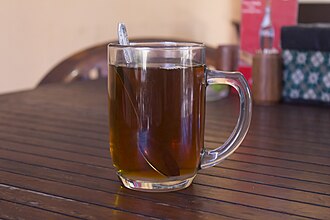
Photo: Wikipedia
This is a concentrated, dehydrated powder that transforms water into a sweet, vibrant, fruit-flavored beverage. It typically dissolves quickly, offering a consistent, often intensely sweet and tangy taste with a smooth, non-pulp texture. Nutritionally, it is a near-pure source of carbohydrates, specifically sugar, providing a rapid energy boost with virtually no protein, fat, or fiber.
Calorie split: 0% protein · 98% carbs · 2% fat
↓ Full nutrition💚 Why it's loved
People love it for its nostalgic, fun, and intensely sweet flavor that evokes childhood memories and social gatherings. Its versatility and convenience make it a staple for quick hydration, party punches, and creating colorful, festive drinks.
⚠️ Watch-outs & how to enjoy it better
The primary downside is the extremely high sugar content, which can cause rapid blood-sugar spikes and contribute to empty calories. To counteract this, practice strict portion control, dilute the powder more than recommended, or pair the drink with a source of protein or healthy fat (like nuts or cheese) to slow sugar absorption.
Key benefits
- Provides quick, easily digestible energy from simple sugars
- Lightweight and shelf-stable for long-term storage and portability
- Offers consistent flavor and sweetness in every serving
- Extremely cost-effective for mass consumption and events
- Can be customized in strength and mixed with various liquids
🍽️ Popular dishes






🌍 Where it's eaten
💡 Did you know?
The powdered drink mix format was popularized in the 1920s, with Kool-Aid being one of the first major brands to sell pre-measured, flavored powder packets that became a cultural icon, especially during the Great Depression for its affordability.
Full nutrition (USDA data · scales with serving)
| Water | 0.52 g |
| Energy | 380 kcal |
| Protein | 0.00 g |
| Total lipid (fat) | 1.0 g |
| Carbohydrate, by difference | 97.9 g |
| Fiber, total dietary | 0.00 g |
| Total Sugars | 97.2 g |
| Calcium, Ca | 11.0 mg |
| Iron, Fe | 0.17 mg |
| Magnesium, Mg | 165 mg |
| Phosphorus, P | 99.0 mg |
| Potassium, K | 39.0 mg |
| Sodium, Na | 130 mg |
| Zinc, Zn | 0.03 mg |
| Copper, Cu | 0.03 mg |
| Selenium, Se | 0.30 ug |
| Vitamin C, total ascorbic acid | 40.6 mg |
| Thiamin | 0.00 mg |
| Riboflavin | 0.01 mg |
| Niacin | 0.00 mg |
| Vitamin B-6 | 0.00 mg |
| Folate, total | 0.00 ug |
| Folic acid | 0.00 ug |
| Folate, food | 0.00 ug |
| Folate, DFE | 0.00 ug |
| Choline, total | 0.10 mg |
| Vitamin B-12 | 0.00 ug |
| Vitamin B-12, added | 0.00 ug |
| Vitamin A, RAE | 0.00 ug |
| Retinol | 0.00 ug |
| Carotene, beta | 0.00 ug |
| Carotene, alpha | 0.00 ug |
| Cryptoxanthin, beta | 0.00 ug |
| Lycopene | 0.00 ug |
| Lutein + zeaxanthin | 0.00 ug |
| Vitamin E (alpha-tocopherol) | 0.08 mg |
| Vitamin E, added | 0.00 mg |
| Vitamin D (D2 + D3) | 0.00 ug |
| Vitamin K (phylloquinone) | 1.9 ug |
| Alcohol, ethyl | 0.00 g |
| Caffeine | 0.00 mg |
| Theobromine | 0.00 mg |
Fat & fatty acid profile (per 100g)
| Fatty acids, total saturated | 0.18 g |
| SFA 4:0 | 0.00 g |
| SFA 6:0 | 0.00 g |
| SFA 8:0 | 0.01 g |
| SFA 10:0 | 0.01 g |
| SFA 12:0 | 0.04 g |
| SFA 14:0 | 0.01 g |
| SFA 16:0 | 0.06 g |
| SFA 18:0 | 0.01 g |
| Fatty acids, total monounsaturated | 0.13 g |
| MUFA 16:1 | 0.00 g |
| MUFA 18:1 | 0.09 g |
| MUFA 20:1 | 0.00 g |
| MUFA 22:1 | 0.00 g |
| Fatty acids, total polyunsaturated | 0.53 g |
| PUFA 18:2 | 0.35 g |
| PUFA 18:3 | 0.04 g |
| PUFA 18:4 | 0.00 g |
| PUFA 20:4 | 0.00 g |
| PUFA 20:5 n-3 (EPA) | 0.00 g |
| PUFA 22:5 n-3 (DPA) | 0.00 g |
| PUFA 22:6 n-3 (DHA) | 0.00 g |
| Cholesterol | 0.00 mg |
FAQ
Is this the same as a fruit juice?
No, it is a synthetic or artificial flavoring mixed with sugar and colorants, not made from actual fruit juice. It lacks the vitamins, minerals, and fiber found in real fruit.
How much sugar is in a typical serving?
A standard serving (about 1 tablespoon of powder) contains roughly 10-12 grams of sugar, which is nearly 100% of its weight. A full prepared cup can contain 20-30 grams of sugar.
Can I use it in baking?
Yes, it can be used to add flavor and color to cakes, cookies, or frostings, but be aware it will significantly increase the sugar content and may affect the texture due to the lack of fiber.
Nutrient density (calculated · NRF9.3)
Nutrient Rich Foods index: beneficial nutrients (protein, fiber, vitamins, minerals) minus saturated fat, added sugar & sodium, per 100 kcal.
NRF9.3 index — Fulgoni, Keast & Drewnowski, 2009. Computed from USDA nutrients.
Weight-loss friendliness (composite index)
Energy density 3.80 kcal/g · 0% calories from protein · 0.0 g fiber · 97.2 g sugar per 100 g.
Composite of energy density (Rolls et al., 1999), protein & fiber satiety, minus sugar. A calculated heuristic — ranks satiety-per-calorie, not a clinical measure.
Dietary load (calculated from USDA values)
Potential renal acid load. Positive = acid-forming, negative = alkaline-forming.
Sodium-to-potassium ratio: 3.33 (lower is better — aim for ≤ 1)
Sodium:potassium per WHO potassium guidance. Computed from USDA nutrients.