

Fruit cocktail, canned, in syrup
Common food

Photo: Wikipedia
A nostalgic medley of diced peaches, pears, grapes, pineapple, and cherries, swimming in a light, sweet syrup. The texture is uniformly soft and juicy, offering a burst of sugary, fruity flavor in every spoonful. Nutritionally, it's a low-fat, low-protein source of quick energy, primarily from its high sugar content.
Calorie split: 2% protein · 97% carbs · 1% fat
↓ Full nutrition💚 Why it's loved
People love it for its reliable, sweet taste and the comforting, familiar blend of fruit textures. It's a versatile staple, enjoyed straight from the can, as a topping, or mixed into desserts.
⚠️ Watch-outs & how to enjoy it better
The high sugar content in the syrup can cause rapid blood-sugar spikes, making it a concern for diabetics or those monitoring sugar intake. To counteract this, opt for versions packed in juice or water, drain the syrup, and pair it with a source of protein or healthy fat like yogurt or nuts to slow sugar absorption.
Key benefits
- Provides a quick source of energy from simple carbohydrates.
- Offers a convenient way to consume a variety of fruits year-round.
- Low in fat and a source of dietary fiber.
- Shelf-stable and requires no preparation.
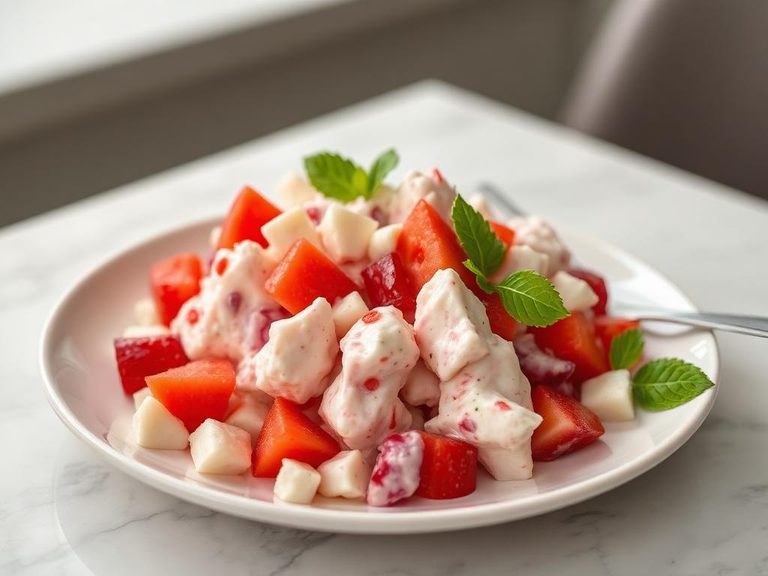
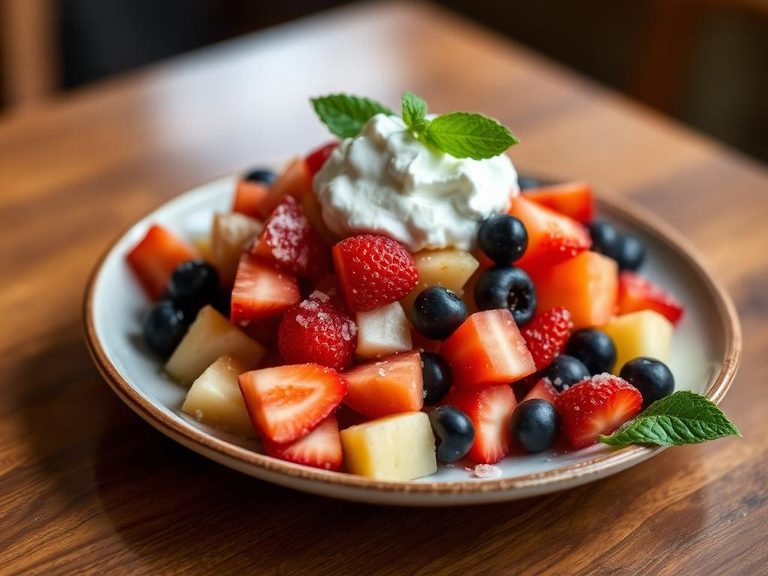
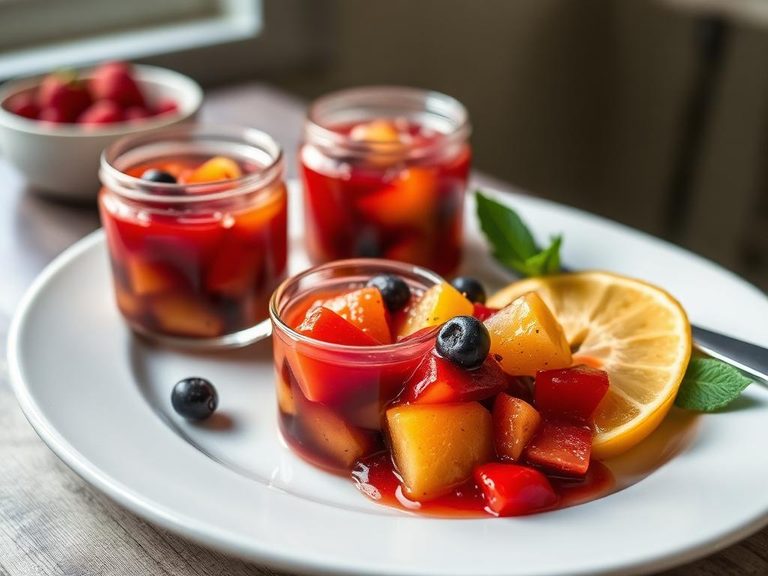
🍽️ Popular dishes



🌍 Where it's eaten
💡 Did you know?
The classic five-fruit mix (peaches, pears, grapes, pineapple, cherries) was standardized by the Del Monte company in the 1930s to ensure a consistent product year-round.
Full nutrition (USDA data · scales with serving)
| Water | 83.5 g |
| Energy | 62.0 kcal |
| Protein | 0.39 g |
| Total lipid (fat) | 0.07 g |
| Carbohydrate, by difference | 15.8 g |
| Fiber, total dietary | 0.90 g |
| Total Sugars | 14.9 g |
| Calcium, Ca | 5.0 mg |
| Iron, Fe | 0.23 mg |
| Magnesium, Mg | 6.0 mg |
| Phosphorus, P | 10.0 mg |
| Potassium, K | 87.0 mg |
| Sodium, Na | 4.0 mg |
| Zinc, Zn | 0.08 mg |
| Copper, Cu | 0.07 mg |
| Selenium, Se | 0.50 ug |
| Vitamin C, total ascorbic acid | 1.9 mg |
| Thiamin | 0.01 mg |
| Riboflavin | 0.01 mg |
| Niacin | 0.33 mg |
| Vitamin B-6 | 0.05 mg |
| Folate, total | 3.0 ug |
| Folic acid | 0.00 ug |
| Folate, food | 3.0 ug |
| Folate, DFE | 3.0 ug |
| Choline, total | 3.4 mg |
| Vitamin B-12 | 0.00 ug |
| Vitamin B-12, added | 0.00 ug |
| Vitamin A, RAE | 12.0 ug |
| Retinol | 0.00 ug |
| Carotene, beta | 116 ug |
| Carotene, alpha | 0.00 ug |
| Cryptoxanthin, beta | 44.0 ug |
| Lycopene | 0.00 ug |
| Lutein + zeaxanthin | 69.0 ug |
| Vitamin E (alpha-tocopherol) | 0.37 mg |
| Vitamin E, added | 0.00 mg |
| Vitamin D (D2 + D3) | 0.00 ug |
| Vitamin K (phylloquinone) | 2.4 ug |
| Alcohol, ethyl | 0.00 g |
| Caffeine | 0.00 mg |
| Theobromine | 0.00 mg |
Fat & fatty acid profile (per 100g)
| Fatty acids, total saturated | 0.01 g |
| SFA 4:0 | 0.00 g |
| SFA 6:0 | 0.00 g |
| SFA 8:0 | 0.00 g |
| SFA 10:0 | 0.00 g |
| SFA 12:0 | 0.00 g |
| SFA 14:0 | 0.00 g |
| SFA 16:0 | 0.01 g |
| SFA 18:0 | 0.00 g |
| Fatty acids, total monounsaturated | 0.01 g |
| MUFA 16:1 | 0.00 g |
| MUFA 18:1 | 0.01 g |
| MUFA 20:1 | 0.00 g |
| MUFA 22:1 | 0.00 g |
| Fatty acids, total polyunsaturated | 0.02 g |
| PUFA 18:2 | 0.02 g |
| PUFA 18:3 | 0.00 g |
| PUFA 18:4 | 0.00 g |
| PUFA 20:4 | 0.00 g |
| PUFA 20:5 n-3 (EPA) | 0.00 g |
| PUFA 22:5 n-3 (DPA) | 0.00 g |
| PUFA 22:6 n-3 (DHA) | 0.00 g |
| Cholesterol | 0.00 mg |
FAQ
What's the difference between fruit cocktail and fruit salad?
Fruit cocktail is a specific, standardized mix of five fruits (peaches, pears, grapes, pineapple, cherries) in syrup or juice. 'Fruit salad' is a general term for any mixture of fruits, fresh or canned, with no fixed recipe.
Is the syrup bad for you?
The syrup is primarily sugar water, adding calories without significant nutrients. For a healthier option, choose fruit canned in 100% juice or water, or drain and rinse the syrup from regular canned fruit.
Can I use it in savory dishes?
Yes, it's a key ingredient in retro savory dishes like Rumaki (chicken liver and water chestnut wraps) and some versions of sweet-and-sour sauce, where its sweetness balances savory and tangy flavors.
Nutrient density (calculated · NRF9.3)
Nutrient Rich Foods index: beneficial nutrients (protein, fiber, vitamins, minerals) minus saturated fat, added sugar & sodium, per 100 kcal.
NRF9.3 index — Fulgoni, Keast & Drewnowski, 2009. Computed from USDA nutrients.
Weight-loss friendliness (composite index)
Energy density 0.62 kcal/g · 3% calories from protein · 0.9 g fiber · 14.9 g sugar per 100 g.
Composite of energy density (Rolls et al., 1999), protein & fiber satiety, minus sugar. A calculated heuristic — ranks satiety-per-calorie, not a clinical measure.
Dietary load (calculated from USDA values)
Potential renal acid load. Positive = acid-forming, negative = alkaline-forming.
Sodium-to-potassium ratio: 0.05 (lower is better — aim for ≤ 1)
Sodium:potassium per WHO potassium guidance. Computed from USDA nutrients.