

Fruit cocktail, (peach and pineapple and pear and grape and cherry), canned, extra light syrup, solids and liquids
Whole food · Fruits and Fruit Juices

Photo: Wikipedia
A vibrant medley of diced peaches, pears, grapes, pineapple, and bright red cherries, all swimming in a light, clear syrup. The texture is uniformly soft and juicy, offering a sweet, tangy, and refreshing burst in every spoonful. Nutritionally, it's a low-calorie, low-fat option that provides quick energy from its carbohydrate content and a modest amount of fiber.
Calorie split: 3% protein · 95% carbs · 1% fat
↓ Full nutrition💚 Why it's loved
People adore it for its nostalgic, sweet-tart flavor profile and the satisfying, soft texture that makes it a comforting treat. Its versatility shines as a standalone snack, a topping for yogurt or pancakes, or a key ingredient in classic desserts.
⚠️ Watch-outs & how to enjoy it better
The primary concern is the added sugar in the syrup, which can cause blood-sugar spikes, especially for those monitoring glucose levels. To counteract this, pair it with a source of protein or healthy fat (like Greek yogurt, cottage cheese, or nuts) to slow sugar absorption, and practice portion control by choosing a smaller serving or draining the syrup.
Key benefits
- Low in calories (45 kcal per 100g)
- Very low in fat (0.07g per 100g)
- Provides quick energy from carbohydrates
- Contains dietary fiber (1.1g per 100g)
- Convenient source of mixed fruit
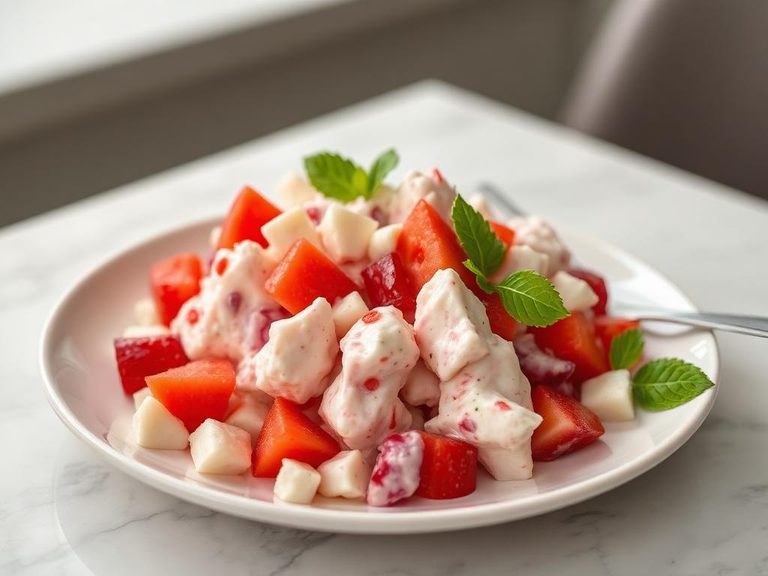
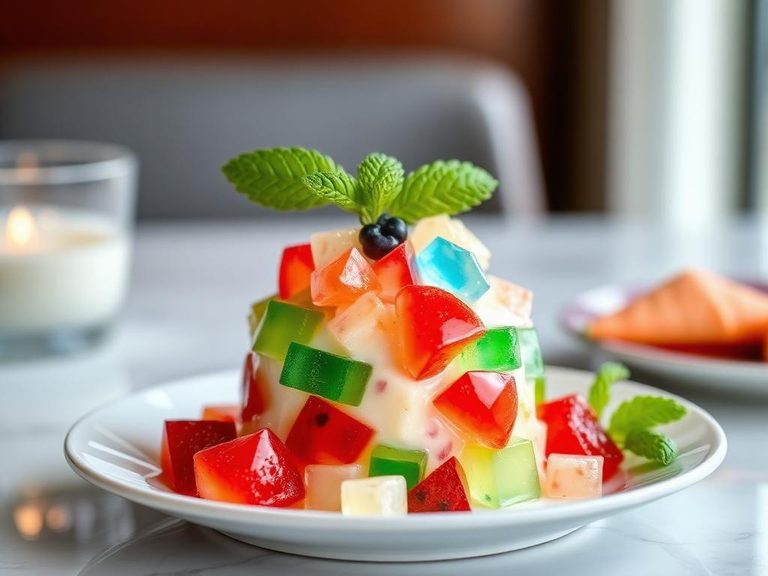
🍽️ Popular dishes


🌍 Where it's eaten
💡 Did you know?
The iconic bright red maraschino cherry in the mix is actually a sweet cherry that has been bleached, soaked in sugar syrup, and dyed—a process invented in the 19th century to preserve fruit.
Full nutrition (USDA data · scales with serving)
| Water | 87.7 g |
| Energy | 45.0 kcal |
| Energy | 188 kj |
| Protein | 0.40 g |
| Total lipid (fat) | 0.07 g |
| Ash | 0.20 g |
| Carbohydrate, by difference | 11.6 g |
| Fiber, total dietary | 1.1 g |
| Calcium, Ca | 8.0 mg |
| Iron, Fe | 0.30 mg |
| Magnesium, Mg | 6.0 mg |
| Phosphorus, P | 12.0 mg |
| Potassium, K | 104 mg |
| Sodium, Na | 4.0 mg |
| Zinc, Zn | 0.08 mg |
| Copper, Cu | 0.10 mg |
| Manganese, Mn | 0.15 mg |
| Vitamin C, total ascorbic acid | 3.0 mg |
| Thiamin | 0.03 mg |
| Riboflavin | 0.01 mg |
| Niacin | 0.50 mg |
| Pantothenic acid | 0.06 mg |
| Vitamin B-6 | 0.05 mg |
| Folate, total | 3.0 ug |
| Folic acid | 0.00 ug |
| Folate, food | 3.0 ug |
| Folate, DFE | 3.0 ug |
| Vitamin B-12 | 0.00 ug |
| Vitamin A, RAE | 12.0 ug |
| Retinol | 0.00 ug |
| Vitamin A, IU | 233 iu |
| Vitamin D (D2 + D3), International Units | 0.00 iu |
| Vitamin D (D2 + D3) | 0.00 ug |
Fat & fatty acid profile (per 100g)
| Fatty acids, total saturated | 0.01 g |
| SFA 16:0 | 0.01 g |
| SFA 18:0 | 0.00 g |
| Fatty acids, total monounsaturated | 0.01 g |
| MUFA 18:1 | 0.01 g |
| Fatty acids, total polyunsaturated | 0.03 g |
| PUFA 18:2 | 0.03 g |
| PUFA 18:3 | 0.00 g |
| Fatty acids, total trans | 0.00 g |
| Cholesterol | 0.00 mg |
FAQ
Is fruit cocktail healthy?
It's a low-calorie, low-fat option that provides some vitamins and fiber, but the 'extra light syrup' means it contains added sugar. It's healthier than versions in heavy syrup, but pairing it with protein or fat is recommended for balanced nutrition.
What's the difference between 'extra light syrup' and 'juice pack'?
'Extra light syrup' is a sugar-water solution with less sugar than light or heavy syrup. 'Juice pack' means the fruit is canned in its own or a fruit juice (like apple or white grape juice), which contains natural sugars but no added refined sugar.
Can I use the syrup in the can?
Yes, the syrup is edible and sweet. You can use it in cocktails, to sweeten iced tea, or as a base for a fruit glaze. For lower sugar intake, you can drain and discard it or rinse the fruit.
Nutrient density (calculated · NRF9.3)
Nutrient Rich Foods index: beneficial nutrients (protein, fiber, vitamins, minerals) minus saturated fat, added sugar & sodium, per 100 kcal.
NRF9.3 index — Fulgoni, Keast & Drewnowski, 2009. Computed from USDA nutrients.
Weight-loss friendliness (composite index)
Energy density 0.45 kcal/g · 4% calories from protein · 1.1 g fiber · 0.0 g sugar per 100 g.
Composite of energy density (Rolls et al., 1999), protein & fiber satiety, minus sugar. A calculated heuristic — ranks satiety-per-calorie, not a clinical measure.
Dietary load (calculated from USDA values)
Potential renal acid load. Positive = acid-forming, negative = alkaline-forming.
Sodium-to-potassium ratio: 0.04 (lower is better — aim for ≤ 1)
Sodium:potassium per WHO potassium guidance. Computed from USDA nutrients.