

Fluid replacement, electrolyte solution
Common food

Photo: Wikipedia
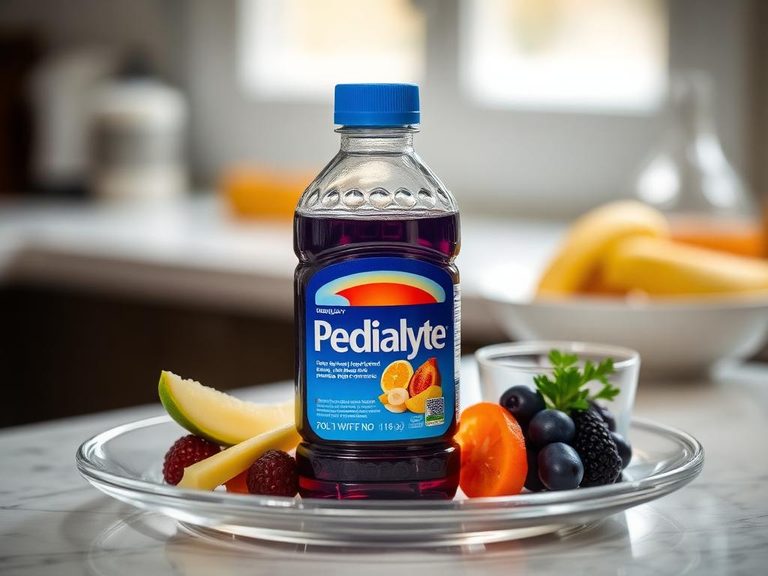
An electrolyte solution is a clear, often slightly salty or sweetened liquid designed to rapidly rehydrate the body by replacing lost fluids and essential minerals. It typically has a thin, water-like texture and a taste ranging from subtly salty to fruity, depending on the formulation. Nutritionally, it's a low-calorie source of quick energy from simple sugars and vital electrolytes like sodium and potassium.
Calorie split: 0% protein · 100% carbs · 0% fat
↓ Full nutrition💚 Why it's loved
People love it for its immediate, tangible relief from dehydration and fatigue, especially during sports or illness. Its often pleasant, light flavor makes it an easy and more effective alternative to plain water for recovery.
⚠️ Watch-outs & how to enjoy it better
The high sugar content in some versions can cause a rapid blood-sugar spike, which is a concern for individuals with diabetes or insulin resistance. Some formulations are high in sodium, which may be unsuitable for people with hypertension or certain kidney conditions. To mitigate, opt for low-sugar or sugar-free versions, check sodium content, and consider pairing with a protein-rich snack if using it for general hydration rather than intense recovery.
Key benefits
- Rapidly rehydrates the body during or after exercise, illness, or heat exposure.
- Replenishes essential electrolytes (sodium, potassium) lost through sweat or dehydration.
- Provides a quick, easily digestible source of energy from simple carbohydrates.
- Helps maintain proper fluid balance and nerve/muscle function.
🍽️ Popular dishes




🌍 Where it's eaten
💡 Did you know?
The concept for modern oral rehydration therapy was inspired by observing rice-water, a traditional home remedy for diarrhea, in Bangladesh during a 1971 cholera outbreak.
Full nutrition (USDA data · scales with serving)
| Water | 96.4 g |
| Energy | 10.0 kcal |
| Protein | 0.00 g |
| Total lipid (fat) | 0.00 g |
| Carbohydrate, by difference | 2.5 g |
| Fiber, total dietary | 0.00 g |
| Total Sugars | 2.5 g |
| Calcium, Ca | 10.0 mg |
| Iron, Fe | 0.00 mg |
| Magnesium, Mg | 1.0 mg |
| Phosphorus, P | 10.0 mg |
| Potassium, K | 77.0 mg |
| Sodium, Na | 101 mg |
| Zinc, Zn | 0.02 mg |
| Copper, Cu | 0.01 mg |
| Selenium, Se | 0.00 ug |
| Vitamin C, total ascorbic acid | 0.00 mg |
| Thiamin | 0.00 mg |
| Riboflavin | 0.00 mg |
| Niacin | 0.00 mg |
| Vitamin B-6 | 0.00 mg |
| Folate, total | 0.00 ug |
| Folic acid | 0.00 ug |
| Folate, food | 0.00 ug |
| Folate, DFE | 0.00 ug |
| Choline, total | 0.00 mg |
| Vitamin B-12 | 0.00 ug |
| Vitamin B-12, added | 0.00 ug |
| Vitamin A, RAE | 0.00 ug |
| Retinol | 0.00 ug |
| Carotene, beta | 0.00 ug |
| Carotene, alpha | 0.00 ug |
| Cryptoxanthin, beta | 0.00 ug |
| Lycopene | 0.00 ug |
| Lutein + zeaxanthin | 0.00 ug |
| Vitamin E (alpha-tocopherol) | 0.00 mg |
| Vitamin E, added | 0.00 mg |
| Vitamin D (D2 + D3) | 0.00 ug |
| Vitamin K (phylloquinone) | 0.00 ug |
| Alcohol, ethyl | 0.00 g |
| Caffeine | 0.00 mg |
| Theobromine | 0.00 mg |
Fat & fatty acid profile (per 100g)
| Fatty acids, total saturated | 0.00 g |
| SFA 4:0 | 0.00 g |
| SFA 6:0 | 0.00 g |
| SFA 8:0 | 0.00 g |
| SFA 10:0 | 0.00 g |
| SFA 12:0 | 0.00 g |
| SFA 14:0 | 0.00 g |
| SFA 16:0 | 0.00 g |
| SFA 18:0 | 0.00 g |
| Fatty acids, total monounsaturated | 0.00 g |
| MUFA 16:1 | 0.00 g |
| MUFA 18:1 | 0.00 g |
| MUFA 20:1 | 0.00 g |
| MUFA 22:1 | 0.00 g |
| Fatty acids, total polyunsaturated | 0.00 g |
| PUFA 18:2 | 0.00 g |
| PUFA 18:3 | 0.00 g |
| PUFA 18:4 | 0.00 g |
| PUFA 20:4 | 0.00 g |
| PUFA 20:5 n-3 (EPA) | 0.00 g |
| PUFA 22:5 n-3 (DPA) | 0.00 g |
| PUFA 22:6 n-3 (DHA) | 0.00 g |
| Cholesterol | 0.00 mg |
FAQ
Is an electrolyte solution the same as a sports drink?
Not exactly. All sports drinks are electrolyte solutions, but not all electrolyte solutions are sports drinks. Medical-grade ORS or Pedialyte are specifically formulated for illness-related dehydration, often with different sugar and electrolyte ratios than sports drinks designed for athletic performance.
Can I drink electrolyte solutions daily?
For most healthy people, it's unnecessary and can lead to excess calorie or sodium intake. Daily use is typically recommended only for individuals with specific medical conditions, heavy daily sweating, or under the guidance of a healthcare professional.
What's the difference between electrolyte water and regular water?
Electrolyte water has added minerals like sodium, potassium, and magnesium. Regular water hydrates but doesn't replace lost electrolytes. For light activity or daily hydration, water is sufficient; electrolyte drinks are beneficial during prolonged, intense exercise or illness.
Nutrient density (calculated · NRF9.3)
Nutrient Rich Foods index: beneficial nutrients (protein, fiber, vitamins, minerals) minus saturated fat, added sugar & sodium, per 100 kcal.
NRF9.3 index — Fulgoni, Keast & Drewnowski, 2009. Computed from USDA nutrients.
Weight-loss friendliness (composite index)
Energy density 0.10 kcal/g · 0% calories from protein · 0.0 g fiber · 2.5 g sugar per 100 g.
Composite of energy density (Rolls et al., 1999), protein & fiber satiety, minus sugar. A calculated heuristic — ranks satiety-per-calorie, not a clinical measure.
Dietary load (calculated from USDA values)
Potential renal acid load. Positive = acid-forming, negative = alkaline-forming.
Sodium-to-potassium ratio: 1.31 (lower is better — aim for ≤ 1)
Sodium:potassium per WHO potassium guidance. Computed from USDA nutrients.