

Egg salad, made with Italian dressing
Common food

Photo: Wikipedia
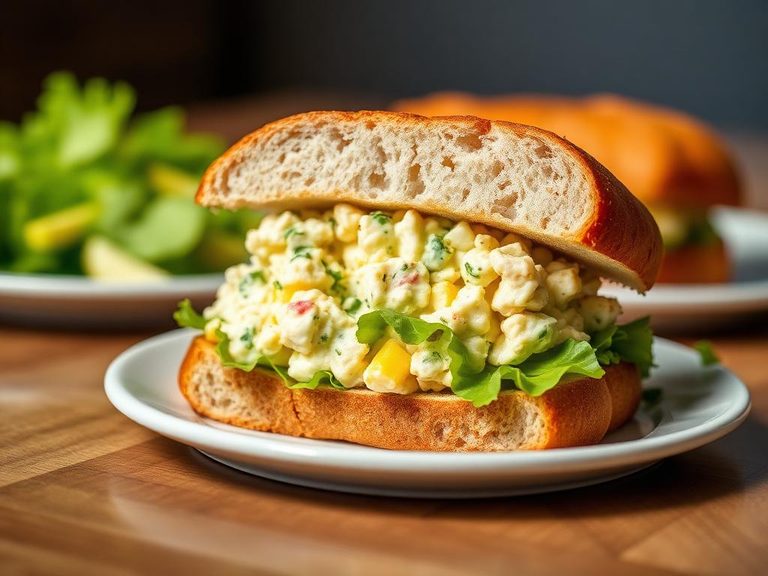
This is a creamy, savory salad where hard-boiled eggs are chopped and tossed in a zesty Italian dressing, creating a tangy twist on the classic. The texture is a satisfying mix of soft egg whites and creamy yolks, with the dressing adding a bright, herby kick. Nutritionally, it's a high-protein, low-carb option, with the fat primarily coming from the egg yolks and oil in the dressing.
Calorie split: 24% protein · 8% carbs · 68% fat
↓ Full nutrition💚 Why it's loved
People love it for its simple, nostalgic comfort combined with the unexpected zing of Italian herbs and vinegar. It's incredibly versatile, easily filling a sandwich, topping a green salad, or being scooped up with crackers.
⚠️ Watch-outs & how to enjoy it better
The main downside is the high sodium content from the Italian dressing, which can be a concern for those monitoring salt intake. It also contains common allergens like eggs and mustard (often in the dressing). To mitigate sodium, you can use a low-sodium dressing or make your own with herbs, vinegar, and a small amount of oil.
Key benefits
- Excellent source of complete protein from eggs.
- Very low in carbohydrates and sugar.
- Provides healthy fats and fat-soluble vitamins from egg yolks.
- Quick and no-cook preparation if using pre-boiled eggs.
- Versatile base for many meals and snacks.
🍽️ Popular dishes

🌍 Where it's eaten
💡 Did you know?
While mayonnaise is the traditional binder for egg salad, using Italian dressing creates a lighter, more acidic version that gained popularity in mid-20th century American potlucks as a 'quick and fancy' alternative.
Full nutrition (USDA data · scales with serving)
| Water | 72.0 g |
| Energy | 172 kcal |
| Protein | 10.0 g |
| Total lipid (fat) | 12.7 g |
| Carbohydrate, by difference | 3.4 g |
| Fiber, total dietary | 0.00 g |
| Total Sugars | 3.1 g |
| Calcium, Ca | 42.0 mg |
| Iron, Fe | 0.99 mg |
| Magnesium, Mg | 9.0 mg |
| Phosphorus, P | 139 mg |
| Potassium, K | 117 mg |
| Sodium, Na | 456 mg |
| Zinc, Zn | 0.84 mg |
| Copper, Cu | 0.01 mg |
| Selenium, Se | 24.7 ug |
| Vitamin C, total ascorbic acid | 0.10 mg |
| Thiamin | 0.06 mg |
| Riboflavin | 0.41 mg |
| Niacin | 0.08 mg |
| Vitamin B-6 | 0.11 mg |
| Folate, total | 35.0 ug |
| Folic acid | 0.00 ug |
| Folate, food | 35.0 ug |
| Folate, DFE | 35.0 ug |
| Choline, total | 233 mg |
| Vitamin B-12 | 0.88 ug |
| Vitamin B-12, added | 0.00 ug |
| Vitamin A, RAE | 118 ug |
| Retinol | 117 ug |
| Carotene, beta | 13.0 ug |
| Carotene, alpha | 0.00 ug |
| Cryptoxanthin, beta | 8.0 ug |
| Lycopene | 3.0 ug |
| Lutein + zeaxanthin | 279 ug |
| Vitamin E (alpha-tocopherol) | 1.3 mg |
| Vitamin E, added | 0.00 mg |
| Vitamin D (D2 + D3) | 1.7 ug |
| Vitamin K (phylloquinone) | 11.8 ug |
| Alcohol, ethyl | 0.00 g |
| Caffeine | 0.00 mg |
| Theobromine | 0.00 mg |
Fat & fatty acid profile (per 100g)
| Fatty acids, total saturated | 3.2 g |
| SFA 4:0 | 0.00 g |
| SFA 6:0 | 0.00 g |
| SFA 8:0 | 0.02 g |
| SFA 10:0 | 0.02 g |
| SFA 12:0 | 0.00 g |
| SFA 14:0 | 0.03 g |
| SFA 16:0 | 2.2 g |
| SFA 18:0 | 0.80 g |
| Fatty acids, total monounsaturated | 4.4 g |
| MUFA 16:1 | 0.25 g |
| MUFA 18:1 | 4.1 g |
| MUFA 20:1 | 0.05 g |
| MUFA 22:1 | 0.00 g |
| Fatty acids, total polyunsaturated | 3.3 g |
| PUFA 18:2 | 2.8 g |
| PUFA 18:3 | 0.34 g |
| PUFA 18:4 | 0.00 g |
| PUFA 20:4 | 0.12 g |
| PUFA 20:5 n-3 (EPA) | 0.00 g |
| PUFA 22:5 n-3 (DPA) | 0.00 g |
| PUFA 22:6 n-3 (DHA) | 0.03 g |
| Cholesterol | 295 mg |
FAQ
How is this different from classic egg salad?
The primary difference is the binder: Italian dressing replaces mayonnaise. This results in a tangier, less creamy, and often lower-calorie salad with a distinct herbal flavor profile.
Can I make it healthier?
Yes. Use a low-sodium or light Italian dressing. You can also mix in extra vegetables like celery, red onion, or spinach to boost fiber and volume without many calories.
How long does it keep in the fridge?
Stored in an airtight container, it should be consumed within 3-4 days. The texture may soften slightly over time.
Nutrient density (calculated · NRF9.3)
Nutrient Rich Foods index: beneficial nutrients (protein, fiber, vitamins, minerals) minus saturated fat, added sugar & sodium, per 100 kcal.
NRF9.3 index — Fulgoni, Keast & Drewnowski, 2009. Computed from USDA nutrients.
Weight-loss friendliness (composite index)
Energy density 1.72 kcal/g · 23% calories from protein · 0.0 g fiber · 3.1 g sugar per 100 g.
Composite of energy density (Rolls et al., 1999), protein & fiber satiety, minus sugar. A calculated heuristic — ranks satiety-per-calorie, not a clinical measure.
Dietary load (calculated from USDA values)
Potential renal acid load. Positive = acid-forming, negative = alkaline-forming.
Sodium-to-potassium ratio: 3.90 (lower is better — aim for ≤ 1)
Sodium:potassium per WHO potassium guidance. Computed from USDA nutrients.