

Dark chocolate candy with nuts
Common food

Photo: Wikipedia
This is a rich, indulgent confection where velvety dark chocolate meets the satisfying crunch of roasted nuts, creating a complex texture that's both smooth and hearty. With a deep, bittersweet cocoa flavor balanced by the nutty, savory notes of almonds or hazelnuts, it's a treat that feels both luxurious and substantial. Nutritionally, it's a dense source of energy, offering a notable amount of fiber and protein alongside its fats and carbs.
Calorie split: 6% protein · 37% carbs · 57% fat
↓ Full nutrition💚 Why it's loved
People adore it for the perfect harmony of rich, bittersweet chocolate and the savory, toasty crunch of nuts, making each bite a satisfying sensory experience. It's a versatile treat, enjoyed on its own, as a dessert component, or as a quick energy boost, and is deeply embedded in holiday and gifting traditions worldwide.
⚠️ Watch-outs & how to enjoy it better
Its high calorie, sugar, and fat content make it easy to overconsume, which can lead to blood-sugar spikes and is a concern for those managing weight or diabetes. As it contains common allergens like tree nuts and potentially dairy, individuals with allergies must be cautious. To enjoy mindfully, practice strict portion control (e.g., one square or a small handful), and pair it with a source of protein or fiber (like a handful of almonds or a piece of fruit) to slow sugar absorption.
Key benefits
- Provides quick energy from carbohydrates and fats
- Contains dietary fiber from nuts and cocoa
- Offers plant-based protein from nuts
- Source of antioxidants from dark cocoa
- Contains minerals like magnesium and iron from cocoa and nuts
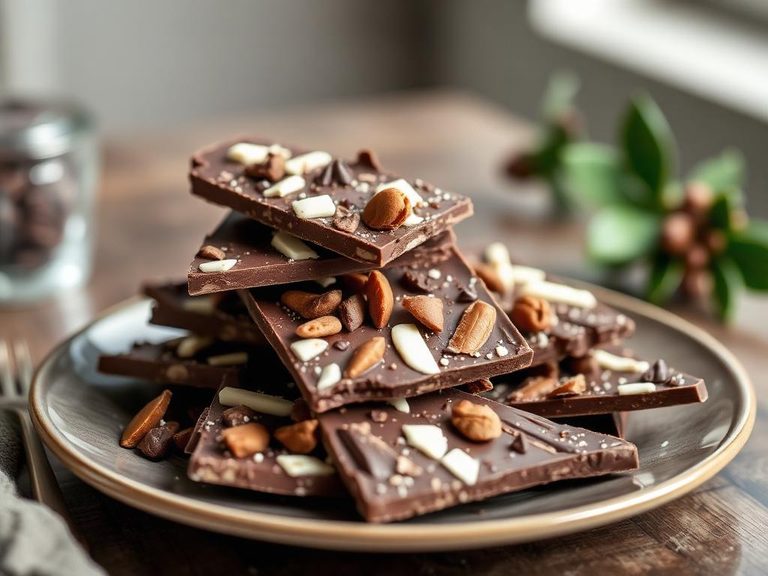
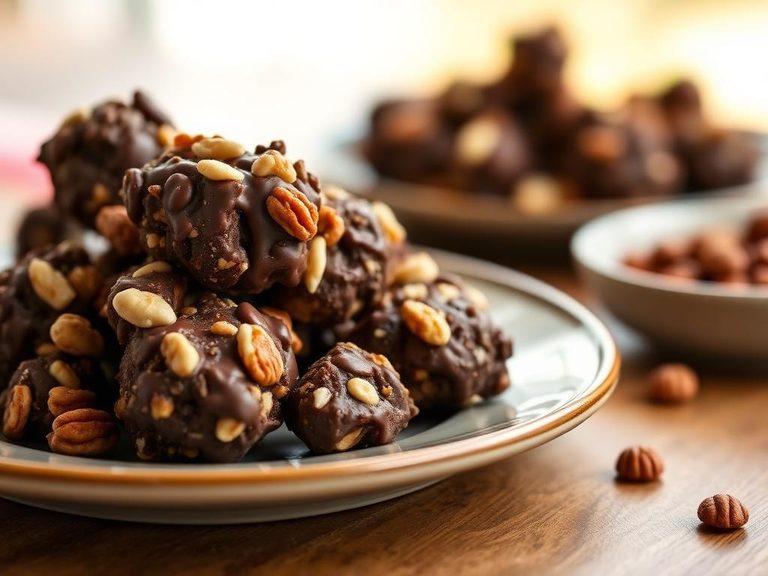
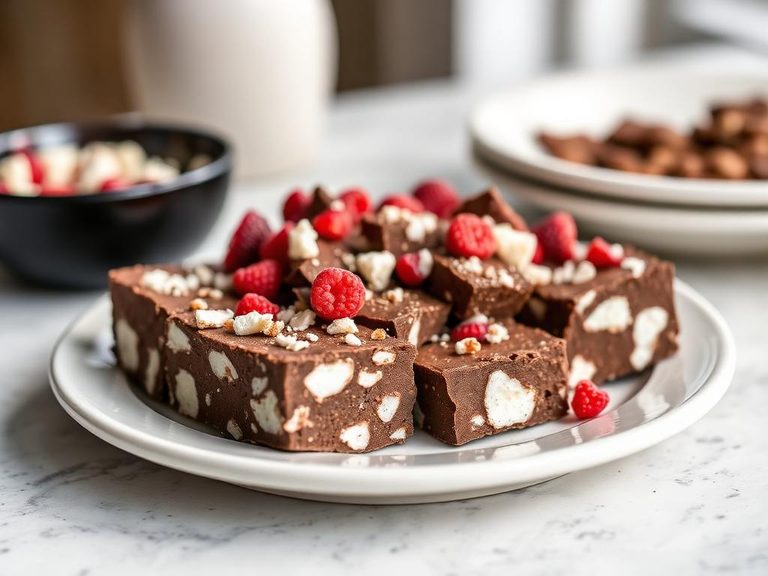
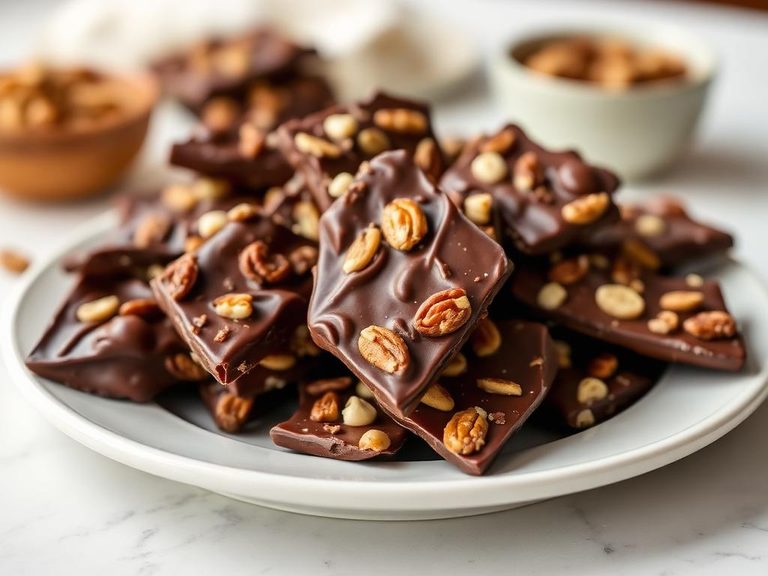
🍽️ Popular dishes


🌍 Where it's eaten
💡 Did you know?
The practice of combining chocolate with nuts became especially popular in the 19th century with the invention of the conching machine, which allowed for the smooth chocolate coating we know today, making it easier to enrobe nuts evenly.
Full nutrition (USDA data · scales with serving)
| Water | 1.3 g |
| Energy | 560 kcal |
| Protein | 8.3 g |
| Total lipid (fat) | 36.3 g |
| Carbohydrate, by difference | 52.2 g |
| Fiber, total dietary | 7.9 g |
| Total Sugars | 37.9 g |
| Calcium, Ca | 99.0 mg |
| Iron, Fe | 7.3 mg |
| Magnesium, Mg | 177 mg |
| Phosphorus, P | 265 mg |
| Potassium, K | 597 mg |
| Sodium, Na | 19.0 mg |
| Zinc, Zn | 2.4 mg |
| Copper, Cu | 1.1 mg |
| Selenium, Se | 3.2 ug |
| Vitamin C, total ascorbic acid | 0.00 mg |
| Thiamin | 0.04 mg |
| Riboflavin | 0.28 mg |
| Niacin | 1.3 mg |
| Vitamin B-6 | 0.06 mg |
| Folate, total | 11.0 ug |
| Folic acid | 0.00 ug |
| Folate, food | 11.0 ug |
| Folate, DFE | 11.0 ug |
| Choline, total | 32.5 mg |
| Vitamin B-12 | 0.18 ug |
| Vitamin B-12, added | 0.00 ug |
| Vitamin A, RAE | 2.0 ug |
| Retinol | 0.00 ug |
| Carotene, beta | 20.0 ug |
| Carotene, alpha | 6.0 ug |
| Cryptoxanthin, beta | 1.0 ug |
| Lycopene | 0.00 ug |
| Lutein + zeaxanthin | 25.0 ug |
| Vitamin E (alpha-tocopherol) | 5.2 mg |
| Vitamin E, added | 0.00 mg |
| Vitamin D (D2 + D3) | 0.00 ug |
| Vitamin K (phylloquinone) | 6.4 ug |
| Alcohol, ethyl | 0.00 g |
| Caffeine | 38.0 mg |
| Theobromine | 412 mg |
Fat & fatty acid profile (per 100g)
| Fatty acids, total saturated | 16.0 g |
| SFA 4:0 | 0.04 g |
| SFA 6:0 | 0.03 g |
| SFA 8:0 | 0.02 g |
| SFA 10:0 | 0.07 g |
| SFA 12:0 | 0.06 g |
| SFA 14:0 | 0.20 g |
| SFA 16:0 | 6.9 g |
| SFA 18:0 | 8.2 g |
| Fatty acids, total monounsaturated | 14.5 g |
| MUFA 16:1 | 0.14 g |
| MUFA 18:1 | 14.3 g |
| MUFA 20:1 | 0.02 g |
| MUFA 22:1 | 0.00 g |
| Fatty acids, total polyunsaturated | 3.5 g |
| PUFA 18:2 | 3.4 g |
| PUFA 18:3 | 0.07 g |
| PUFA 18:4 | 0.00 g |
| PUFA 20:4 | 0.00 g |
| PUFA 20:5 n-3 (EPA) | 0.00 g |
| PUFA 22:5 n-3 (DPA) | 0.00 g |
| PUFA 22:6 n-3 (DHA) | 0.00 g |
| Cholesterol | 6.0 mg |
FAQ
Is dark chocolate candy with nuts healthy?
It can be part of a balanced diet in moderation. It offers antioxidants and some nutrients, but is high in calories, sugar, and fat. The nuts add protein and healthy fats, but portion control is key.
What nuts are most commonly used?
Almonds, hazelnuts, peanuts, and pecans are very common. The choice often depends on regional preferences and the specific candy tradition.
How should I store it?
Store it in a cool, dry place (like a pantry) away from strong odors. For longer storage, keep it in an airtight container in the refrigerator, but let it come to room temperature before eating for the best flavor and texture.
Nutrient density (calculated · NRF9.3)
Nutrient Rich Foods index: beneficial nutrients (protein, fiber, vitamins, minerals) minus saturated fat, added sugar & sodium, per 100 kcal.
NRF9.3 index — Fulgoni, Keast & Drewnowski, 2009. Computed from USDA nutrients.
Weight-loss friendliness (composite index)
Energy density 5.60 kcal/g · 6% calories from protein · 7.9 g fiber · 37.9 g sugar per 100 g.
Composite of energy density (Rolls et al., 1999), protein & fiber satiety, minus sugar. A calculated heuristic — ranks satiety-per-calorie, not a clinical measure.
Dietary load (calculated from USDA values)
Potential renal acid load. Positive = acid-forming, negative = alkaline-forming.
Sodium-to-potassium ratio: 0.03 (lower is better — aim for ≤ 1)
Sodium:potassium per WHO potassium guidance. Computed from USDA nutrients.