

Dark chocolate candy
Common food
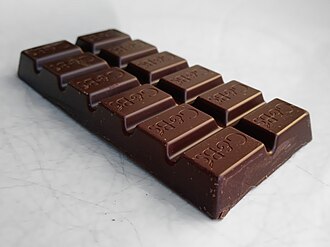
Photo: Wikipedia
Dark chocolate candy is a rich, bittersweet confection made from cocoa solids, cocoa butter, and sugar, offering a deep, complex flavor with a satisfying, smooth melt. Nutritionally dense, it provides a significant calorie boost (550 kcal per 100g) with a notable fat content (32.2g) and a surprising amount of fiber (7.2g). Its high sugar content (46.14g) is a key characteristic, balancing the intense cocoa notes.
Calorie split: 4% protein · 44% carbs · 53% fat
↓ Full nutrition💚 Why it's loved
People adore dark chocolate candy for its intense, layered flavor profile that ranges from fruity to nutty, and its luxurious, velvety texture. It's a versatile treat, enjoyed on its own, as a baking ingredient, or paired with wine and coffee, deeply embedded in global dessert and gifting cultures.
⚠️ Watch-outs & how to enjoy it better
Its high sugar (46.14g) and calorie (550 kcal) content can lead to blood-sugar spikes and is a concern for those managing weight or diabetes. To counteract this, practice strict portion control (e.g., a 1-ounce square) and pair it with a source of protein or healthy fat, like a handful of almonds or a piece of cheese, to slow sugar absorption.
Key benefits
- Rich in antioxidants like flavonoids from cocoa solids
- Provides a quick energy source from carbohydrates and fats
- Contains dietary fiber (7.2g per 100g) for digestive health
- May support mood and cognitive function through compounds like theobromine
🍽️ Popular dishes





🌍 Where it's eaten
💡 Did you know?
The cocoa butter in dark chocolate has a melting point just below human body temperature (around 34°C / 93°F), which is why it literally melts in your mouth.
Full nutrition (USDA data · scales with serving)
| Water | 1.0 g |
| Energy | 550 kcal |
| Protein | 5.1 g |
| Total lipid (fat) | 32.2 g |
| Carbohydrate, by difference | 60.0 g |
| Fiber, total dietary | 7.2 g |
| Total Sugars | 46.1 g |
| Calcium, Ca | 57.0 mg |
| Iron, Fe | 8.1 mg |
| Magnesium, Mg | 152 mg |
| Phosphorus, P | 214 mg |
| Potassium, K | 568 mg |
| Sodium, Na | 23.0 mg |
| Zinc, Zn | 2.1 mg |
| Copper, Cu | 1.1 mg |
| Selenium, Se | 3.5 ug |
| Vitamin C, total ascorbic acid | 0.00 mg |
| Thiamin | 0.03 mg |
| Riboflavin | 0.05 mg |
| Niacin | 0.75 mg |
| Vitamin B-6 | 0.04 mg |
| Folate, total | 0.00 ug |
| Folic acid | 0.00 ug |
| Folate, food | 0.00 ug |
| Folate, DFE | 0.00 ug |
| Choline, total | 27.6 mg |
| Vitamin B-12 | 0.23 ug |
| Vitamin B-12, added | 0.00 ug |
| Vitamin A, RAE | 2.0 ug |
| Retinol | 0.00 ug |
| Carotene, beta | 25.0 ug |
| Carotene, alpha | 7.0 ug |
| Cryptoxanthin, beta | 1.0 ug |
| Lycopene | 0.00 ug |
| Lutein + zeaxanthin | 31.0 ug |
| Vitamin E (alpha-tocopherol) | 0.55 mg |
| Vitamin E, added | 0.00 mg |
| Vitamin D (D2 + D3) | 0.00 ug |
| Vitamin K (phylloquinone) | 8.0 ug |
| Alcohol, ethyl | 0.00 g |
| Caffeine | 47.0 mg |
| Theobromine | 515 mg |
Fat & fatty acid profile (per 100g)
| Fatty acids, total saturated | 19.0 g |
| SFA 4:0 | 0.05 g |
| SFA 6:0 | 0.04 g |
| SFA 8:0 | 0.03 g |
| SFA 10:0 | 0.08 g |
| SFA 12:0 | 0.07 g |
| SFA 14:0 | 0.25 g |
| SFA 16:0 | 7.8 g |
| SFA 18:0 | 10.1 g |
| Fatty acids, total monounsaturated | 9.8 g |
| MUFA 16:1 | 0.11 g |
| MUFA 18:1 | 9.7 g |
| MUFA 20:1 | 0.02 g |
| MUFA 22:1 | 0.00 g |
| Fatty acids, total polyunsaturated | 1.1 g |
| PUFA 18:2 | 1.0 g |
| PUFA 18:3 | 0.08 g |
| PUFA 18:4 | 0.00 g |
| PUFA 20:4 | 0.00 g |
| PUFA 20:5 n-3 (EPA) | 0.00 g |
| PUFA 22:5 n-3 (DPA) | 0.00 g |
| PUFA 22:6 n-3 (DHA) | 0.00 g |
| Cholesterol | 7.0 mg |
FAQ
Is dark chocolate candy healthy?
It can be part of a healthy diet due to its antioxidants and fiber, but it is calorie-dense and high in sugar. Moderation is key.
How much dark chocolate should I eat per day?
A common recommendation is about 1 ounce (28g) per day, which provides the benefits without excessive calories or sugar.
Does dark chocolate contain caffeine?
Yes, dark chocolate contains caffeine and theobromine, both stimulants, though in lower amounts than coffee.
Nutrient density (calculated · NRF9.3)
Nutrient Rich Foods index: beneficial nutrients (protein, fiber, vitamins, minerals) minus saturated fat, added sugar & sodium, per 100 kcal.
NRF9.3 index — Fulgoni, Keast & Drewnowski, 2009. Computed from USDA nutrients.
Weight-loss friendliness (composite index)
Energy density 5.50 kcal/g · 4% calories from protein · 7.2 g fiber · 46.1 g sugar per 100 g.
Composite of energy density (Rolls et al., 1999), protein & fiber satiety, minus sugar. A calculated heuristic — ranks satiety-per-calorie, not a clinical measure.
Dietary load (calculated from USDA values)
Potential renal acid load. Positive = acid-forming, negative = alkaline-forming.
Sodium-to-potassium ratio: 0.04 (lower is better — aim for ≤ 1)
Sodium:potassium per WHO potassium guidance. Computed from USDA nutrients.