

Chewing gum, sugar free
Common food
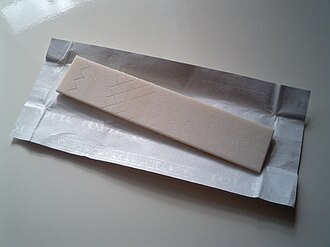
Photo: Wikipedia
Sugar-free chewing gum is a modern, engineered confection designed for prolonged chewing without the dental damage of sugar. It offers a satisfying, elastic texture and a burst of artificial or natural flavors, from classic peppermint to exotic fruit blends. Nutritionally, it is a near-zero-calorie, zero-protein, zero-fat food, with its caloric content coming almost entirely from sugar alcohols like sorbitol or xylitol.
Calorie split: 0% protein · 99% carbs · 1% fat
↓ Full nutrition💚 Why it's loved
People love it for the satisfying, rhythmic act of chewing and the immediate, long-lasting burst of flavor that freshens breath and can curb snacking urges. It's a versatile, pocket-sized habit that offers a moment of sensory pleasure or stress relief in a culture that values convenience and oral hygiene.
⚠️ Watch-outs & how to enjoy it better
The sugar alcohols (like sorbitol) used as sweeteners can cause digestive discomfort, bloating, or laxative effects in sensitive individuals, especially if consumed in large quantities. To counteract this, start with a single piece and monitor your tolerance; if you have a sensitive stomach, choose gums sweetened with stevia or other non-sugar alcohols, and always consume in moderation.
Key benefits
- Stimulates saliva production, which can help neutralize mouth acids
- Provides a sugar-free alternative to satisfy oral fixation and sweet cravings
- Often contains xylitol, which may help reduce cavity-causing bacteria
- Can improve focus or alertness through the act of chewing
- Serves as a low-calorie, portable breath freshener
🍽️ Popular dishes




🌍 Where it's eaten
💡 Did you know?
The first commercially successful sugar-free gum, Wrigley's Orbit, was actually developed during World War II as a ration-friendly gum for American soldiers, but it wasn't released to the public until 1944.
Full nutrition (USDA data · scales with serving)
| Water | 3.5 g |
| Energy | 268 kcal |
| Protein | 0.00 g |
| Total lipid (fat) | 0.40 g |
| Carbohydrate, by difference | 94.8 g |
| Fiber, total dietary | 2.4 g |
| Total Sugars | 0.00 g |
| Calcium, Ca | 20.0 mg |
| Iron, Fe | 0.00 mg |
| Magnesium, Mg | 0.00 mg |
| Phosphorus, P | 0.00 mg |
| Potassium, K | 0.00 mg |
| Sodium, Na | 7.0 mg |
| Zinc, Zn | 0.00 mg |
| Copper, Cu | 0.00 mg |
| Selenium, Se | 0.50 ug |
| Vitamin C, total ascorbic acid | 0.00 mg |
| Thiamin | 0.00 mg |
| Riboflavin | 0.00 mg |
| Niacin | 0.00 mg |
| Vitamin B-6 | 0.00 mg |
| Folate, total | 0.00 ug |
| Folic acid | 0.00 ug |
| Folate, food | 0.00 ug |
| Folate, DFE | 0.00 ug |
| Choline, total | 0.00 mg |
| Vitamin B-12 | 0.00 ug |
| Vitamin B-12, added | 0.00 ug |
| Vitamin A, RAE | 0.00 ug |
| Retinol | 0.00 ug |
| Carotene, beta | 0.00 ug |
| Carotene, alpha | 0.00 ug |
| Cryptoxanthin, beta | 0.00 ug |
| Lycopene | 0.00 ug |
| Lutein + zeaxanthin | 0.00 ug |
| Vitamin E (alpha-tocopherol) | 0.00 mg |
| Vitamin E, added | 0.00 mg |
| Vitamin D (D2 + D3) | 0.00 ug |
| Vitamin K (phylloquinone) | 0.00 ug |
| Alcohol, ethyl | 0.00 g |
| Caffeine | 0.00 mg |
| Theobromine | 0.00 mg |
Fat & fatty acid profile (per 100g)
| Fatty acids, total saturated | 0.06 g |
| SFA 4:0 | 0.00 g |
| SFA 6:0 | 0.00 g |
| SFA 8:0 | 0.00 g |
| SFA 10:0 | 0.00 g |
| SFA 12:0 | 0.00 g |
| SFA 14:0 | 0.00 g |
| SFA 16:0 | 0.04 g |
| SFA 18:0 | 0.01 g |
| Fatty acids, total monounsaturated | 0.09 g |
| MUFA 16:1 | 0.00 g |
| MUFA 18:1 | 0.09 g |
| MUFA 20:1 | 0.00 g |
| MUFA 22:1 | 0.00 g |
| Fatty acids, total polyunsaturated | 0.23 g |
| PUFA 18:2 | 0.20 g |
| PUFA 18:3 | 0.03 g |
| PUFA 18:4 | 0.00 g |
| PUFA 20:4 | 0.00 g |
| PUFA 20:5 n-3 (EPA) | 0.00 g |
| PUFA 22:5 n-3 (DPA) | 0.00 g |
| PUFA 22:6 n-3 (DHA) | 0.00 g |
| Cholesterol | 0.00 mg |
FAQ
Is sugar-free gum truly calorie-free?
No, it contains calories, typically from sugar alcohols like sorbitol or xylitol. While the body doesn't fully metabolize them, they still contribute to the total calorie count, which is why the nutritional data shows 268 kcal per 100g.
Can sugar-free gum cause digestive issues?
Yes, the sugar alcohols used as sweeteners can have a laxative effect and cause bloating or gas, especially if consumed in large amounts. It's best to stick to one or two pieces at a time.
Is sugar-free gum good for dental health?
Generally, yes. Chewing sugar-free gum, especially those sweetened with xylitol, stimulates saliva flow which helps wash away food particles and neutralize acids, potentially reducing the risk of cavities.
Nutrient density (calculated · NRF9.3)
Nutrient Rich Foods index: beneficial nutrients (protein, fiber, vitamins, minerals) minus saturated fat, added sugar & sodium, per 100 kcal.
NRF9.3 index — Fulgoni, Keast & Drewnowski, 2009. Computed from USDA nutrients.
Weight-loss friendliness (composite index)
Energy density 2.68 kcal/g · 0% calories from protein · 2.4 g fiber · 0.0 g sugar per 100 g.
Composite of energy density (Rolls et al., 1999), protein & fiber satiety, minus sugar. A calculated heuristic — ranks satiety-per-calorie, not a clinical measure.
Dietary load (calculated from USDA values)
Potential renal acid load. Positive = acid-forming, negative = alkaline-forming.
Sodium:potassium per WHO potassium guidance. Computed from USDA nutrients.