

Breakfast bars, oats, sugar, raisins, coconut (include granola bar)
Whole food · Snacks

Photo: Wikipedia
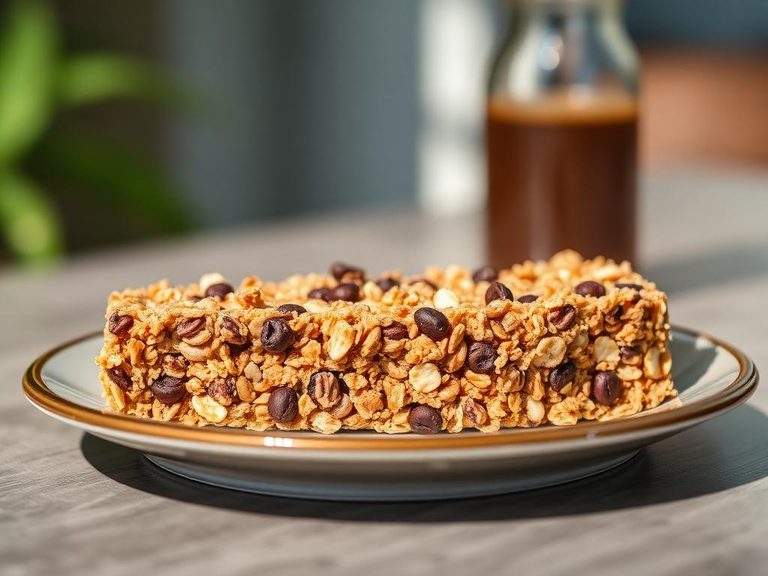
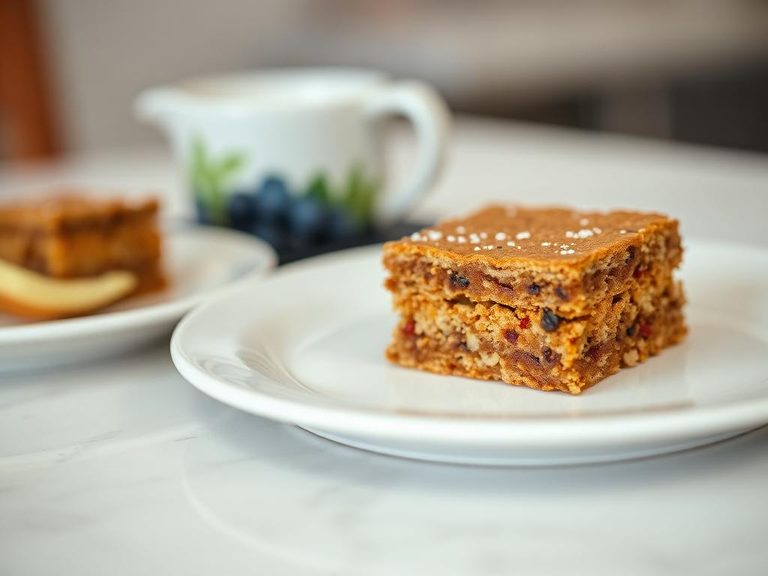
A dense, chewy bar packed with rolled oats, sweetened with sugar and raisins, and toasted with shredded coconut for a tropical crunch. It delivers a quick, energy-dense hit of carbohydrates with a satisfyingly hearty texture, making it a staple for on-the-go snacking. While high in sugar, it provides a notable 9.8g of protein per 100g to help sustain energy levels.
Calorie split: 8% protein · 57% carbs · 34% fat
↓ Full nutrition💚 Why it's loved
People love its satisfyingly chewy, crunchy texture and the sweet, comforting combination of oats, raisins, and coconut. It’s a beloved, versatile snack that fits perfectly into busy lifestyles, from hiking trails to office desks, embodying a classic, wholesome treat.
⚠️ Watch-outs & how to enjoy it better
The high sugar content (27.52g per 100g) can cause rapid blood-sugar spikes, making it less ideal for those managing diabetes or insulin resistance. To counteract this, pair it with a source of protein or healthy fat (like a handful of nuts or a cheese stick) and practice portion control by sticking to a single bar.
Key benefits
- Provides quick, sustained energy from complex carbohydrates and simple sugars
- Offers a convenient, portable source of calories and protein
- Contains dietary fiber from oats and raisins for digestive health
- Coconut adds healthy medium-chain triglycerides (MCTs) for energy
- Serves as a practical pre- or post-workout fuel source
🍽️ Popular dishes
🌍 Where it's eaten
💡 Did you know?
The modern granola bar was popularized in the 1970s by the Quaker Oats Company, which sought a convenient way to sell its oatmeal in a portable format.
Full nutrition (USDA data · scales with serving)
| Water | 4.1 g |
| Energy | 464 kcal |
| Energy | 1943 kj |
| Protein | 9.8 g |
| Total lipid (fat) | 17.6 g |
| Ash | 1.8 g |
| Carbohydrate, by difference | 66.7 g |
| Fiber, total dietary | 3.1 g |
| Total Sugars | 27.5 g |
| Calcium, Ca | 60.0 mg |
| Iron, Fe | 3.2 mg |
| Magnesium, Mg | 101 mg |
| Phosphorus, P | 277 mg |
| Potassium, K | 326 mg |
| Sodium, Na | 251 mg |
| Zinc, Zn | 1.6 mg |
| Copper, Cu | 0.36 mg |
| Selenium, Se | 16.0 ug |
| Vitamin C, total ascorbic acid | 1.0 mg |
| Thiamin | 0.28 mg |
| Riboflavin | 0.11 mg |
| Niacin | 1.8 mg |
| Vitamin B-6 | 0.35 mg |
| Folate, total | 81.0 ug |
| Folic acid | 0.00 ug |
| Folate, food | 81.0 ug |
| Folate, DFE | 81.0 ug |
| Choline, total | 27.6 mg |
| Vitamin B-12 | 0.00 ug |
| Vitamin B-12, added | 0.00 ug |
| Vitamin A, RAE | 8.0 ug |
| Retinol | 0.00 ug |
| Carotene, beta | 91.0 ug |
| Carotene, alpha | 0.00 ug |
| Cryptoxanthin, beta | 0.00 ug |
| Vitamin A, IU | 152 iu |
| Lycopene | 0.00 ug |
| Lutein + zeaxanthin | 107 ug |
| Vitamin E (alpha-tocopherol) | 0.82 mg |
| Vitamin E, added | 0.00 mg |
| Vitamin D (D2 + D3), International Units | 0.00 iu |
| Vitamin D (D2 + D3) | 0.00 ug |
| Vitamin K (phylloquinone) | 15.9 ug |
| Alcohol, ethyl | 0.00 g |
| Caffeine | 0.00 mg |
| Theobromine | 0.00 mg |
Fat & fatty acid profile (per 100g)
| Fatty acids, total saturated | 12.7 g |
| SFA 4:0 | 0.00 g |
| SFA 6:0 | 0.08 g |
| SFA 8:0 | 1.0 g |
| SFA 10:0 | 0.80 g |
| SFA 12:0 | 6.1 g |
| SFA 14:0 | 2.4 g |
| SFA 16:0 | 1.7 g |
| SFA 18:0 | 0.56 g |
| Fatty acids, total monounsaturated | 1.9 g |
| MUFA 16:1 | 0.01 g |
| MUFA 18:1 | 1.9 g |
| MUFA 20:1 | 0.00 g |
| MUFA 22:1 | 0.00 g |
| Fatty acids, total polyunsaturated | 1.6 g |
| PUFA 18:2 | 1.6 g |
| PUFA 18:3 | 0.01 g |
| PUFA 18:4 | 0.00 g |
| PUFA 20:4 | 0.00 g |
| PUFA 20:5 n-3 (EPA) | 0.00 g |
| PUFA 22:5 n-3 (DPA) | 0.00 g |
| PUFA 22:6 n-3 (DHA) | 0.00 g |
| Cholesterol | 0.00 mg |
FAQ
Is a breakfast bar a healthy breakfast option?
It can be part of a balanced breakfast, but its high sugar content means it should be paired with protein (like yogurt or eggs) and fiber-rich foods to prevent energy crashes and provide sustained nutrition.
How does the fiber content compare to other breakfast foods?
At 3.1g per 100g, it provides some fiber from oats and raisins, but is lower than whole fruits or vegetables. It's a moderate source, not a high-fiber choice.
Can it be part of a weight management plan?
Due to its high calorie density (464 kcal/100g), portion control is key. It's best used as an occasional energy boost rather than a daily staple, and should be accounted for within your daily calorie goals.
Nutrient density (calculated · NRF9.3)
Nutrient Rich Foods index: beneficial nutrients (protein, fiber, vitamins, minerals) minus saturated fat, added sugar & sodium, per 100 kcal.
NRF9.3 index — Fulgoni, Keast & Drewnowski, 2009. Computed from USDA nutrients.
Weight-loss friendliness (composite index)
Energy density 4.64 kcal/g · 8% calories from protein · 3.1 g fiber · 27.5 g sugar per 100 g.
Composite of energy density (Rolls et al., 1999), protein & fiber satiety, minus sugar. A calculated heuristic — ranks satiety-per-calorie, not a clinical measure.
Dietary load (calculated from USDA values)
Potential renal acid load. Positive = acid-forming, negative = alkaline-forming.
Sodium-to-potassium ratio: 0.77 (lower is better — aim for ≤ 1)
Sodium:potassium per WHO potassium guidance. Computed from USDA nutrients.