

Beef and noodles, no sauce
Common food

Photo: Wikipedia
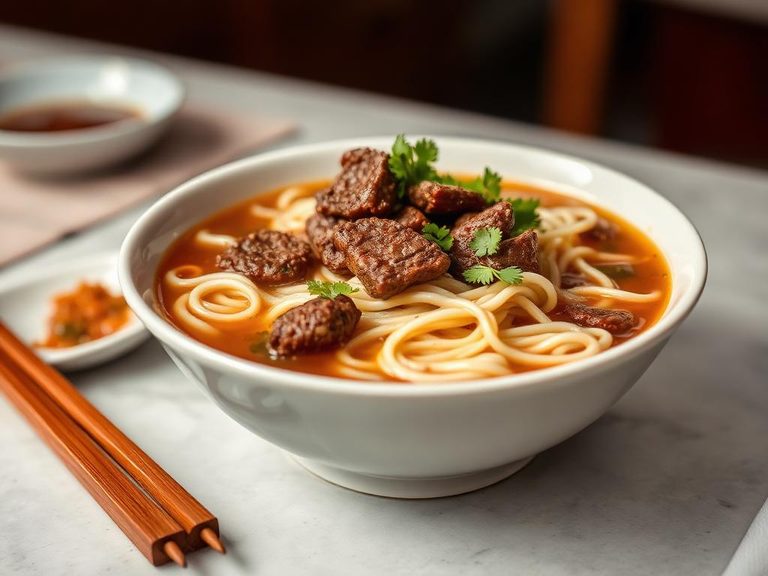
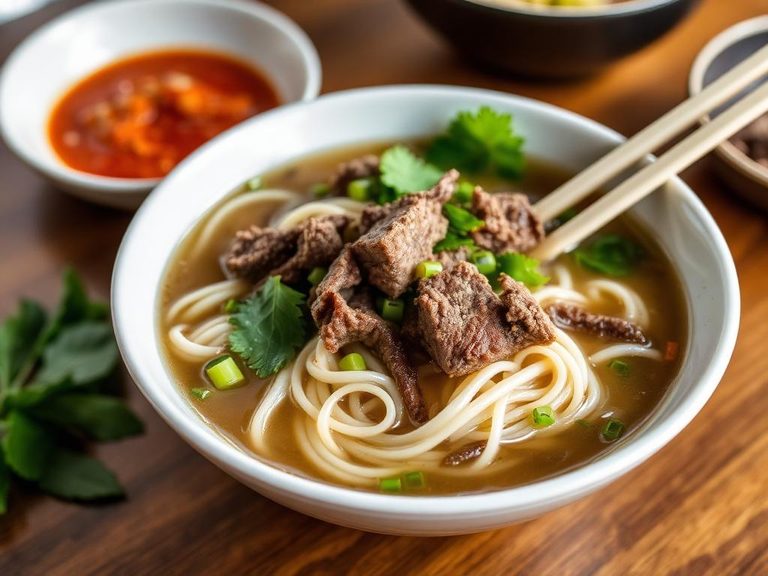
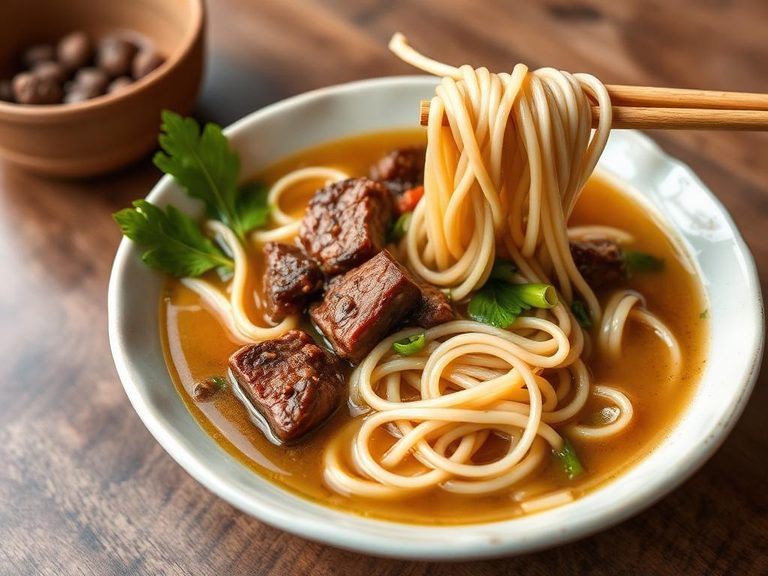
This is a simple, hearty dish of tender beef slices and soft wheat noodles served in a clear broth, without a heavy sauce. The texture is a satisfying contrast between the chewy noodles and the melt-in-your-mouth beef. Nutritionally, it's a balanced, protein-rich meal that provides sustained energy without excessive fat.
Calorie split: 24% protein · 35% carbs · 41% fat
↓ Full nutrition💚 Why it's loved
People love it for its comforting, savory simplicity and the pure, clean flavors of beef and wheat. It's a versatile base that can be customized with countless toppings, making it a beloved staple in many Asian cuisines.
⚠️ Watch-outs & how to enjoy it better
The dish can be high in sodium from the broth, which may concern those monitoring salt intake. The noodles are a refined carbohydrate, which can cause faster blood sugar spikes. To counteract, pair with extra vegetables or a side of pickled radish for fiber, and opt for a low-sodium broth or ask for broth on the side to control intake.
Key benefits
- High-quality protein source for muscle maintenance.
- Provides complex carbohydrates for steady energy.
- Lower in fat compared to saucy or fried noodle dishes.
- Broth-based preparation can aid hydration.
- A complete, balanced meal in a single bowl.
🍽️ Popular dishes
🌍 Where it's eaten
💡 Did you know?
The practice of slicing beef thinly for quick cooking in broth is a technique perfected in Chinese cuisine to conserve fuel, as thin slices cook in the time it takes to boil water.
Full nutrition (USDA data · scales with serving)
| Water | 62.6 g |
| Energy | 189 kcal |
| Protein | 11.4 g |
| Total lipid (fat) | 8.4 g |
| Carbohydrate, by difference | 16.2 g |
| Fiber, total dietary | 0.80 g |
| Total Sugars | 0.26 g |
| Calcium, Ca | 16.0 mg |
| Iron, Fe | 1.8 mg |
| Magnesium, Mg | 20.0 mg |
| Phosphorus, P | 113 mg |
| Potassium, K | 125 mg |
| Sodium, Na | 377 mg |
| Zinc, Zn | 2.5 mg |
| Copper, Cu | 0.09 mg |
| Selenium, Se | 22.5 ug |
| Vitamin C, total ascorbic acid | 0.00 mg |
| Thiamin | 0.20 mg |
| Riboflavin | 0.15 mg |
| Niacin | 3.0 mg |
| Vitamin B-6 | 0.15 mg |
| Folate, total | 57.0 ug |
| Folic acid | 50.0 ug |
| Folate, food | 8.0 ug |
| Folate, DFE | 92.0 ug |
| Choline, total | 43.3 mg |
| Vitamin B-12 | 0.95 ug |
| Vitamin B-12, added | 0.00 ug |
| Vitamin A, RAE | 20.0 ug |
| Retinol | 19.0 ug |
| Carotene, beta | 12.0 ug |
| Carotene, alpha | 0.00 ug |
| Cryptoxanthin, beta | 0.00 ug |
| Lycopene | 0.00 ug |
| Lutein + zeaxanthin | 24.0 ug |
| Vitamin E (alpha-tocopherol) | 0.32 mg |
| Vitamin E, added | 0.00 mg |
| Vitamin D (D2 + D3) | 0.10 ug |
| Vitamin K (phylloquinone) | 2.3 ug |
| Alcohol, ethyl | 0.00 g |
| Caffeine | 0.00 mg |
| Theobromine | 0.00 mg |
Fat & fatty acid profile (per 100g)
| Fatty acids, total saturated | 2.7 g |
| SFA 4:0 | 0.00 g |
| SFA 6:0 | 0.00 g |
| SFA 8:0 | 0.00 g |
| SFA 10:0 | 0.00 g |
| SFA 12:0 | 0.00 g |
| SFA 14:0 | 0.16 g |
| SFA 16:0 | 1.6 g |
| SFA 18:0 | 0.82 g |
| Fatty acids, total monounsaturated | 3.6 g |
| MUFA 16:1 | 0.23 g |
| MUFA 18:1 | 3.2 g |
| MUFA 20:1 | 0.02 g |
| MUFA 22:1 | 0.00 g |
| Fatty acids, total polyunsaturated | 0.98 g |
| PUFA 18:2 | 0.88 g |
| PUFA 18:3 | 0.07 g |
| PUFA 18:4 | 0.00 g |
| PUFA 20:4 | 0.02 g |
| PUFA 20:5 n-3 (EPA) | 0.00 g |
| PUFA 22:5 n-3 (DPA) | 0.00 g |
| PUFA 22:6 n-3 (DHA) | 0.00 g |
| Cholesterol | 48.0 mg |
FAQ
Is beef and noodles a good post-workout meal?
Yes, it can be. The beef provides protein for muscle repair, and the noodles offer carbohydrates to replenish glycogen stores. For optimal recovery, ensure the portion of noodles is substantial and consider adding some vegetables.
How is it different from beef noodle soup?
The terms are often used interchangeably. 'Beef and noodles, no sauce' specifically describes a clear broth-based dish, distinguishing it from versions with a thick, dark soy-based or tomato-based sauce.
Can I make it healthier at home?
Absolutely. Use lean cuts of beef, whole wheat or alternative grain noodles, a low-sodium broth, and load it with fresh vegetables like bok choy, carrots, and spinach to boost fiber and micronutrient content.
Nutrient density (calculated · NRF9.3)
Nutrient Rich Foods index: beneficial nutrients (protein, fiber, vitamins, minerals) minus saturated fat, added sugar & sodium, per 100 kcal.
NRF9.3 index — Fulgoni, Keast & Drewnowski, 2009. Computed from USDA nutrients.
Weight-loss friendliness (composite index)
Energy density 1.89 kcal/g · 24% calories from protein · 0.8 g fiber · 0.3 g sugar per 100 g.
Composite of energy density (Rolls et al., 1999), protein & fiber satiety, minus sugar. A calculated heuristic — ranks satiety-per-calorie, not a clinical measure.
Dietary load (calculated from USDA values)
Potential renal acid load. Positive = acid-forming, negative = alkaline-forming.
Sodium-to-potassium ratio: 3.02 (lower is better — aim for ≤ 1)
Sodium:potassium per WHO potassium guidance. Computed from USDA nutrients.