

Alfredo sauce with meat
Common food

Photo: Wikipedia
Alfredo sauce with meat is a decadent, creamy Italian-American staple that coats pasta in a velvety, rich blanket of butter, cheese, and savory protein. It boasts a luxurious, high-fat profile with a subtle savory depth, making it a calorie-dense comfort food. This sauce is a powerhouse of dietary fat and provides a moderate protein boost, though it is notably low in carbohydrates and fiber.
Calorie split: 15% protein · 3% carbs · 81% fat
↓ Full nutrition💚 Why it's loved
People adore Alfredo sauce with meat for its indulgent, creamy texture and the comforting, savory flavor that feels like a true treat. Its versatility makes it a go-to for transforming simple pasta into a hearty, satisfying meal that appeals to a wide range of palates.
⚠️ Watch-outs & how to enjoy it better
The high fat and calorie density can be a concern for those monitoring their intake, and the lack of fiber may not promote optimal digestion. To counteract this, pair it with a large side of roasted vegetables or a leafy green salad to add fiber and volume, and practice portion control by using it as a coating rather than a pool for your pasta.
Key benefits
- Provides a concentrated source of dietary fat for sustained energy
- Offers a moderate protein boost from the added meat
- Extremely low in carbohydrates and sugars
- Serves as a versatile, quick-to-prepare sauce base for various proteins
- Delivers a satisfying, rich mouthfeel that enhances meal satiety
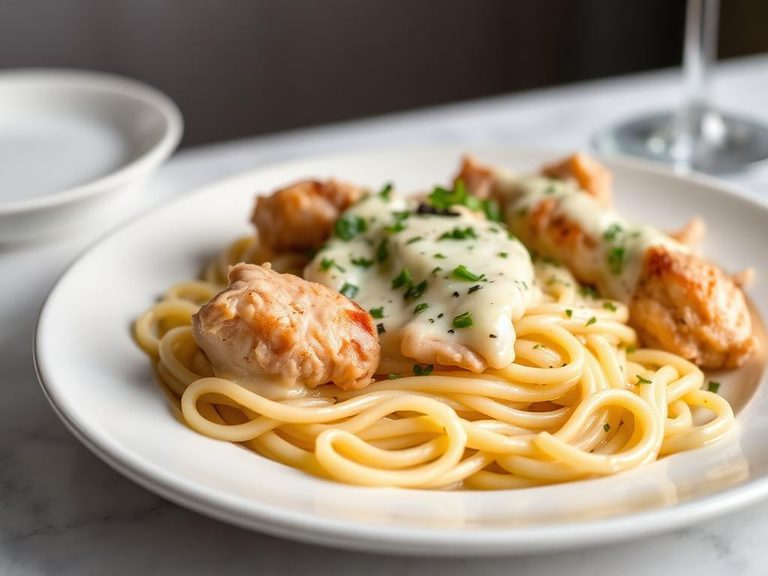
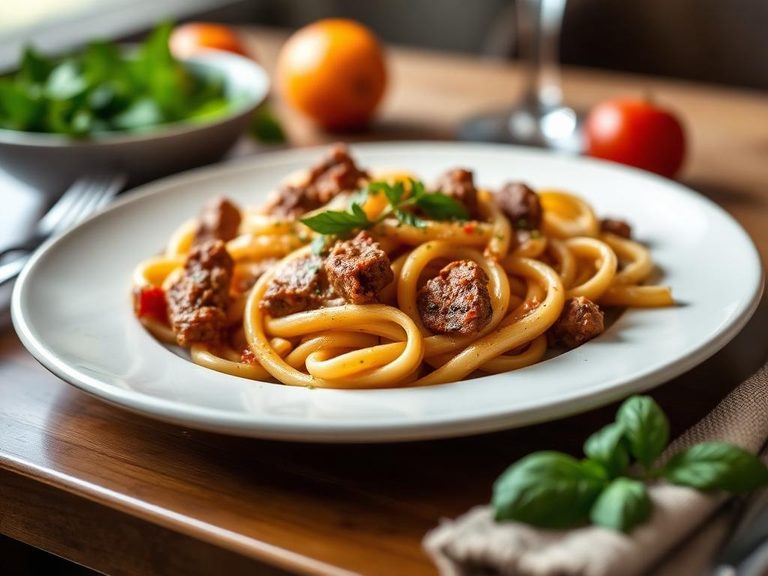
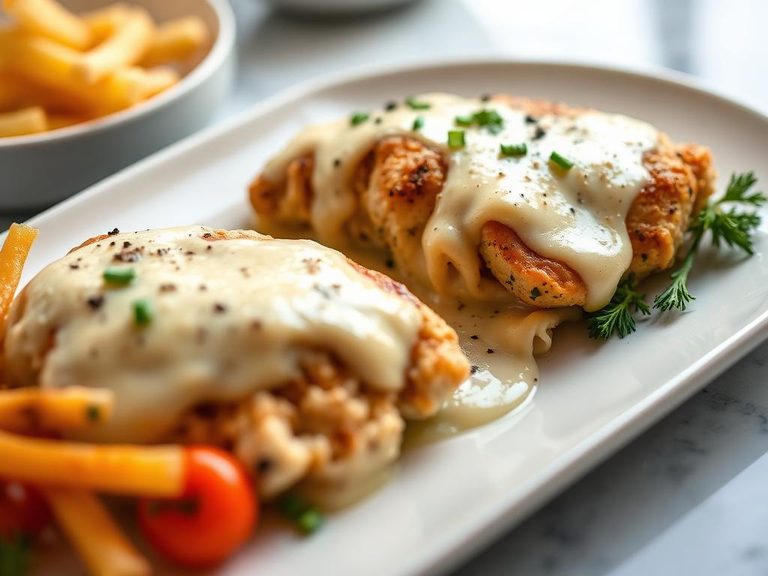
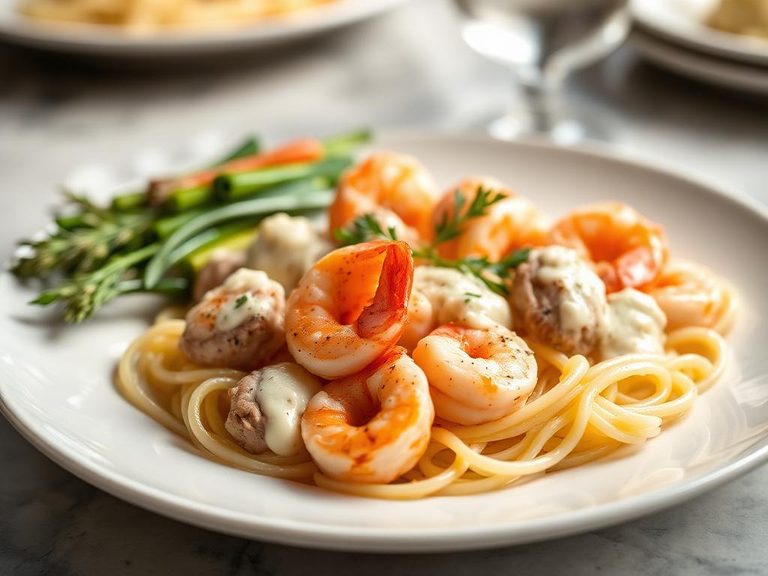
🍽️ Popular dishes
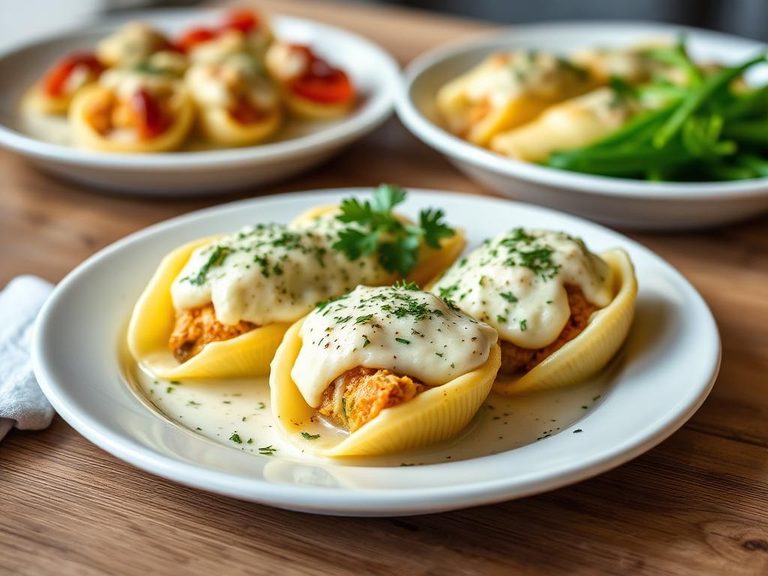
🌍 Where it's eaten
💡 Did you know?
The original Alfredo sauce, created by Alfredo di Lelio in Rome, contained only butter and Parmesan cheese, with no cream or meat at all.
Full nutrition (USDA data · scales with serving)
| Water | 75.1 g |
| Energy | 171 kcal |
| Protein | 6.5 g |
| Total lipid (fat) | 15.3 g |
| Carbohydrate, by difference | 1.4 g |
| Fiber, total dietary | 0.00 g |
| Total Sugars | 0.73 g |
| Calcium, Ca | 58.0 mg |
| Iron, Fe | 0.48 mg |
| Magnesium, Mg | 7.0 mg |
| Phosphorus, P | 76.0 mg |
| Potassium, K | 89.0 mg |
| Sodium, Na | 520 mg |
| Zinc, Zn | 1.4 mg |
| Copper, Cu | 0.02 mg |
| Selenium, Se | 6.2 ug |
| Vitamin C, total ascorbic acid | 0.10 mg |
| Thiamin | 0.02 mg |
| Riboflavin | 0.09 mg |
| Niacin | 0.97 mg |
| Vitamin B-6 | 0.08 mg |
| Folate, total | 3.0 ug |
| Folic acid | 0.00 ug |
| Folate, food | 3.0 ug |
| Folate, DFE | 3.0 ug |
| Choline, total | 20.3 mg |
| Vitamin B-12 | 0.56 ug |
| Vitamin B-12, added | 0.00 ug |
| Vitamin A, RAE | 111 ug |
| Retinol | 111 ug |
| Carotene, beta | 5.0 ug |
| Carotene, alpha | 0.00 ug |
| Cryptoxanthin, beta | 0.00 ug |
| Lycopene | 0.00 ug |
| Lutein + zeaxanthin | 0.00 ug |
| Vitamin E (alpha-tocopherol) | 0.27 mg |
| Vitamin E, added | 0.00 mg |
| Vitamin D (D2 + D3) | 0.40 ug |
| Vitamin K (phylloquinone) | 1.4 ug |
| Alcohol, ethyl | 0.00 g |
| Caffeine | 0.00 mg |
| Theobromine | 0.00 mg |
Fat & fatty acid profile (per 100g)
| Fatty acids, total saturated | 8.1 g |
| SFA 4:0 | 0.26 g |
| SFA 6:0 | 0.21 g |
| SFA 8:0 | 0.13 g |
| SFA 10:0 | 0.30 g |
| SFA 12:0 | 0.36 g |
| SFA 14:0 | 1.2 g |
| SFA 16:0 | 3.9 g |
| SFA 18:0 | 1.5 g |
| Fatty acids, total monounsaturated | 3.9 g |
| MUFA 16:1 | 0.32 g |
| MUFA 18:1 | 3.8 g |
| MUFA 20:1 | 0.03 g |
| MUFA 22:1 | 0.00 g |
| Fatty acids, total polyunsaturated | 0.60 g |
| PUFA 18:2 | 0.37 g |
| PUFA 18:3 | 0.06 g |
| PUFA 18:4 | 0.00 g |
| PUFA 20:4 | 0.03 g |
| PUFA 20:5 n-3 (EPA) | 0.00 g |
| PUFA 22:5 n-3 (DPA) | 0.01 g |
| PUFA 22:6 n-3 (DHA) | 0.00 g |
| Cholesterol | 52.0 mg |
FAQ
Is Alfredo sauce with meat considered a healthy food?
It is a high-fat, calorie-dense sauce that provides protein but lacks fiber and micronutrients. It can be part of a balanced diet in moderation, but it is not typically classified as a 'health food' due to its saturated fat content.
What is the best way to store leftover Alfredo sauce with meat?
Store it in an airtight container in the refrigerator for up to 3-4 days. Reheat gently on the stovetop or in the microwave, adding a splash of milk or cream if it becomes too thick.
Can I make a lighter version of Alfredo sauce with meat?
Yes, you can substitute heavy cream with a mixture of milk and cornstarch, use reduced-fat cheese, and choose lean meats like turkey or chicken breast. Adding pureed cauliflower or white beans can also thicken the sauce while adding fiber.
Nutrient density (calculated · NRF9.3)
Nutrient Rich Foods index: beneficial nutrients (protein, fiber, vitamins, minerals) minus saturated fat, added sugar & sodium, per 100 kcal.
NRF9.3 index — Fulgoni, Keast & Drewnowski, 2009. Computed from USDA nutrients.
Weight-loss friendliness (composite index)
Energy density 1.71 kcal/g · 15% calories from protein · 0.0 g fiber · 0.7 g sugar per 100 g.
Composite of energy density (Rolls et al., 1999), protein & fiber satiety, minus sugar. A calculated heuristic — ranks satiety-per-calorie, not a clinical measure.
Dietary load (calculated from USDA values)
Potential renal acid load. Positive = acid-forming, negative = alkaline-forming.
Sodium-to-potassium ratio: 5.84 (lower is better — aim for ≤ 1)
Sodium:potassium per WHO potassium guidance. Computed from USDA nutrients.