

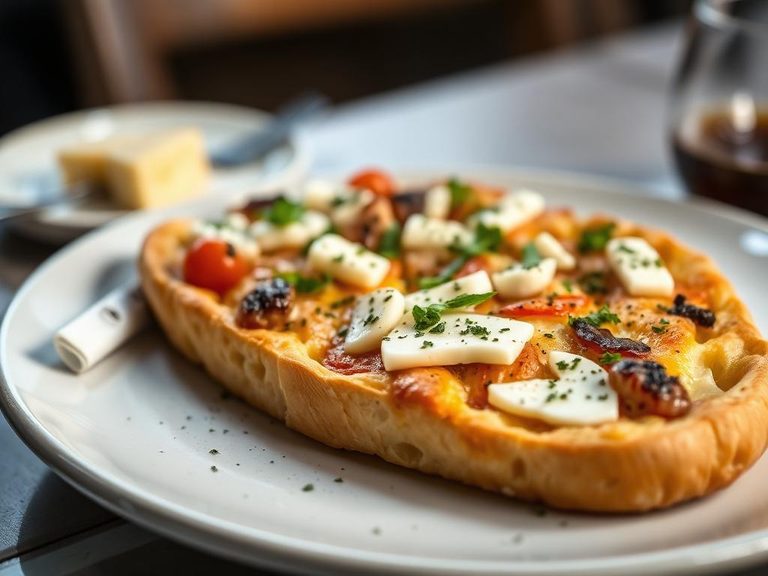
White pizza, cheese, with vegetables, thin crust
Common food
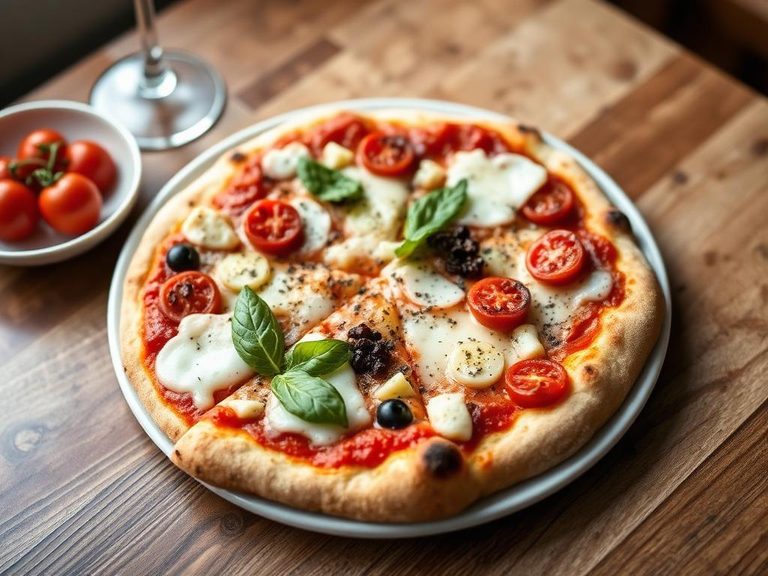
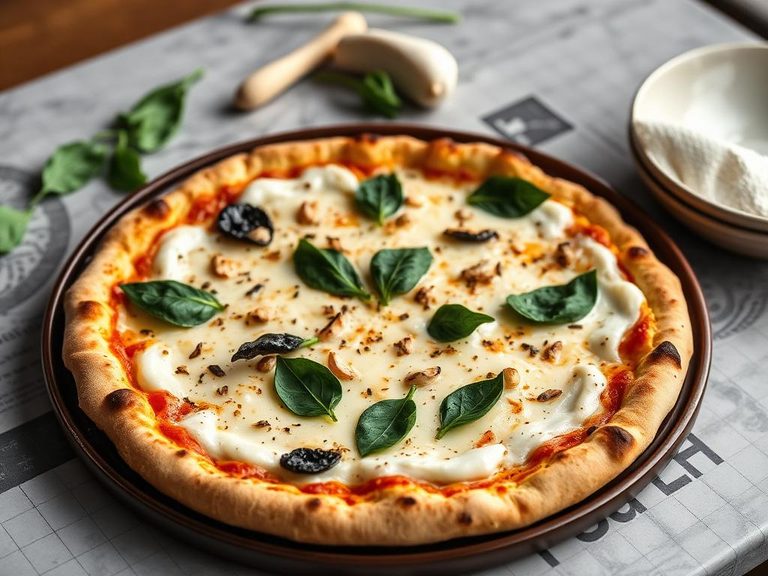
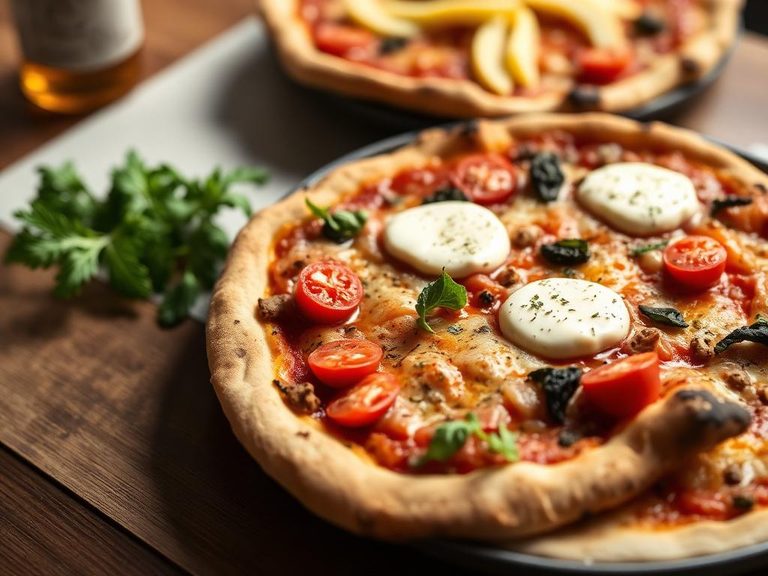
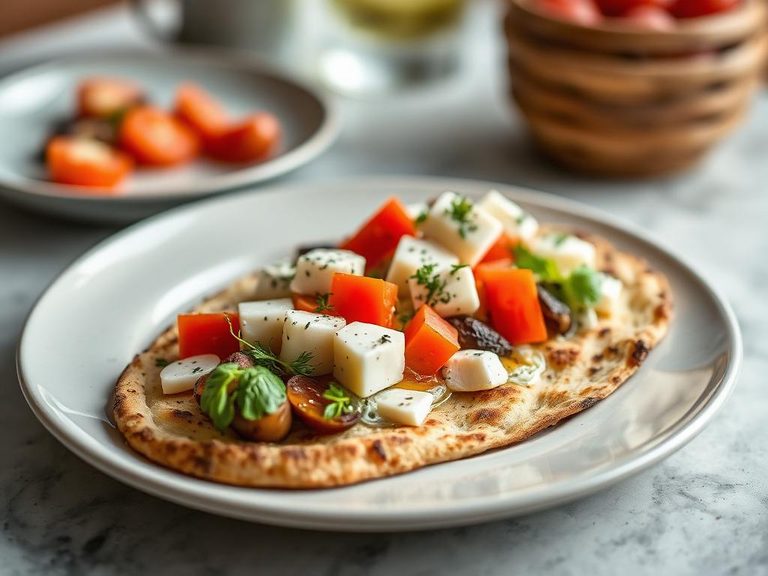
A white pizza with cheese and vegetables on a thin crust is a light, crisp alternative to its tomato-sauced cousin. The thin base provides a satisfying crunch, while the melted cheese offers a creamy, savory layer that lets the flavors of fresh vegetables like spinach, mushrooms, or bell peppers shine. Nutritionally, it delivers a moderate protein boost from the cheese, with the carbs coming primarily from the refined flour crust.
Calorie split: 17% protein · 39% carbs · 44% fat
↓ Full nutrition💚 Why it's loved
People adore it for the pure, rich flavor of melted cheese and garlic-infused olive oil, which creates a savory, umami-rich experience. Its simplicity and versatility make it a crowd-pleaser, easily customized with seasonal vegetables.
⚠️ Watch-outs & how to enjoy it better
The refined flour crust can cause a rapid blood-sugar spike, and the cheese is high in saturated fat and sodium. Those with lactose intolerance or gluten sensitivities should be cautious. To counteract this, pair a slice with a large side salad dressed with vinegar to slow digestion, and be mindful of portion size.
Key benefits
- Provides calcium and protein from the cheese topping.
- Thin crust reduces overall carbohydrate load compared to thick-crust versions.
- Vegetable toppings add fiber, vitamins, and antioxidants.
- Can be a lighter, lower-calorie pizza option when portion-controlled.
🍽️ Popular dishes
🌍 Where it's eaten
💡 Did you know?
Authentic Roman 'Pizza Bianca' is often sold by weight from large, rectangular trays and eaten folded in half as street food, with no cheese at all—just dough, olive oil, and salt.
Full nutrition (USDA data · scales with serving)
| Water | 52.5 g |
| Energy | 241 kcal |
| Protein | 10.1 g |
| Total lipid (fat) | 11.7 g |
| Carbohydrate, by difference | 23.6 g |
| Fiber, total dietary | 1.2 g |
| Total Sugars | 2.9 g |
| Calcium, Ca | 226 mg |
| Iron, Fe | 2.0 mg |
| Magnesium, Mg | 21.0 mg |
| Phosphorus, P | 176 mg |
| Potassium, K | 131 mg |
| Sodium, Na | 466 mg |
| Zinc, Zn | 1.2 mg |
| Copper, Cu | 0.09 mg |
| Selenium, Se | 13.6 ug |
| Vitamin C, total ascorbic acid | 4.9 mg |
| Thiamin | 0.21 mg |
| Riboflavin | 0.25 mg |
| Niacin | 2.0 mg |
| Vitamin B-6 | 0.10 mg |
| Folate, total | 45.0 ug |
| Folic acid | 27.0 ug |
| Folate, food | 43.0 ug |
| Folate, DFE | 64.0 ug |
| Choline, total | 11.7 mg |
| Vitamin B-12 | 0.24 ug |
| Vitamin B-12, added | 0.00 ug |
| Vitamin A, RAE | 61.0 ug |
| Retinol | 58.0 ug |
| Carotene, beta | 31.0 ug |
| Carotene, alpha | 2.0 ug |
| Cryptoxanthin, beta | 1.0 ug |
| Lycopene | 0.00 ug |
| Lutein + zeaxanthin | 82.0 ug |
| Vitamin E (alpha-tocopherol) | 1.3 mg |
| Vitamin E, added | 0.00 mg |
| Vitamin D (D2 + D3) | 0.10 ug |
| Vitamin K (phylloquinone) | 3.5 ug |
| Alcohol, ethyl | 0.00 g |
| Caffeine | 0.00 mg |
| Theobromine | 0.00 mg |
Fat & fatty acid profile (per 100g)
| Fatty acids, total saturated | 4.3 g |
| SFA 4:0 | 0.12 g |
| SFA 6:0 | 0.09 g |
| SFA 8:0 | 0.06 g |
| SFA 10:0 | 0.14 g |
| SFA 12:0 | 0.17 g |
| SFA 14:0 | 0.54 g |
| SFA 16:0 | 2.3 g |
| SFA 18:0 | 0.75 g |
| Fatty acids, total monounsaturated | 4.9 g |
| MUFA 16:1 | 0.15 g |
| MUFA 18:1 | 4.8 g |
| MUFA 20:1 | 0.03 g |
| MUFA 22:1 | 0.00 g |
| Fatty acids, total polyunsaturated | 1.2 g |
| PUFA 18:2 | 1.1 g |
| PUFA 18:3 | 0.11 g |
| PUFA 18:4 | 0.00 g |
| PUFA 20:4 | 0.01 g |
| PUFA 20:5 n-3 (EPA) | 0.00 g |
| PUFA 22:5 n-3 (DPA) | 0.00 g |
| PUFA 22:6 n-3 (DHA) | 0.00 g |
| Cholesterol | 20.0 mg |
FAQ
What makes a pizza a 'white pizza'?
A white pizza (pizza bianca) is defined by the absence of a tomato-based sauce. Instead, it typically uses a base of olive oil, garlic, and often a creamy element like ricotta or a generous layer of mozzarella cheese.
Is thin-crust white pizza healthier than regular pizza?
It can be, primarily because the thinner crust means fewer calories and carbohydrates per slice. However, the healthiness depends heavily on the amount and type of cheese used and the portion size.
What are the best vegetables to put on a white pizza?
Popular choices include spinach, mushrooms, roasted garlic, artichoke hearts, bell peppers, and zucchini. These vegetables add flavor, texture, and nutrients without making the pizza too watery.
Nutrient density (calculated · NRF9.3)
Nutrient Rich Foods index: beneficial nutrients (protein, fiber, vitamins, minerals) minus saturated fat, added sugar & sodium, per 100 kcal.
NRF9.3 index — Fulgoni, Keast & Drewnowski, 2009. Computed from USDA nutrients.
Weight-loss friendliness (composite index)
Energy density 2.41 kcal/g · 17% calories from protein · 1.2 g fiber · 2.9 g sugar per 100 g.
Composite of energy density (Rolls et al., 1999), protein & fiber satiety, minus sugar. A calculated heuristic — ranks satiety-per-calorie, not a clinical measure.
Dietary load (calculated from USDA values)
Potential renal acid load. Positive = acid-forming, negative = alkaline-forming.
Sodium-to-potassium ratio: 3.56 (lower is better — aim for ≤ 1)
Sodium:potassium per WHO potassium guidance. Computed from USDA nutrients.