

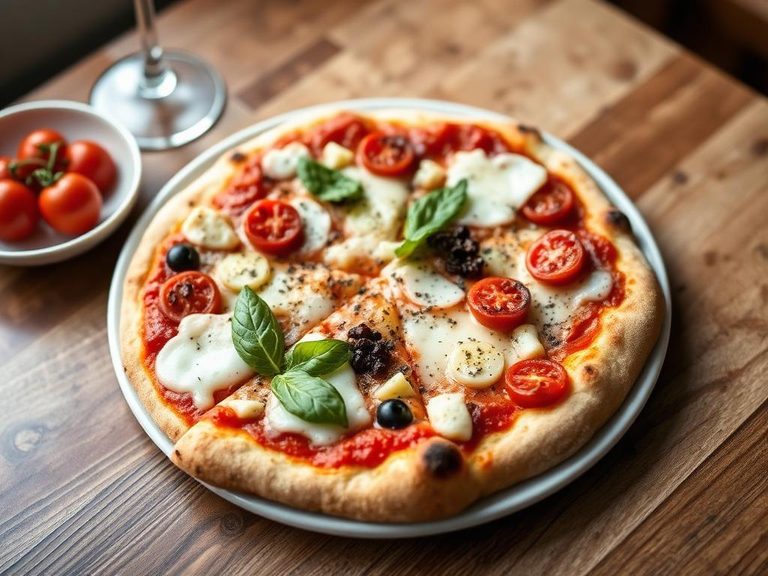
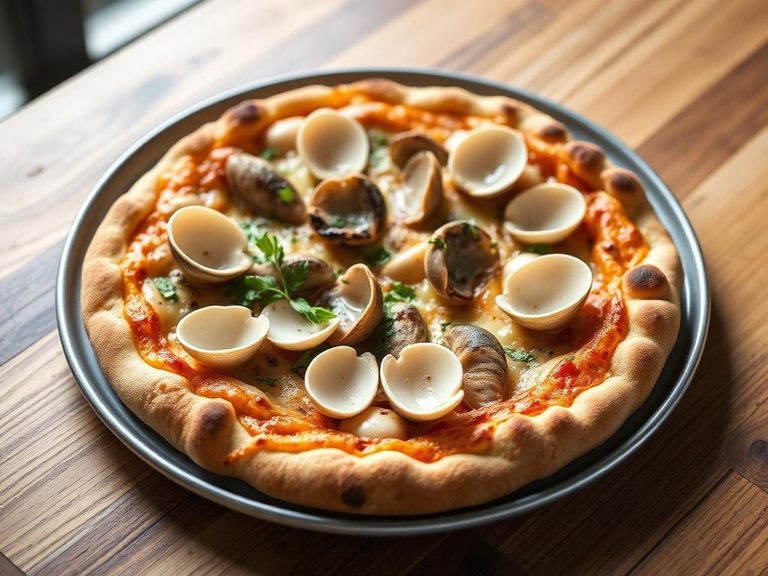
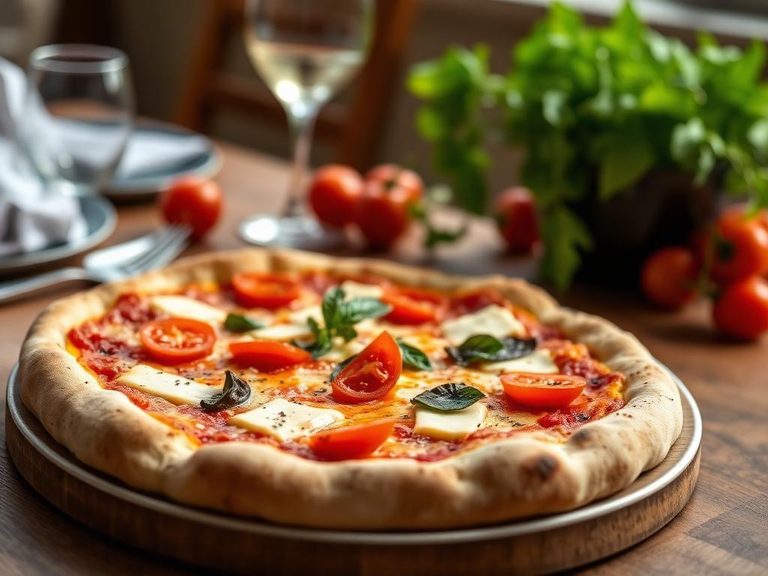
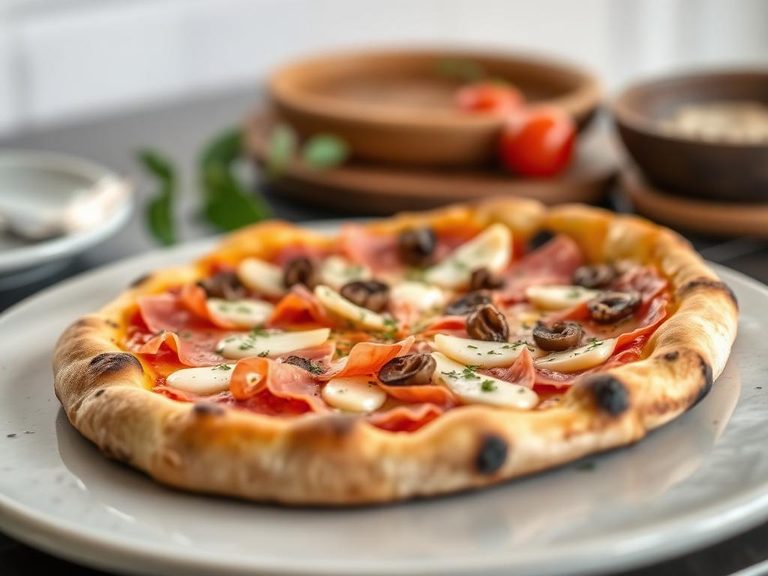
White pizza, cheese, with meat, thin crust
Common food
This is a white pizza, meaning it uses a garlic and olive oil base instead of tomato sauce, topped with a blend of cheeses like mozzarella and ricotta, and finished with savory meat toppings like Italian sausage or prosciutto on a thin, crispy crust. The first bite offers a satisfying crunch followed by a rich, salty, and umami-packed flavor from the melted cheese and meat, with a subtle garlic aroma. Nutritionally, it's a calorie-dense option, providing a solid protein boost from the cheese and meat, but it's also high in fat and sodium.
Calorie split: 18% protein · 30% carbs · 52% fat
↓ Full nutrition💚 Why it's loved
People love it for the pure, unadulterated savory richness of cheese and meat without the acidity of tomato sauce, allowing the quality of the dairy and toppings to shine. It's a beloved comfort food that's often seen as a more adult or sophisticated alternative to classic pepperoni, perfect for sharing.
⚠️ Watch-outs & how to enjoy it better
The combination of refined flour crust, high-fat cheese, and processed meats can lead to a significant blood-sugar spike and is very high in sodium and saturated fat. To counteract this, pair a smaller slice with a large, vinegar-dressed green salad to add fiber and slow digestion, and be mindful of portion size.
Key benefits
- High in protein for muscle maintenance.
- Provides calcium from cheese for bone health.
- Thin crust can mean fewer refined carbs than deep-dish versions.
- The fat content aids in the absorption of fat-soluble vitamins.
🍽️ Popular dishes
🌍 Where it's eaten
💡 Did you know?
The classic Roman 'Pizza Bianca' is often just olive oil, salt, and rosemary on dough, and was historically sold by weight, not by the slice.
Full nutrition (USDA data · scales with serving)
| Water | 43.8 g |
| Energy | 304 kcal |
| Protein | 13.6 g |
| Total lipid (fat) | 17.4 g |
| Carbohydrate, by difference | 22.8 g |
| Fiber, total dietary | 0.90 g |
| Total Sugars | 2.6 g |
| Calcium, Ca | 224 mg |
| Iron, Fe | 1.8 mg |
| Magnesium, Mg | 23.0 mg |
| Phosphorus, P | 203 mg |
| Potassium, K | 165 mg |
| Sodium, Na | 622 mg |
| Zinc, Zn | 1.6 mg |
| Copper, Cu | 0.08 mg |
| Selenium, Se | 18.1 ug |
| Vitamin C, total ascorbic acid | 0.10 mg |
| Thiamin | 0.26 mg |
| Riboflavin | 0.30 mg |
| Niacin | 3.0 mg |
| Vitamin B-6 | 0.14 mg |
| Folate, total | 44.0 ug |
| Folic acid | 28.0 ug |
| Folate, food | 42.0 ug |
| Folate, DFE | 63.0 ug |
| Choline, total | 21.4 mg |
| Vitamin B-12 | 0.45 ug |
| Vitamin B-12, added | 0.00 ug |
| Vitamin A, RAE | 62.0 ug |
| Retinol | 62.0 ug |
| Carotene, beta | 0.00 ug |
| Carotene, alpha | 0.00 ug |
| Cryptoxanthin, beta | 0.00 ug |
| Lycopene | 0.00 ug |
| Lutein + zeaxanthin | 19.0 ug |
| Vitamin E (alpha-tocopherol) | 1.3 mg |
| Vitamin E, added | 0.00 mg |
| Vitamin D (D2 + D3) | 0.30 ug |
| Vitamin K (phylloquinone) | 3.1 ug |
| Alcohol, ethyl | 0.00 g |
| Caffeine | 0.00 mg |
| Theobromine | 0.00 mg |
Fat & fatty acid profile (per 100g)
| Fatty acids, total saturated | 6.5 g |
| SFA 4:0 | 0.12 g |
| SFA 6:0 | 0.10 g |
| SFA 8:0 | 0.06 g |
| SFA 10:0 | 0.15 g |
| SFA 12:0 | 0.17 g |
| SFA 14:0 | 0.66 g |
| SFA 16:0 | 3.6 g |
| SFA 18:0 | 1.5 g |
| Fatty acids, total monounsaturated | 7.2 g |
| MUFA 16:1 | 0.31 g |
| MUFA 18:1 | 6.9 g |
| MUFA 20:1 | 0.08 g |
| MUFA 22:1 | 0.00 g |
| Fatty acids, total polyunsaturated | 2.1 g |
| PUFA 18:2 | 1.9 g |
| PUFA 18:3 | 0.14 g |
| PUFA 18:4 | 0.00 g |
| PUFA 20:4 | 0.03 g |
| PUFA 20:5 n-3 (EPA) | 0.00 g |
| PUFA 22:5 n-3 (DPA) | 0.01 g |
| PUFA 22:6 n-3 (DHA) | 0.00 g |
| Cholesterol | 36.0 mg |
FAQ
Why is it called 'white' pizza?
It's called 'white' because it lacks the traditional red tomato sauce, relying instead on a base of olive oil, garlic, and sometimes ricotta or béchamel.
Is white pizza healthier than regular pizza?
Not necessarily. While it avoids the sugar in some tomato sauces, it is typically much higher in fat and calories from the generous cheese and oil base.
What's the best meat topping for a white pizza?
Classic choices include crumbled Italian sausage, prosciutto added after baking, or crispy pancetta, as their strong, salty flavors complement the rich cheese base.
Nutrient density (calculated · NRF9.3)
Nutrient Rich Foods index: beneficial nutrients (protein, fiber, vitamins, minerals) minus saturated fat, added sugar & sodium, per 100 kcal.
NRF9.3 index — Fulgoni, Keast & Drewnowski, 2009. Computed from USDA nutrients.
Weight-loss friendliness (composite index)
Energy density 3.04 kcal/g · 18% calories from protein · 0.9 g fiber · 2.6 g sugar per 100 g.
Composite of energy density (Rolls et al., 1999), protein & fiber satiety, minus sugar. A calculated heuristic — ranks satiety-per-calorie, not a clinical measure.
Dietary load (calculated from USDA values)
Potential renal acid load. Positive = acid-forming, negative = alkaline-forming.
Sodium-to-potassium ratio: 3.77 (lower is better — aim for ≤ 1)
Sodium:potassium per WHO potassium guidance. Computed from USDA nutrients.