

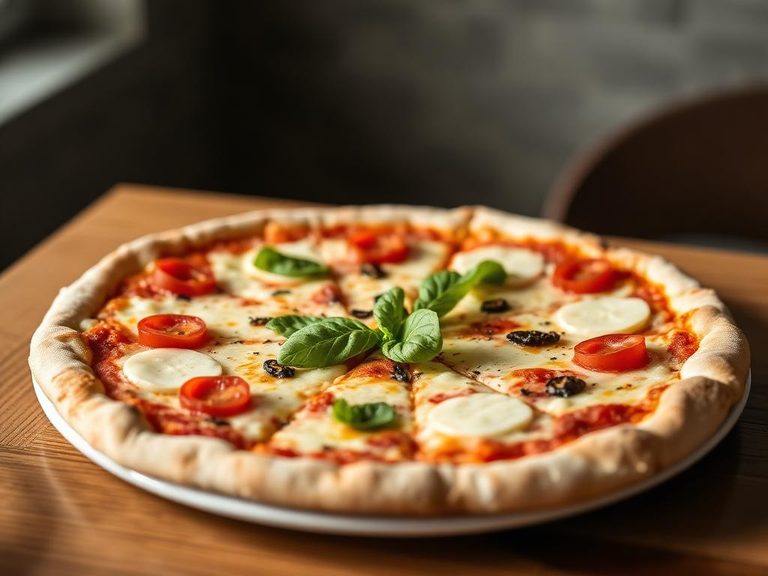
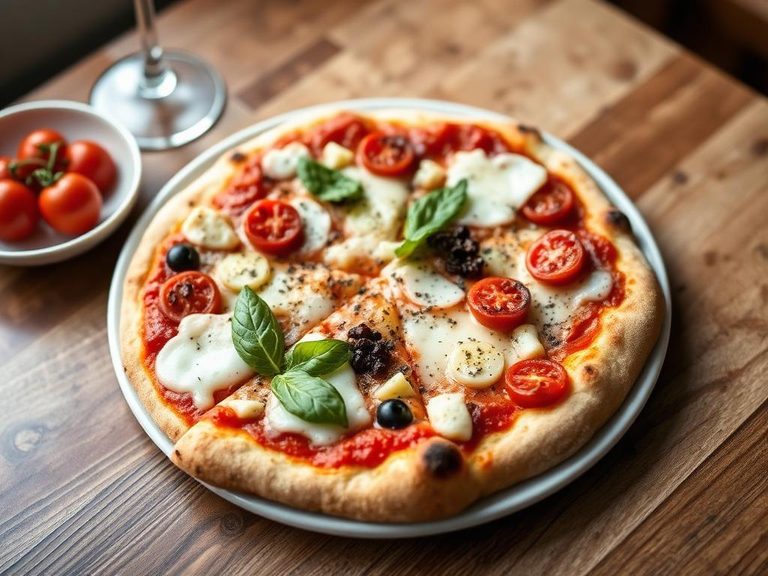
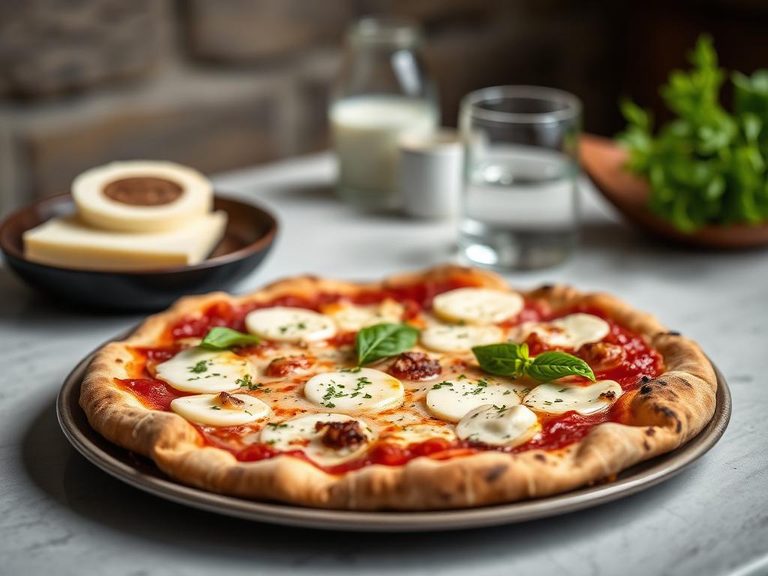
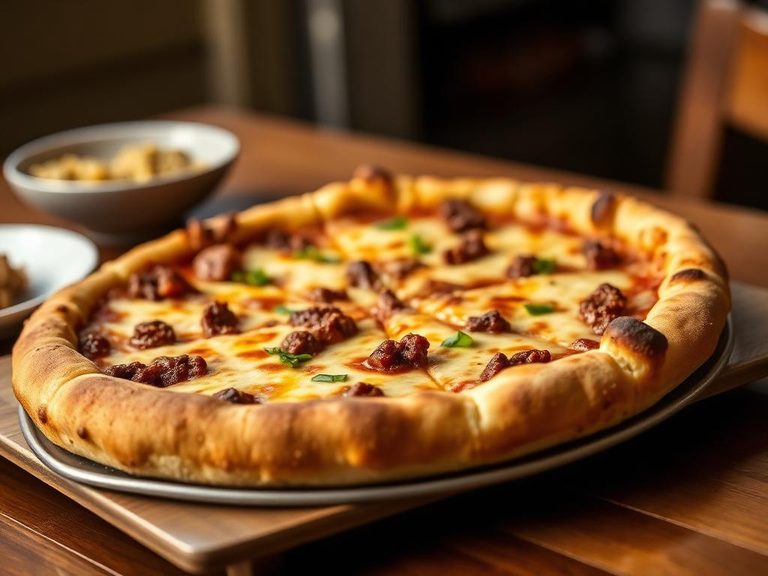
White pizza, cheese, with meat, thick crust
Common food
A thick, doughy crust supports a rich blend of melted cheeses—typically mozzarella, provolone, and Parmesan—without a traditional tomato sauce, creating a creamy, savory base. Often topped with savory meats like sausage, pepperoni, or bacon, each bite offers a satisfying chew from the crust and a salty, umami-packed flavor from the cheese and meat. With nearly 15g of fat and a hearty calorie count per 100g, it's a decadent, energy-dense meal.
Calorie split: 18% protein · 37% carbs · 45% fat
↓ Full nutrition💚 Why it's loved
People love it for the indulgent, comforting combination of gooey, melted cheese and savory meat on a chewy, bready base. It's a customizable classic that satisfies deep cravings for salt, fat, and carbohydrates in one convenient, shareable package.
⚠️ Watch-outs & how to enjoy it better
The thick crust and high-fat cheese can lead to a heavy, calorie-dense meal that may cause sluggishness or blood-sugar spikes. Those monitoring sodium intake or with gluten or dairy sensitivities should exercise caution. To counteract, pair a smaller portion with a large, vinegar-dressed green salad to add fiber and volume, and ensure the meat topping is a leaner option like grilled chicken.
Key benefits
- Provides a significant source of protein for muscle maintenance.
- Offers calcium from the cheese blend for bone health.
- Delivers quick energy from its carbohydrate-rich crust.
- Can be a good source of B vitamins, especially B12, from meat toppings.
🍽️ Popular dishes
🌍 Where it's eaten
💡 Did you know?
The 'white pizza' (pizza bianca) predates the tomato-topped pizza, as tomatoes were not introduced to Italian cuisine until the 16th century.
Full nutrition (USDA data · scales with serving)
| Water | 42.7 g |
| Energy | 296 kcal |
| Protein | 12.8 g |
| Total lipid (fat) | 14.8 g |
| Carbohydrate, by difference | 27.2 g |
| Fiber, total dietary | 1.1 g |
| Total Sugars | 3.0 g |
| Calcium, Ca | 203 mg |
| Iron, Fe | 2.1 mg |
| Magnesium, Mg | 23.0 mg |
| Phosphorus, P | 184 mg |
| Potassium, K | 158 mg |
| Sodium, Na | 621 mg |
| Zinc, Zn | 1.5 mg |
| Copper, Cu | 0.08 mg |
| Selenium, Se | 17.9 ug |
| Vitamin C, total ascorbic acid | 0.10 mg |
| Thiamin | 0.29 mg |
| Riboflavin | 0.30 mg |
| Niacin | 3.3 mg |
| Vitamin B-6 | 0.13 mg |
| Folate, total | 52.0 ug |
| Folic acid | 34.0 ug |
| Folate, food | 50.0 ug |
| Folate, DFE | 76.0 ug |
| Choline, total | 20.2 mg |
| Vitamin B-12 | 0.37 ug |
| Vitamin B-12, added | 0.00 ug |
| Vitamin A, RAE | 51.0 ug |
| Retinol | 51.0 ug |
| Carotene, beta | 0.00 ug |
| Carotene, alpha | 0.00 ug |
| Cryptoxanthin, beta | 0.00 ug |
| Lycopene | 0.00 ug |
| Lutein + zeaxanthin | 24.0 ug |
| Vitamin E (alpha-tocopherol) | 1.1 mg |
| Vitamin E, added | 0.00 mg |
| Vitamin D (D2 + D3) | 0.30 ug |
| Vitamin K (phylloquinone) | 3.1 ug |
| Alcohol, ethyl | 0.00 g |
| Caffeine | 0.00 mg |
| Theobromine | 0.00 mg |
Fat & fatty acid profile (per 100g)
| Fatty acids, total saturated | 5.5 g |
| SFA 4:0 | 0.10 g |
| SFA 6:0 | 0.08 g |
| SFA 8:0 | 0.05 g |
| SFA 10:0 | 0.13 g |
| SFA 12:0 | 0.14 g |
| SFA 14:0 | 0.54 g |
| SFA 16:0 | 3.0 g |
| SFA 18:0 | 1.2 g |
| Fatty acids, total monounsaturated | 6.0 g |
| MUFA 16:1 | 0.26 g |
| MUFA 18:1 | 5.8 g |
| MUFA 20:1 | 0.07 g |
| MUFA 22:1 | 0.00 g |
| Fatty acids, total polyunsaturated | 1.9 g |
| PUFA 18:2 | 1.7 g |
| PUFA 18:3 | 0.14 g |
| PUFA 18:4 | 0.00 g |
| PUFA 20:4 | 0.03 g |
| PUFA 20:5 n-3 (EPA) | 0.00 g |
| PUFA 22:5 n-3 (DPA) | 0.01 g |
| PUFA 22:6 n-3 (DHA) | 0.00 g |
| Cholesterol | 30.0 mg |
FAQ
Why is it called 'white' pizza if it has meat on it?
The 'white' refers to the absence of a red tomato sauce base. The color comes from the generous layer of white cheeses like mozzarella and ricotta.
Is this pizza type healthier than a standard pepperoni pizza?
It can be slightly lower in sugar and acidity from lacking tomato sauce, but the thick crust and generous cheese often mean a similar or higher fat and calorie content. The nutritional difference depends heavily on the specific recipe and portion size.
What's the best way to reheat leftover thick-crust white pizza?
For the crispiest crust, reheat slices in a skillet over medium-low heat with a lid on, or in an oven at 375°F (190°C) for 10 minutes. A toaster oven also works well. Avoid the microwave, which will make the crust tough and chewy.
Nutrient density (calculated · NRF9.3)
Nutrient Rich Foods index: beneficial nutrients (protein, fiber, vitamins, minerals) minus saturated fat, added sugar & sodium, per 100 kcal.
NRF9.3 index — Fulgoni, Keast & Drewnowski, 2009. Computed from USDA nutrients.
Weight-loss friendliness (composite index)
Energy density 2.96 kcal/g · 17% calories from protein · 1.1 g fiber · 3.0 g sugar per 100 g.
Composite of energy density (Rolls et al., 1999), protein & fiber satiety, minus sugar. A calculated heuristic — ranks satiety-per-calorie, not a clinical measure.
Dietary load (calculated from USDA values)
Potential renal acid load. Positive = acid-forming, negative = alkaline-forming.
Sodium-to-potassium ratio: 3.93 (lower is better — aim for ≤ 1)
Sodium:potassium per WHO potassium guidance. Computed from USDA nutrients.