

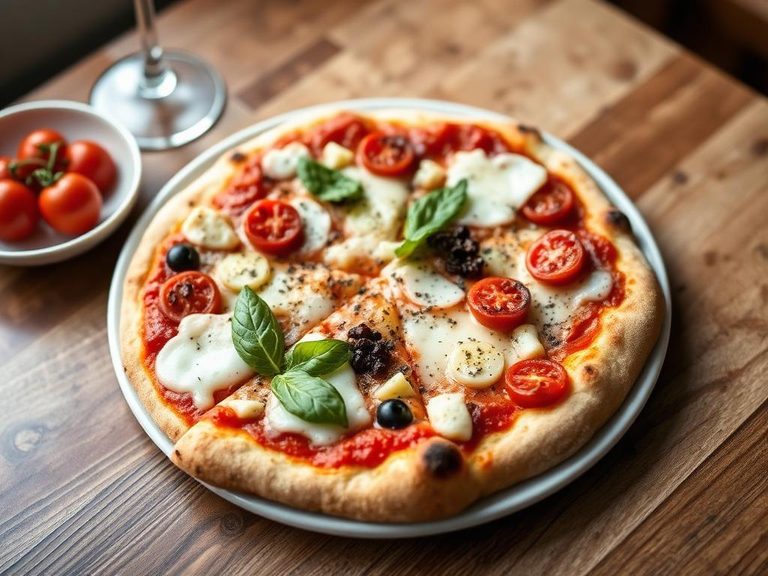
White pizza, cheese, with meat and vegetables, thick crust
Common food

Photo: Wikipedia
A hearty, thick-crust white pizza loaded with savory meats and fresh vegetables, all blanketed in a rich layer of melted cheese. The crust offers a satisfying chew, while the toppings provide a savory, salty contrast. At 270 kcal per 100g, it delivers a substantial protein punch from the cheese and meat.
Calorie split: 17% protein · 38% carbs · 45% fat
↓ Full nutrition💚 Why it's loved
People love it for the comforting combination of gooey cheese, savory meat, and the satisfying texture of a thick, chewy crust. It's a versatile crowd-pleaser, perfect for sharing and customizing with favorite toppings.
⚠️ Watch-outs & how to enjoy it better
The thick crust and cheese can make it high in refined carbs and saturated fat, potentially causing blood-sugar spikes or heaviness. To counteract, pair a smaller slice with a large, leafy green salad to add fiber and volume, and choose leaner meats like grilled chicken.
Key benefits
- Good source of protein for muscle maintenance
- Provides calcium from the cheese
- Contains vegetables for added vitamins
- Energy-dense, suitable for active lifestyles
- Satisfying and filling due to protein and fat content
🍽️ Popular dishes

🌍 Where it's eaten
💡 Did you know?
The 'white pizza' (pizza bianca) traditionally has no tomato sauce, a style that dates back to the earliest pizzas in Naples before tomatoes from the Americas became a common ingredient.
Full nutrition (USDA data · scales with serving)
| Water | 47.4 g |
| Energy | 270 kcal |
| Protein | 11.7 g |
| Total lipid (fat) | 13.3 g |
| Carbohydrate, by difference | 25.3 g |
| Fiber, total dietary | 1.1 g |
| Total Sugars | 3.1 g |
| Calcium, Ca | 184 mg |
| Iron, Fe | 1.9 mg |
| Magnesium, Mg | 22.0 mg |
| Phosphorus, P | 168 mg |
| Potassium, K | 159 mg |
| Sodium, Na | 559 mg |
| Zinc, Zn | 1.4 mg |
| Copper, Cu | 0.08 mg |
| Selenium, Se | 16.2 ug |
| Vitamin C, total ascorbic acid | 3.7 mg |
| Thiamin | 0.27 mg |
| Riboflavin | 0.28 mg |
| Niacin | 3.0 mg |
| Vitamin B-6 | 0.14 mg |
| Folate, total | 48.0 ug |
| Folic acid | 31.0 ug |
| Folate, food | 46.0 ug |
| Folate, DFE | 70.0 ug |
| Choline, total | 18.9 mg |
| Vitamin B-12 | 0.33 ug |
| Vitamin B-12, added | 0.00 ug |
| Vitamin A, RAE | 47.0 ug |
| Retinol | 46.0 ug |
| Carotene, beta | 13.0 ug |
| Carotene, alpha | 1.0 ug |
| Cryptoxanthin, beta | 0.00 ug |
| Lycopene | 0.00 ug |
| Lutein + zeaxanthin | 43.0 ug |
| Vitamin E (alpha-tocopherol) | 1.1 mg |
| Vitamin E, added | 0.00 mg |
| Vitamin D (D2 + D3) | 0.20 ug |
| Vitamin K (phylloquinone) | 3.3 ug |
| Alcohol, ethyl | 0.00 g |
| Caffeine | 0.00 mg |
| Theobromine | 0.00 mg |
Fat & fatty acid profile (per 100g)
| Fatty acids, total saturated | 4.9 g |
| SFA 4:0 | 0.09 g |
| SFA 6:0 | 0.07 g |
| SFA 8:0 | 0.05 g |
| SFA 10:0 | 0.11 g |
| SFA 12:0 | 0.13 g |
| SFA 14:0 | 0.49 g |
| SFA 16:0 | 2.7 g |
| SFA 18:0 | 1.1 g |
| Fatty acids, total monounsaturated | 5.4 g |
| MUFA 16:1 | 0.23 g |
| MUFA 18:1 | 5.2 g |
| MUFA 20:1 | 0.06 g |
| MUFA 22:1 | 0.00 g |
| Fatty acids, total polyunsaturated | 1.7 g |
| PUFA 18:2 | 1.6 g |
| PUFA 18:3 | 0.13 g |
| PUFA 18:4 | 0.00 g |
| PUFA 20:4 | 0.02 g |
| PUFA 20:5 n-3 (EPA) | 0.00 g |
| PUFA 22:5 n-3 (DPA) | 0.01 g |
| PUFA 22:6 n-3 (DHA) | 0.00 g |
| Cholesterol | 27.0 mg |
FAQ
What makes a pizza 'white'?
A white pizza (pizza bianca) is defined by the absence of a tomato-based sauce. It typically uses an olive oil, garlic, or ricotta base, letting the cheese and toppings be the primary flavors.
Is thick-crust pizza less healthy than thin crust?
Thick-crust pizza generally has more calories and refined carbohydrates per slice than thin crust. However, it can be more filling, which may help with portion control for some people.
How can I add more fiber to this meal?
You can increase fiber by adding vegetable toppings like broccoli, spinach, or bell peppers. Serving it with a side salad or vegetable soup is another excellent way to boost the fiber content of the overall meal.
Nutrient density (calculated · NRF9.3)
Nutrient Rich Foods index: beneficial nutrients (protein, fiber, vitamins, minerals) minus saturated fat, added sugar & sodium, per 100 kcal.
NRF9.3 index — Fulgoni, Keast & Drewnowski, 2009. Computed from USDA nutrients.
Weight-loss friendliness (composite index)
Energy density 2.70 kcal/g · 17% calories from protein · 1.1 g fiber · 3.1 g sugar per 100 g.
Composite of energy density (Rolls et al., 1999), protein & fiber satiety, minus sugar. A calculated heuristic — ranks satiety-per-calorie, not a clinical measure.
Dietary load (calculated from USDA values)
Potential renal acid load. Positive = acid-forming, negative = alkaline-forming.
Sodium-to-potassium ratio: 3.52 (lower is better — aim for ≤ 1)
Sodium:potassium per WHO potassium guidance. Computed from USDA nutrients.