

Whiskey and ginger ale
Common food
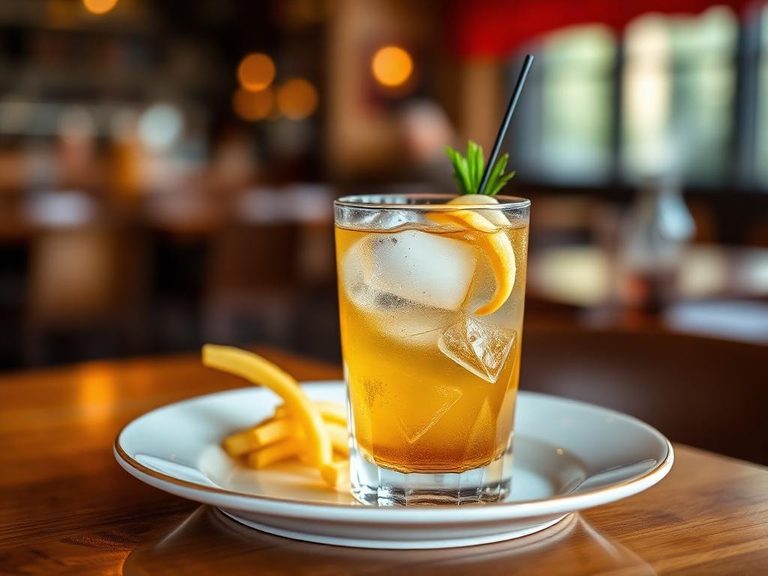
A classic highball cocktail blending the spicy, caramel warmth of whiskey with the crisp, effervescent sweetness of ginger ale. It's a simple, refreshing drink with a smooth texture and a balanced sweet-and-spicy flavor profile. Nutritionally, it's a low-protein, low-fat beverage deriving its calories almost entirely from alcohol and sugar.
Calorie split: 0% protein · 100% carbs · 0% fat
↓ Full nutrition💚 Why it's loved
People love it for its effortless balance—the whiskey's depth cuts through the ginger ale's sweetness, creating a drink that's both comforting and refreshing. It's a versatile staple that works as a casual sipper or a party cocktail, deeply embedded in pub culture.
⚠️ Watch-outs & how to enjoy it better
The primary downside is the sugar content from the ginger ale, which can cause blood-sugar spikes, and the empty calories from alcohol. To counteract, use a diet or low-sugar ginger ale, practice strict portion control, and always consume with food, especially a meal containing protein and fat to slow absorption.
Key benefits
- Provides a quick source of energy from carbohydrates.
- Ginger ale may offer mild digestive comfort.
- Simple preparation with just two ingredients.
- Highly customizable with different whiskey types.
🍽️ Popular dishes
🌍 Where it's eaten
💡 Did you know?
The 'highball' glass itself, the standard vessel for this drink, was popularized in the 1890s at a New York train station bar to serve whiskey and soda quickly to passengers.
Full nutrition (USDA data · scales with serving)
| Water | 85.1 g |
| Energy | 83.0 kcal |
| Protein | 0.00 g |
| Total lipid (fat) | 0.00 g |
| Carbohydrate, by difference | 6.6 g |
| Fiber, total dietary | 0.00 g |
| Total Sugars | 6.7 g |
| Calcium, Ca | 2.0 mg |
| Iron, Fe | 0.14 mg |
| Magnesium, Mg | 1.0 mg |
| Phosphorus, P | 1.0 mg |
| Potassium, K | 1.0 mg |
| Sodium, Na | 6.0 mg |
| Zinc, Zn | 0.05 mg |
| Copper, Cu | 0.02 mg |
| Selenium, Se | 0.10 ug |
| Vitamin C, total ascorbic acid | 0.00 mg |
| Thiamin | 0.00 mg |
| Riboflavin | 0.00 mg |
| Niacin | 0.00 mg |
| Vitamin B-6 | 0.00 mg |
| Folate, total | 0.00 ug |
| Folic acid | 0.00 ug |
| Folate, food | 0.00 ug |
| Folate, DFE | 0.00 ug |
| Choline, total | 0.00 mg |
| Vitamin B-12 | 0.00 ug |
| Vitamin B-12, added | 0.00 ug |
| Vitamin A, RAE | 0.00 ug |
| Retinol | 0.00 ug |
| Carotene, beta | 0.00 ug |
| Carotene, alpha | 0.00 ug |
| Cryptoxanthin, beta | 0.00 ug |
| Lycopene | 0.00 ug |
| Lutein + zeaxanthin | 0.00 ug |
| Vitamin E (alpha-tocopherol) | 0.00 mg |
| Vitamin E, added | 0.00 mg |
| Vitamin D (D2 + D3) | 0.00 ug |
| Vitamin K (phylloquinone) | 0.00 ug |
| Alcohol, ethyl | 8.3 g |
| Caffeine | 0.00 mg |
| Theobromine | 0.00 mg |
Fat & fatty acid profile (per 100g)
| Fatty acids, total saturated | 0.00 g |
| SFA 4:0 | 0.00 g |
| SFA 6:0 | 0.00 g |
| SFA 8:0 | 0.00 g |
| SFA 10:0 | 0.00 g |
| SFA 12:0 | 0.00 g |
| SFA 14:0 | 0.00 g |
| SFA 16:0 | 0.00 g |
| SFA 18:0 | 0.00 g |
| Fatty acids, total monounsaturated | 0.00 g |
| MUFA 16:1 | 0.00 g |
| MUFA 18:1 | 0.00 g |
| MUFA 20:1 | 0.00 g |
| MUFA 22:1 | 0.00 g |
| Fatty acids, total polyunsaturated | 0.00 g |
| PUFA 18:2 | 0.00 g |
| PUFA 18:3 | 0.00 g |
| PUFA 18:4 | 0.00 g |
| PUFA 20:4 | 0.00 g |
| PUFA 20:5 n-3 (EPA) | 0.00 g |
| PUFA 22:5 n-3 (DPA) | 0.00 g |
| PUFA 22:6 n-3 (DHA) | 0.00 g |
| Cholesterol | 0.00 mg |
FAQ
What's the best whiskey for a whiskey and ginger ale?
A smooth, mellow bourbon or Canadian whisky is classic. For a spicier kick, a rye whiskey works well. Avoid overly peaty or expensive single malts, as their complex flavors can be masked.
Can I make a lower-sugar version?
Absolutely. Substitute regular ginger ale with a diet ginger ale, ginger beer (check sugar content), or use a splash of real ginger syrup with soda water for more control.
Is this drink gluten-free?
The whiskey itself is typically gluten-free after distillation, but some flavored whiskeys or additives may not be. Most major brand gingers ales are gluten-free, but always check labels if you have a severe sensitivity.
Nutrient density (calculated · NRF9.3)
Nutrient Rich Foods index: beneficial nutrients (protein, fiber, vitamins, minerals) minus saturated fat, added sugar & sodium, per 100 kcal.
NRF9.3 index — Fulgoni, Keast & Drewnowski, 2009. Computed from USDA nutrients.
Weight-loss friendliness (composite index)
Energy density 0.83 kcal/g · 0% calories from protein · 0.0 g fiber · 6.7 g sugar per 100 g.
Composite of energy density (Rolls et al., 1999), protein & fiber satiety, minus sugar. A calculated heuristic — ranks satiety-per-calorie, not a clinical measure.
Dietary load (calculated from USDA values)
Potential renal acid load. Positive = acid-forming, negative = alkaline-forming.
Sodium-to-potassium ratio: 6.00 (lower is better — aim for ≤ 1)
Sodium:potassium per WHO potassium guidance. Computed from USDA nutrients.