

Vegetable mixture, dried
Common food
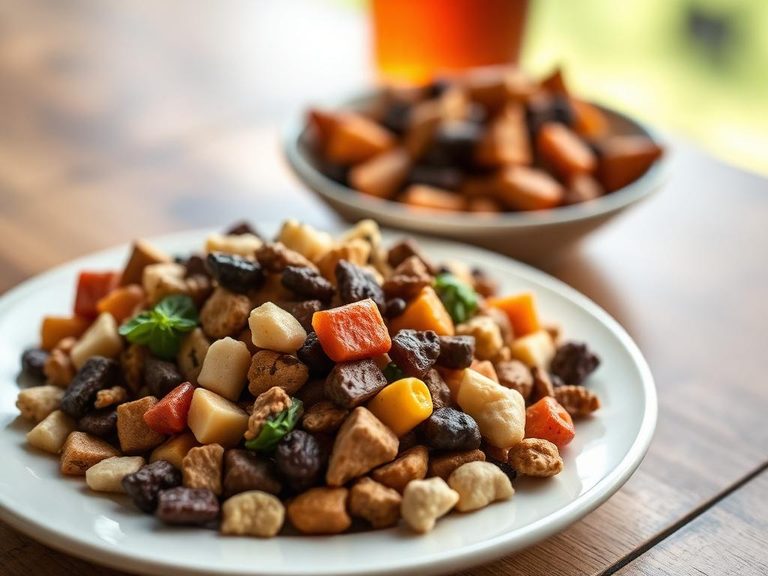
This is a concentrated, shelf-stable blend of dehydrated vegetables—often including carrots, peas, corn, and bell peppers—reduced to a lightweight, chewy form. It offers an intense, savory-sweet vegetable flavor with a firm, slightly leathery texture that rehydrates into a tender bite. Nutritionally, it's a standout for its high fiber and protein content relative to its calorie density.
Calorie split: 20% protein · 57% carbs · 23% fat
↓ Full nutrition💚 Why it's loved
People love it for its incredible convenience and ability to add instant vegetable nutrition to soups, stews, and camping meals. Its concentrated flavor acts as a natural flavor booster, and it's a staple in many cultures for preserving seasonal harvests.
⚠️ Watch-outs & how to enjoy it better
The high fiber content can cause digestive discomfort (gas, bloating) if introduced too quickly or consumed in large amounts. The natural sugars are concentrated, which may affect blood sugar for sensitive individuals. To counteract, start with small portions, rehydrate and cook with a source of fat or protein (like beans or meat), and drink plenty of water.
Key benefits
- Excellent source of dietary fiber for digestive health
- High plant-based protein content for a vegetable product
- Long shelf life reduces food waste
- Concentrated source of micronutrients like vitamin A and potassium
- Lightweight and portable for convenient nutrition
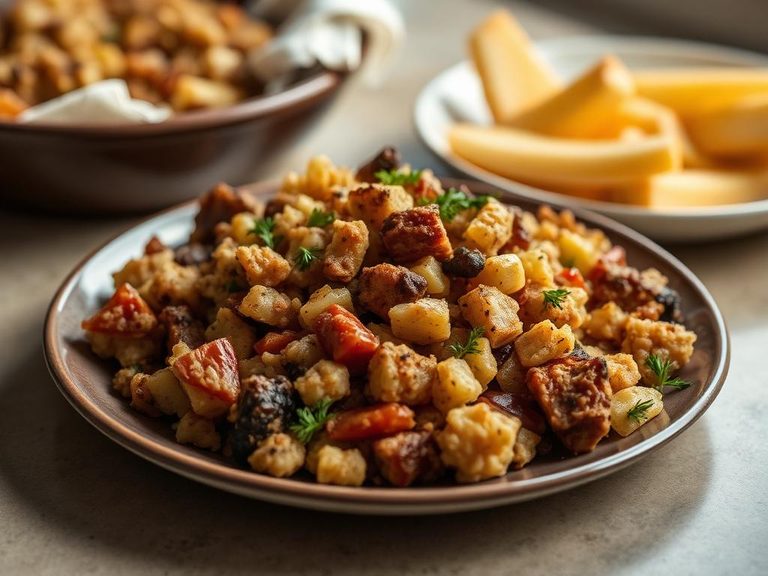
🍽️ Popular dishes




🌍 Where it's eaten
💡 Did you know?
The dehydration process can concentrate the natural sugars in vegetables like carrots and corn, making them taste significantly sweeter than their fresh counterparts.
Full nutrition (USDA data · scales with serving)
| Water | 19.1 g |
| Energy | 328 kcal |
| Protein | 17.4 g |
| Total lipid (fat) | 8.9 g |
| Carbohydrate, by difference | 49.2 g |
| Fiber, total dietary | 18.5 g |
| Total Sugars | 18.9 g |
| Calcium, Ca | 232 mg |
| Iron, Fe | 5.5 mg |
| Magnesium, Mg | 152 mg |
| Phosphorus, P | 406 mg |
| Potassium, K | 1639 mg |
| Sodium, Na | 368 mg |
| Zinc, Zn | 3.4 mg |
| Copper, Cu | 0.74 mg |
| Selenium, Se | 12.9 ug |
| Vitamin C, total ascorbic acid | 193 mg |
| Thiamin | 0.48 mg |
| Riboflavin | 0.70 mg |
| Niacin | 7.1 mg |
| Vitamin B-6 | 0.93 mg |
| Folate, total | 233 ug |
| Folic acid | 0.00 ug |
| Folate, food | 233 ug |
| Folate, DFE | 233 ug |
| Choline, total | 87.1 mg |
| Vitamin B-12 | 0.00 ug |
| Vitamin B-12, added | 0.00 ug |
| Vitamin A, RAE | 988 ug |
| Retinol | 0.00 ug |
| Carotene, beta | 9994 ug |
| Carotene, alpha | 3477 ug |
| Cryptoxanthin, beta | 235 ug |
| Lycopene | 2426 ug |
| Lutein + zeaxanthin | 3708 ug |
| Vitamin E (alpha-tocopherol) | 6.0 mg |
| Vitamin E, added | 0.00 mg |
| Vitamin D (D2 + D3) | 0.00 ug |
| Vitamin K (phylloquinone) | 224 ug |
| Alcohol, ethyl | 0.00 g |
| Caffeine | 0.00 mg |
| Theobromine | 0.00 mg |
Fat & fatty acid profile (per 100g)
| Fatty acids, total saturated | 1.2 g |
| SFA 4:0 | 0.00 g |
| SFA 6:0 | 0.00 g |
| SFA 8:0 | 0.00 g |
| SFA 10:0 | 0.00 g |
| SFA 12:0 | 0.00 g |
| SFA 14:0 | 0.01 g |
| SFA 16:0 | 0.83 g |
| SFA 18:0 | 0.33 g |
| Fatty acids, total monounsaturated | 1.6 g |
| MUFA 16:1 | 0.02 g |
| MUFA 18:1 | 1.6 g |
| MUFA 20:1 | 0.01 g |
| MUFA 22:1 | 0.00 g |
| Fatty acids, total polyunsaturated | 5.3 g |
| PUFA 18:2 | 4.8 g |
| PUFA 18:3 | 0.48 g |
| PUFA 18:4 | 0.00 g |
| PUFA 20:4 | 0.00 g |
| PUFA 20:5 n-3 (EPA) | 0.00 g |
| PUFA 22:5 n-3 (DPA) | 0.00 g |
| PUFA 22:6 n-3 (DHA) | 0.00 g |
| Cholesterol | 0.00 mg |
FAQ
How do I rehydrate dried vegetable mixture?
Simply soak in hot water or broth for 10-15 minutes, or add directly to simmering soups and stews where they will rehydrate during cooking.
Is dried vegetable mixture healthy?
Yes, it's a nutrient-dense food, retaining most vitamins, minerals, and fiber from fresh vegetables. The main consideration is the concentrated fiber and natural sugars.
How long does dried vegetable mixture last?
When stored in a cool, dark, and dry place in an airtight container, it can last for 1-2 years or more.
Nutrient density (calculated · NRF9.3)
Nutrient Rich Foods index: beneficial nutrients (protein, fiber, vitamins, minerals) minus saturated fat, added sugar & sodium, per 100 kcal.
NRF9.3 index — Fulgoni, Keast & Drewnowski, 2009. Computed from USDA nutrients.
Weight-loss friendliness (composite index)
Energy density 3.28 kcal/g · 21% calories from protein · 18.5 g fiber · 18.9 g sugar per 100 g.
Composite of energy density (Rolls et al., 1999), protein & fiber satiety, minus sugar. A calculated heuristic — ranks satiety-per-calorie, not a clinical measure.
Dietary load (calculated from USDA values)
Potential renal acid load. Positive = acid-forming, negative = alkaline-forming.
Sodium-to-potassium ratio: 0.22 (lower is better — aim for ≤ 1)
Sodium:potassium per WHO potassium guidance. Computed from USDA nutrients.