

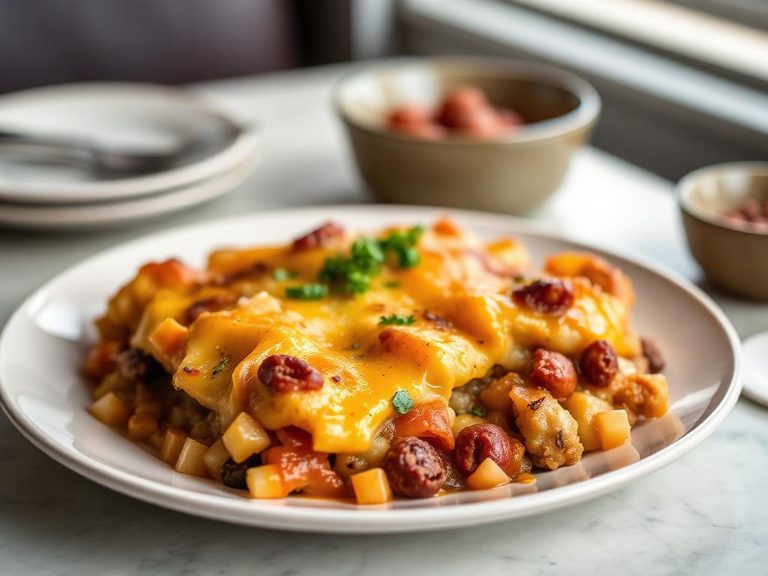
Tuna noodle casserole with mushroom sauce
Common food

Photo: Wikipedia
A comforting casserole of tender egg noodles and flaked tuna bound in a creamy, savory mushroom sauce, often topped with a crispy breadcrumb layer. Each bite offers a satisfying contrast between the soft pasta and the rich, umami-laden sauce, delivering a complete meal with a notable protein punch for its calorie count.
Calorie split: 26% protein · 40% carbs · 34% fat
↓ Full nutrition💚 Why it's loved
People cherish it as the ultimate nostalgic comfort food—a warm, hearty, and creamy one-dish meal that's easy to prepare and universally satisfying. Its mild, savory flavor profile makes it a family-friendly staple that's both filling and flavorful.
⚠️ Watch-outs & how to enjoy it better
The creamy sauce and refined noodles can lead to a rapid blood-sugar spike, and the dish can be high in sodium, especially with canned tuna and condensed soup. To counteract this, pair a moderate portion with a side of steamed broccoli or green beans for fiber, and opt for low-sodium tuna and soup if making it from scratch.
Key benefits
- High-quality protein from tuna supports muscle maintenance.
- Relatively low in calories for a complete, filling meal.
- Provides energy from complex carbohydrates in the noodles.
- Contains selenium and B vitamins from tuna and mushrooms.
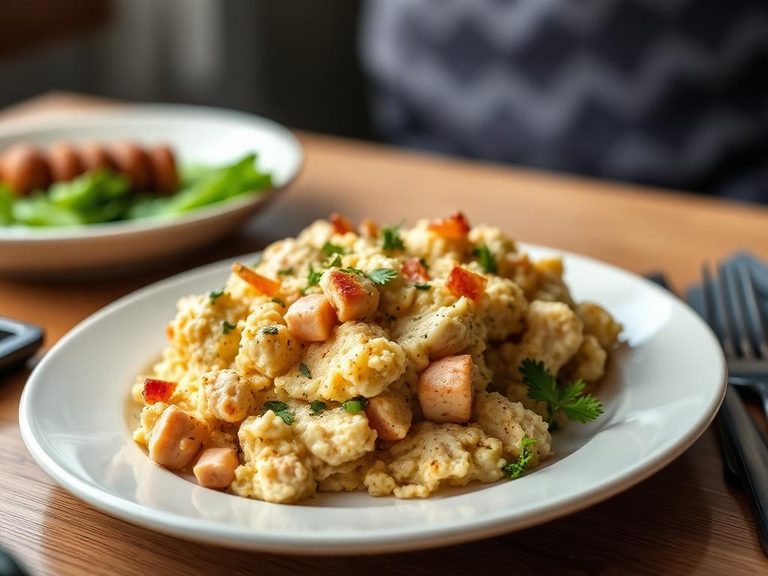
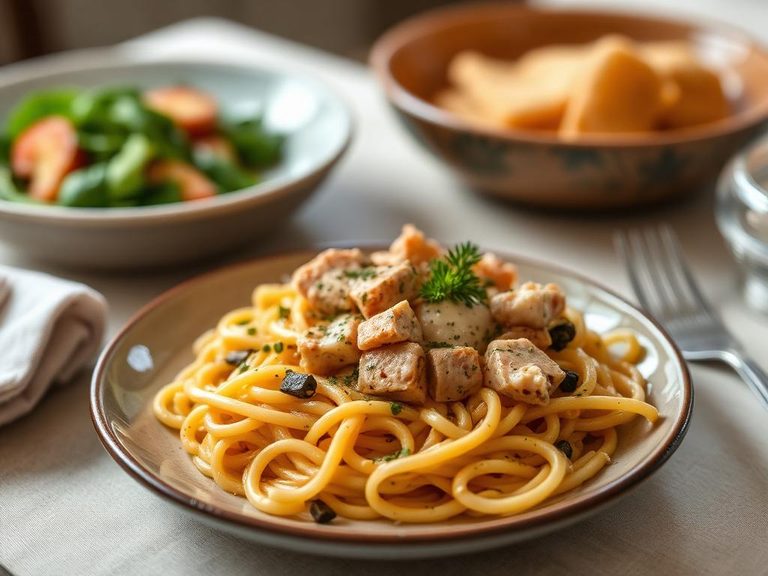
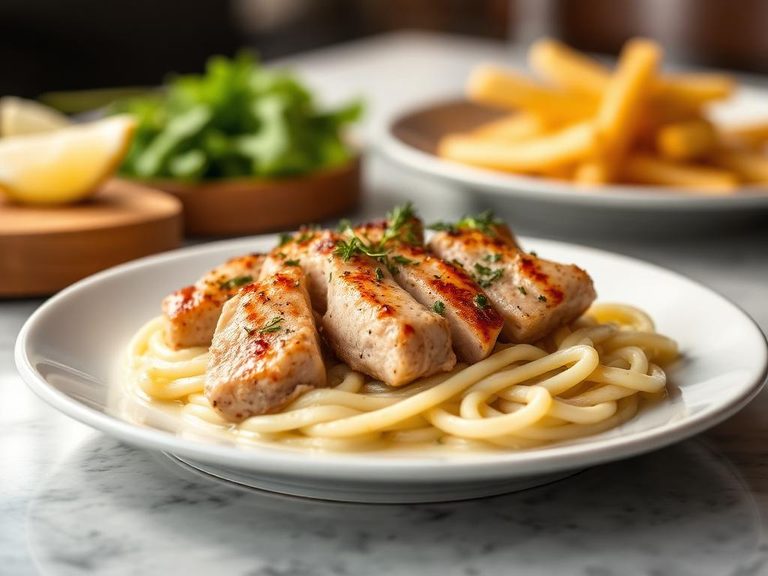
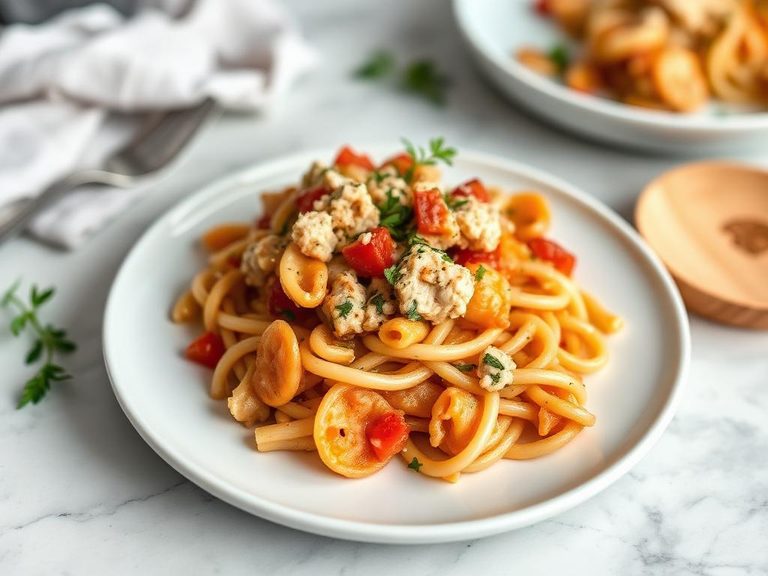
🍽️ Popular dishes
🌍 Where it's eaten
💡 Did you know?
The classic crunchy topping isn't always breadcrumbs; many vintage recipes call for crushed potato chips or even cornflakes for an extra salty, crispy contrast.
Full nutrition (USDA data · scales with serving)
| Water | 70.6 g |
| Energy | 139 kcal |
| Protein | 9.0 g |
| Total lipid (fat) | 5.2 g |
| Carbohydrate, by difference | 13.9 g |
| Fiber, total dietary | 0.80 g |
| Total Sugars | 1.1 g |
| Calcium, Ca | 37.0 mg |
| Iron, Fe | 1.3 mg |
| Magnesium, Mg | 18.0 mg |
| Phosphorus, P | 95.0 mg |
| Potassium, K | 116 mg |
| Sodium, Na | 328 mg |
| Zinc, Zn | 0.57 mg |
| Copper, Cu | 0.07 mg |
| Selenium, Se | 31.6 ug |
| Vitamin C, total ascorbic acid | 0.00 mg |
| Thiamin | 0.14 mg |
| Riboflavin | 0.11 mg |
| Niacin | 4.3 mg |
| Vitamin B-6 | 0.13 mg |
| Folate, total | 30.0 ug |
| Folic acid | 25.0 ug |
| Folate, food | 5.0 ug |
| Folate, DFE | 48.0 ug |
| Choline, total | 22.9 mg |
| Vitamin B-12 | 0.91 ug |
| Vitamin B-12, added | 0.00 ug |
| Vitamin A, RAE | 35.0 ug |
| Retinol | 34.0 ug |
| Carotene, beta | 5.0 ug |
| Carotene, alpha | 0.00 ug |
| Cryptoxanthin, beta | 0.00 ug |
| Lycopene | 0.00 ug |
| Lutein + zeaxanthin | 13.0 ug |
| Vitamin E (alpha-tocopherol) | 0.31 mg |
| Vitamin E, added | 0.00 mg |
| Vitamin D (D2 + D3) | 0.60 ug |
| Vitamin K (phylloquinone) | 6.3 ug |
| Alcohol, ethyl | 0.00 g |
| Caffeine | 0.00 mg |
| Theobromine | 0.00 mg |
Fat & fatty acid profile (per 100g)
| Fatty acids, total saturated | 1.9 g |
| SFA 4:0 | 0.06 g |
| SFA 6:0 | 0.04 g |
| SFA 8:0 | 0.03 g |
| SFA 10:0 | 0.06 g |
| SFA 12:0 | 0.07 g |
| SFA 14:0 | 0.23 g |
| SFA 16:0 | 0.99 g |
| SFA 18:0 | 0.36 g |
| Fatty acids, total monounsaturated | 1.1 g |
| MUFA 16:1 | 0.05 g |
| MUFA 18:1 | 1.0 g |
| MUFA 20:1 | 0.01 g |
| MUFA 22:1 | 0.00 g |
| Fatty acids, total polyunsaturated | 1.3 g |
| PUFA 18:2 | 1.1 g |
| PUFA 18:3 | 0.13 g |
| PUFA 18:4 | 0.00 g |
| PUFA 20:4 | 0.01 g |
| PUFA 20:5 n-3 (EPA) | 0.01 g |
| PUFA 22:5 n-3 (DPA) | 0.00 g |
| PUFA 22:6 n-3 (DHA) | 0.06 g |
| Cholesterol | 28.0 mg |
FAQ
Is tuna noodle casserole healthy?
It can be part of a balanced diet. It's a good source of protein, but versions made with condensed soup and heavy cream can be high in sodium and saturated fat. Using whole-grain noodles, low-sodium ingredients, and adding vegetables can significantly improve its nutritional profile.
What kind of tuna is best for casserole?
Canned light tuna (often skipjack) is most traditional for its milder flavor and lower cost. Albacore tuna will give a firmer texture and milder taste but is higher in fat and mercury. Always choose tuna packed in water, not oil, to control fat content.
Can I make tuna noodle casserole ahead of time?
Yes, it's an ideal make-ahead dish. Assemble it without the topping, cover, and refrigerate for up to 24 hours. Add the crunchy topping just before baking to prevent sogginess. You may need to add 5-10 minutes to the baking time if going straight from the fridge.
Nutrient density (calculated · NRF9.3)
Nutrient Rich Foods index: beneficial nutrients (protein, fiber, vitamins, minerals) minus saturated fat, added sugar & sodium, per 100 kcal.
NRF9.3 index — Fulgoni, Keast & Drewnowski, 2009. Computed from USDA nutrients.
Weight-loss friendliness (composite index)
Energy density 1.39 kcal/g · 26% calories from protein · 0.8 g fiber · 1.1 g sugar per 100 g.
Composite of energy density (Rolls et al., 1999), protein & fiber satiety, minus sugar. A calculated heuristic — ranks satiety-per-calorie, not a clinical measure.
Dietary load (calculated from USDA values)
Potential renal acid load. Positive = acid-forming, negative = alkaline-forming.
Sodium-to-potassium ratio: 2.83 (lower is better — aim for ≤ 1)
Sodium:potassium per WHO potassium guidance. Computed from USDA nutrients.