

Sugar, NFS
Common food
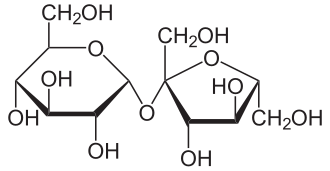
Photo: Wikipedia
Sugar, NFS (Not Further Specified) is the pure, crystalline form of sucrose, the common table sugar derived from sugarcane or sugar beets. It offers an intensely sweet taste with a clean, sharp finish and a dry, granular texture that dissolves readily in liquids. Nutritionally, it is a concentrated source of simple carbohydrates, providing 401 kcal and nearly 100g of sugar per 100g, with no protein, fat, or fiber.
Calorie split: 0% protein · 99% carbs · 1% fat
↓ Full nutrition💚 Why it's loved
People love sugar for its unparalleled ability to deliver immediate, pleasurable sweetness, triggering a dopamine response in the brain. Its versatility is legendary, transforming sour berries into jam, bitter cocoa into chocolate, and plain dough into celebratory cakes across virtually every global cuisine.
⚠️ Watch-outs & how to enjoy it better
Excessive consumption is linked to blood-sugar spikes, weight gain, and dental caries. To counteract this, practice strict portion control, pair sugary foods with protein or healthy fats (like nuts or yogurt) to slow absorption, and prioritize sugar as an occasional ingredient rather than a dietary staple.
Key benefits
- Rapid source of quick energy for the body and brain
- Universal flavor enhancer, balancing bitterness and acidity in cooking
- Acts as a preservative in jams, jellies, and pickles
- Facilitates fermentation in bread and alcoholic beverages
- Essential for creating texture in confections like meringue and caramel
🍽️ Popular dishes






🌍 Where it's eaten
💡 Did you know?
The human tongue has specific taste receptors for sweetness that can detect sugar at concentrations as low as 5 millimolar, making it one of our most sensitive tastes, likely an evolutionary adaptation to identify energy-rich foods.
Full nutrition (USDA data · scales with serving)
| Water | 0.02 g |
| Energy | 401 kcal |
| Protein | 0.00 g |
| Total lipid (fat) | 0.32 g |
| Carbohydrate, by difference | 99.6 g |
| Fiber, total dietary | 0.00 g |
| Total Sugars | 99.8 g |
| Calcium, Ca | 1.0 mg |
| Iron, Fe | 0.05 mg |
| Magnesium, Mg | 0.00 mg |
| Phosphorus, P | 0.00 mg |
| Potassium, K | 2.0 mg |
| Sodium, Na | 1.0 mg |
| Zinc, Zn | 0.01 mg |
| Copper, Cu | 0.01 mg |
| Selenium, Se | 0.60 ug |
| Vitamin C, total ascorbic acid | 0.00 mg |
| Thiamin | 0.00 mg |
| Riboflavin | 0.02 mg |
| Niacin | 0.00 mg |
| Vitamin B-6 | 0.00 mg |
| Folate, total | 0.00 ug |
| Folic acid | 0.00 ug |
| Folate, food | 0.00 ug |
| Folate, DFE | 0.00 ug |
| Choline, total | 0.00 mg |
| Vitamin B-12 | 0.00 ug |
| Vitamin B-12, added | 0.00 ug |
| Vitamin A, RAE | 0.00 ug |
| Retinol | 0.00 ug |
| Carotene, beta | 0.00 ug |
| Carotene, alpha | 0.00 ug |
| Cryptoxanthin, beta | 0.00 ug |
| Lycopene | 0.00 ug |
| Lutein + zeaxanthin | 0.00 ug |
| Vitamin E (alpha-tocopherol) | 0.00 mg |
| Vitamin E, added | 0.00 mg |
| Vitamin D (D2 + D3) | 0.00 ug |
| Vitamin K (phylloquinone) | 0.00 ug |
| Alcohol, ethyl | 0.00 g |
| Caffeine | 0.00 mg |
| Theobromine | 0.00 mg |
Fat & fatty acid profile (per 100g)
| Fatty acids, total saturated | 0.00 g |
| SFA 4:0 | 0.00 g |
| SFA 6:0 | 0.00 g |
| SFA 8:0 | 0.00 g |
| SFA 10:0 | 0.00 g |
| SFA 12:0 | 0.00 g |
| SFA 14:0 | 0.00 g |
| SFA 16:0 | 0.00 g |
| SFA 18:0 | 0.00 g |
| Fatty acids, total monounsaturated | 0.00 g |
| MUFA 16:1 | 0.00 g |
| MUFA 18:1 | 0.00 g |
| MUFA 20:1 | 0.00 g |
| MUFA 22:1 | 0.00 g |
| Fatty acids, total polyunsaturated | 0.00 g |
| PUFA 18:2 | 0.00 g |
| PUFA 18:3 | 0.00 g |
| PUFA 18:4 | 0.00 g |
| PUFA 20:4 | 0.00 g |
| PUFA 20:5 n-3 (EPA) | 0.00 g |
| PUFA 22:5 n-3 (DPA) | 0.00 g |
| PUFA 22:6 n-3 (DHA) | 0.00 g |
| Cholesterol | 0.00 mg |
FAQ
What does 'NFS' mean on a nutrition label?
'NFS' stands for 'Not Further Specified.' It indicates the item is a generic version of the food (like white granulated sugar) without specifying the exact source (cane vs. beet) or any additives.
Is sugar a carbohydrate?
Yes. Sugar is a simple carbohydrate, specifically a disaccharide (sucrose) made of glucose and fructose. It is digested and absorbed very quickly, providing a rapid energy spike.
Why does sugar have zero protein and fat?
Refined sugar is a purified carbohydrate extracted from plants. The refining process removes all other natural components like proteins, fats, minerals, and fiber, leaving behind nearly pure sucrose.
Nutrient density (calculated · NRF9.3)
Nutrient Rich Foods index: beneficial nutrients (protein, fiber, vitamins, minerals) minus saturated fat, added sugar & sodium, per 100 kcal.
NRF9.3 index — Fulgoni, Keast & Drewnowski, 2009. Computed from USDA nutrients.
Weight-loss friendliness (composite index)
Energy density 4.01 kcal/g · 0% calories from protein · 0.0 g fiber · 99.8 g sugar per 100 g.
Composite of energy density (Rolls et al., 1999), protein & fiber satiety, minus sugar. A calculated heuristic — ranks satiety-per-calorie, not a clinical measure.
Dietary load (calculated from USDA values)
Potential renal acid load. Positive = acid-forming, negative = alkaline-forming.
Sodium-to-potassium ratio: 0.50 (lower is better — aim for ≤ 1)
Sodium:potassium per WHO potassium guidance. Computed from USDA nutrients.