

Sports drink, NFS
Common food
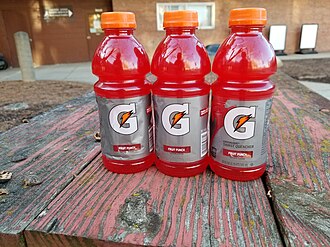
Photo: Wikipedia
Sports drink, NFS is a clear, electrolyte-enhanced beverage designed for rapid hydration, typically with a light, slightly syrupy texture and a sweet, often citrusy or berry-like flavor. Its primary nutritional role is to replenish fluids, carbohydrates, and electrolytes lost through sweat during intense or prolonged physical activity. With 26 kcal and 6.43g of carbs per 100g, it provides a quick energy source without protein or fat.
Calorie split: 0% protein · 100% carbs · 0% fat
↓ Full nutrition💚 Why it's loved
People love it for its refreshing, thirst-quenching taste that makes it easier to drink large volumes than plain water, especially during or after a tough workout. It's a staple in gyms, sports sidelines, and outdoor activities, symbolizing energy and recovery.
⚠️ Watch-outs & how to enjoy it better
The high sugar content (5.24g per 100g) can cause blood-sugar spikes and is not ideal for sedentary individuals or those managing diabetes. The added sodium may be excessive for people with hypertension or on low-sodium diets. To mitigate, consume only during/after intense exercise, choose low-sugar versions, or dilute it with water.
Key benefits
- Rapidly replenishes fluids and electrolytes lost via sweat.
- Provides quick-digesting carbohydrates for immediate energy.
- Can help maintain endurance during prolonged exercise.
- Often contains sodium and potassium to support nerve and muscle function.
- More effective than plain water for rehydration after heavy sweating.
🍽️ Popular dishes






🌍 Where it's eaten
💡 Did you know?
The first modern sports drink, Gatorade, was developed in 1965 at the University of Florida to help the school's football team, the Gators, cope with the intense heat and humidity.
Full nutrition (USDA data · scales with serving)
| Water | 93.4 g |
| Energy | 26.0 kcal |
| Protein | 0.00 g |
| Total lipid (fat) | 0.00 g |
| Carbohydrate, by difference | 6.4 g |
| Fiber, total dietary | 0.00 g |
| Total Sugars | 5.2 g |
| Calcium, Ca | 1.0 mg |
| Iron, Fe | 0.05 mg |
| Magnesium, Mg | 0.00 mg |
| Phosphorus, P | 10.0 mg |
| Potassium, K | 15.0 mg |
| Sodium, Na | 39.0 mg |
| Zinc, Zn | 0.01 mg |
| Copper, Cu | 0.01 mg |
| Selenium, Se | 0.00 ug |
| Vitamin C, total ascorbic acid | 0.40 mg |
| Thiamin | 0.01 mg |
| Riboflavin | 0.00 mg |
| Niacin | 0.22 mg |
| Vitamin B-6 | 0.02 mg |
| Folate, total | 0.00 ug |
| Folic acid | 0.00 ug |
| Folate, food | 0.00 ug |
| Folate, DFE | 0.00 ug |
| Choline, total | 0.00 mg |
| Vitamin B-12 | 0.00 ug |
| Vitamin B-12, added | 0.00 ug |
| Vitamin A, RAE | 0.00 ug |
| Retinol | 0.00 ug |
| Carotene, beta | 0.00 ug |
| Carotene, alpha | 0.00 ug |
| Cryptoxanthin, beta | 0.00 ug |
| Lycopene | 0.00 ug |
| Lutein + zeaxanthin | 0.00 ug |
| Vitamin E (alpha-tocopherol) | 0.00 mg |
| Vitamin E, added | 0.00 mg |
| Vitamin D (D2 + D3) | 0.00 ug |
| Vitamin K (phylloquinone) | 0.20 ug |
| Alcohol, ethyl | 0.00 g |
| Caffeine | 0.00 mg |
| Theobromine | 0.00 mg |
Fat & fatty acid profile (per 100g)
| Fatty acids, total saturated | 0.00 g |
| SFA 4:0 | 0.00 g |
| SFA 6:0 | 0.00 g |
| SFA 8:0 | 0.00 g |
| SFA 10:0 | 0.00 g |
| SFA 12:0 | 0.00 g |
| SFA 14:0 | 0.00 g |
| SFA 16:0 | 0.00 g |
| SFA 18:0 | 0.00 g |
| Fatty acids, total monounsaturated | 0.00 g |
| MUFA 16:1 | 0.00 g |
| MUFA 18:1 | 0.00 g |
| MUFA 20:1 | 0.00 g |
| MUFA 22:1 | 0.00 g |
| Fatty acids, total polyunsaturated | 0.00 g |
| PUFA 18:2 | 0.00 g |
| PUFA 18:3 | 0.00 g |
| PUFA 18:4 | 0.00 g |
| PUFA 20:4 | 0.00 g |
| PUFA 20:5 n-3 (EPA) | 0.00 g |
| PUFA 22:5 n-3 (DPA) | 0.00 g |
| PUFA 22:6 n-3 (DHA) | 0.00 g |
| Cholesterol | 0.00 mg |
FAQ
Is sports drink the same as an energy drink?
No. Sports drinks primarily replace fluids and electrolytes with moderate carbs, while energy drinks focus on high doses of caffeine and stimulants for alertness, often with high sugar.
Can I drink sports drink every day?
It's not recommended for daily use unless you're an athlete with high sweat losses. Regular consumption of the added sugars and sodium without intense activity can contribute to weight gain and elevated blood pressure.
What does NFS stand for on a nutrition label?
NFS stands for 'Not Further Specified.' It indicates the product is a generic or representative version of that food category, and the data is an average.
Nutrient density (calculated · NRF9.3)
Nutrient Rich Foods index: beneficial nutrients (protein, fiber, vitamins, minerals) minus saturated fat, added sugar & sodium, per 100 kcal.
NRF9.3 index — Fulgoni, Keast & Drewnowski, 2009. Computed from USDA nutrients.
Weight-loss friendliness (composite index)
Energy density 0.26 kcal/g · 0% calories from protein · 0.0 g fiber · 5.2 g sugar per 100 g.
Composite of energy density (Rolls et al., 1999), protein & fiber satiety, minus sugar. A calculated heuristic — ranks satiety-per-calorie, not a clinical measure.
Dietary load (calculated from USDA values)
Potential renal acid load. Positive = acid-forming, negative = alkaline-forming.
Sodium-to-potassium ratio: 2.60 (lower is better — aim for ≤ 1)
Sodium:potassium per WHO potassium guidance. Computed from USDA nutrients.