

Soup, pea, split with ham, canned, prepared with equal volume water
Whole food · Soups, Sauces, and Gravies

Photo: Wikipedia
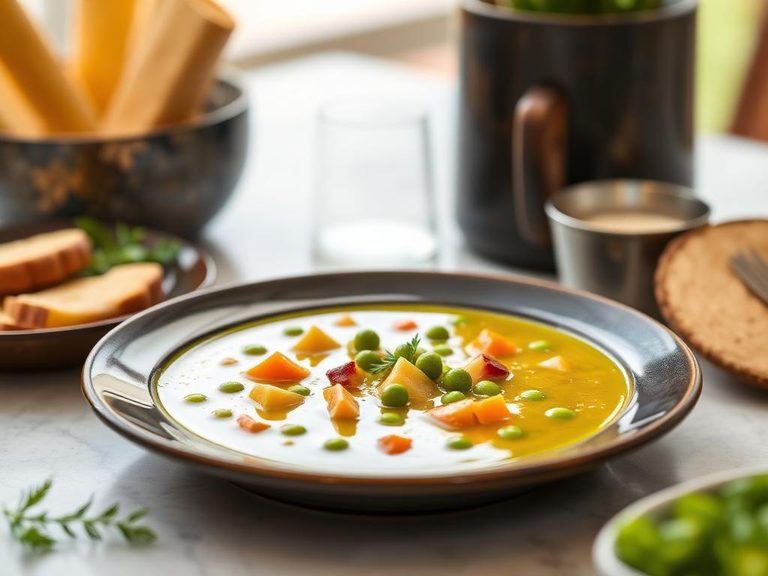
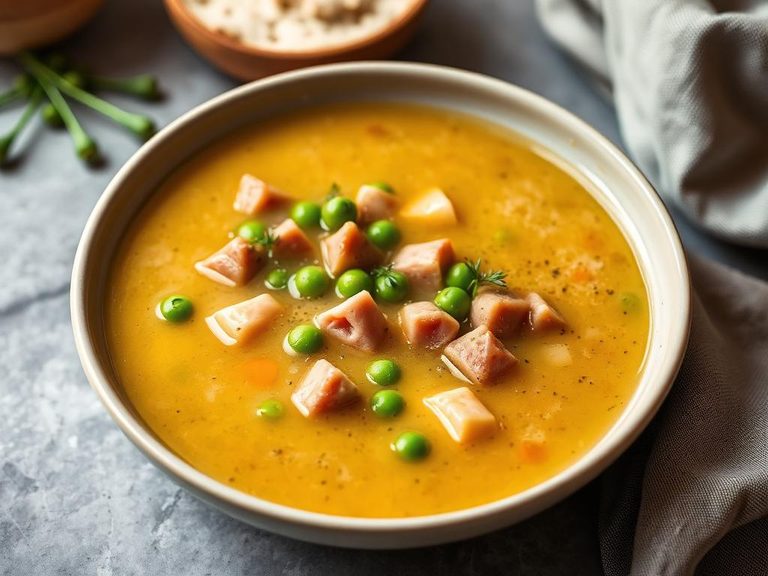
This is a classic, hearty canned soup that transforms humble dried split peas and savory ham into a thick, comforting purée. Its texture is rustic and velvety, with the peas breaking down completely during cooking, while small, tender bits of ham provide a salty, meaty contrast. Nutritionally, it's a standout for delivering a solid 4 grams of protein and nearly 1 gram of fiber per 100-gram serving, making it a surprisingly filling low-calorie option.
Calorie split: 21% protein · 58% carbs · 21% fat
↓ Full nutrition💚 Why it's loved
People adore this soup for its deep, savory umami flavor from the ham and its nostalgic, stick-to-your-ribs comfort. It's a versatile one-pot meal that pairs perfectly with crusty bread or crackers for dipping.
⚠️ Watch-outs & how to enjoy it better
The primary caution is its likely high sodium content from the ham and canning process, which can be problematic for those monitoring blood pressure. To counteract this, choose a low-sodium version if available, and pair it with a fresh, potassium-rich side salad or unsalted crackers to help balance electrolytes. Some may also experience digestive gas from the legumes; starting with a smaller portion can help.
Key benefits
- Excellent source of plant-based protein from split peas.
- Provides dietary fiber for digestive health and satiety.
- Low in fat, with only 1.74g per 100g serving.
- Rich in folate, iron, and B vitamins from the legumes.
- Quick and convenient source of a balanced, warm meal.
🍽️ Popular dishes
🌍 Where it's eaten
💡 Did you know?
In the Netherlands, a traditional thick pea soup (Erwtensoep) is so dense that a spoon should stand upright in it—a test of a properly made batch.
Full nutrition (USDA data · scales with serving)
| Water | 81.8 g |
| Energy | 75.0 kcal |
| Energy | 314 kj |
| Protein | 4.1 g |
| Total lipid (fat) | 1.7 g |
| Ash | 1.4 g |
| Carbohydrate, by difference | 11.1 g |
| Fiber, total dietary | 0.90 g |
| Calcium, Ca | 9.0 mg |
| Iron, Fe | 0.90 mg |
| Magnesium, Mg | 19.0 mg |
| Phosphorus, P | 84.0 mg |
| Potassium, K | 158 mg |
| Sodium, Na | 398 mg |
| Zinc, Zn | 0.52 mg |
| Copper, Cu | 0.15 mg |
| Manganese, Mn | 0.27 mg |
| Vitamin C, total ascorbic acid | 0.60 mg |
| Thiamin | 0.06 mg |
| Riboflavin | 0.03 mg |
| Niacin | 0.58 mg |
| Pantothenic acid | 0.10 mg |
| Vitamin B-6 | 0.03 mg |
| Folate, total | 1.0 ug |
| Folic acid | 0.00 ug |
| Folate, food | 1.0 ug |
| Folate, DFE | 1.0 ug |
| Vitamin B-12 | 0.10 ug |
| Vitamin A, RAE | 9.0 ug |
| Retinol | 0.00 ug |
| Vitamin A, IU | 176 iu |
Fat & fatty acid profile (per 100g)
| Fatty acids, total saturated | 0.70 g |
| SFA 4:0 | 0.01 g |
| SFA 6:0 | 0.01 g |
| SFA 8:0 | 0.01 g |
| SFA 10:0 | 0.01 g |
| SFA 12:0 | 0.02 g |
| SFA 14:0 | 0.06 g |
| SFA 16:0 | 0.37 g |
| SFA 18:0 | 0.20 g |
| Fatty acids, total monounsaturated | 0.71 g |
| MUFA 16:1 | 0.03 g |
| MUFA 18:1 | 0.66 g |
| Fatty acids, total polyunsaturated | 0.25 g |
| PUFA 18:2 | 0.23 g |
| PUFA 18:3 | 0.02 g |
| Cholesterol | 3.0 mg |
Amino acid profile (per 100g)
| Tryptophan | 0.04 g |
| Threonine | 0.14 g |
| Isoleucine | 0.17 g |
| Leucine | 0.28 g |
| Lysine | 0.28 g |
| Methionine | 0.06 g |
| Cystine | 0.05 g |
| Phenylalanine | 0.18 g |
| Tyrosine | 0.13 g |
| Valine | 0.19 g |
| Arginine | 0.28 g |
| Histidine | 0.09 g |
| Alanine | 0.19 g |
| Aspartic acid | 0.41 g |
| Glutamic acid | 0.69 g |
| Glycine | 0.20 g |
| Proline | 0.18 g |
| Serine | 0.17 g |
FAQ
Is canned split pea soup healthy?
Yes, it can be a nutritious choice. It's low in calories, a good source of plant protein and fiber, and typically low in fat. The main nutritional drawback is often high sodium, so checking labels for low-sodium options is recommended.
Why does my split pea soup turn out thin?
Canned soup is usually pre-thickened. If you're making it from scratch, the soup thickens as the peas break down during long simmering. If it's still thin, you can blend a portion of it and stir it back in, or simmer it longer to reduce.
Can I freeze leftover canned split pea soup?
Yes, you can freeze it. Transfer the soup to airtight containers or freezer bags, leaving some headspace for expansion. It will keep well for up to 3 months. Thaw in the refrigerator before reheating.
Nutrient density (calculated · NRF9.3)
Nutrient Rich Foods index: beneficial nutrients (protein, fiber, vitamins, minerals) minus saturated fat, added sugar & sodium, per 100 kcal.
NRF9.3 index — Fulgoni, Keast & Drewnowski, 2009. Computed from USDA nutrients.
Weight-loss friendliness (composite index)
Energy density 0.75 kcal/g · 22% calories from protein · 0.9 g fiber · 0.0 g sugar per 100 g.
Composite of energy density (Rolls et al., 1999), protein & fiber satiety, minus sugar. A calculated heuristic — ranks satiety-per-calorie, not a clinical measure.
Dietary load (calculated from USDA values)
Potential renal acid load. Positive = acid-forming, negative = alkaline-forming.
Sodium-to-potassium ratio: 2.52 (lower is better — aim for ≤ 1)
Sodium:potassium per WHO potassium guidance. Computed from USDA nutrients.