

Soft drink, NFS, diet
Common food
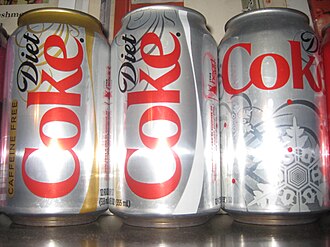
Photo: Wikipedia
Diet soft drinks (NFS, or 'not further specified') are sugar-free, calorie-free carbonated beverages designed to mimic the sweet, fizzy experience of traditional sodas without the caloric load. They typically have a crisp, effervescent texture and a sweet taste derived from non-nutritive sweeteners like aspartame or sucralose. Nutritionally, they contribute virtually no macros—just 2 kcal, 0.11g protein, 0.29g carbs, and 0.03g fat per 100g.
Calorie split: 24% protein · 62% carbs · 14% fat
↓ Full nutrition💚 Why it's loved
People love diet sodas for delivering the familiar sweet, bubbly satisfaction of a soft drink while aligning with low-sugar or calorie-conscious lifestyles. Their versatility makes them a go-to mixer in cocktails, a base for mocktails, and a refreshing standalone beverage.
⚠️ Watch-outs & how to enjoy it better
Some individuals may experience digestive discomfort (like bloating) from certain sugar alcohols or carbonation. Those with phenylketonuria (PKU) must avoid aspartame-containing varieties. To mitigate potential issues, consume in moderation, choose cans over large bottles for portion control, and pair with water to stay hydrated.
Key benefits
- Zero sugar and very low calorie, aiding weight management.
- Provides the sensory experience of soda without sugar intake.
- Can be a useful tool for reducing overall added sugar consumption.
- Offers a wide variety of flavors for taste preference flexibility.
🍽️ Popular dishes





🌍 Where it's eaten
💡 Did you know?
The first diet soda, 'No-Cal,' was introduced in 1952 and was originally marketed to diabetic patients before gaining mainstream popularity.
Full nutrition (USDA data · scales with serving)
| Water | 99.5 g |
| Energy | 2.0 kcal |
| Protein | 0.11 g |
| Total lipid (fat) | 0.03 g |
| Carbohydrate, by difference | 0.29 g |
| Fiber, total dietary | 0.00 g |
| Total Sugars | 0.00 g |
| Calcium, Ca | 3.0 mg |
| Iron, Fe | 0.11 mg |
| Magnesium, Mg | 1.0 mg |
| Phosphorus, P | 9.0 mg |
| Potassium, K | 8.0 mg |
| Sodium, Na | 8.0 mg |
| Zinc, Zn | 0.01 mg |
| Copper, Cu | 0.00 mg |
| Selenium, Se | 0.00 ug |
| Vitamin C, total ascorbic acid | 0.00 mg |
| Thiamin | 0.01 mg |
| Riboflavin | 0.02 mg |
| Niacin | 0.00 mg |
| Vitamin B-6 | 0.00 mg |
| Folate, total | 0.00 ug |
| Folic acid | 0.00 ug |
| Folate, food | 0.00 ug |
| Folate, DFE | 0.00 ug |
| Choline, total | 0.00 mg |
| Vitamin B-12 | 0.00 ug |
| Vitamin B-12, added | 0.00 ug |
| Vitamin A, RAE | 0.00 ug |
| Retinol | 0.00 ug |
| Carotene, beta | 0.00 ug |
| Carotene, alpha | 0.00 ug |
| Cryptoxanthin, beta | 0.00 ug |
| Lycopene | 0.00 ug |
| Lutein + zeaxanthin | 0.00 ug |
| Vitamin E (alpha-tocopherol) | 0.00 mg |
| Vitamin E, added | 0.00 mg |
| Vitamin D (D2 + D3) | 0.00 ug |
| Vitamin K (phylloquinone) | 0.00 ug |
| Alcohol, ethyl | 0.00 g |
| Caffeine | 12.0 mg |
| Theobromine | 0.00 mg |
Fat & fatty acid profile (per 100g)
| Fatty acids, total saturated | 0.00 g |
| SFA 4:0 | 0.00 g |
| SFA 6:0 | 0.00 g |
| SFA 8:0 | 0.00 g |
| SFA 10:0 | 0.00 g |
| SFA 12:0 | 0.00 g |
| SFA 14:0 | 0.00 g |
| SFA 16:0 | 0.00 g |
| SFA 18:0 | 0.00 g |
| Fatty acids, total monounsaturated | 0.00 g |
| MUFA 16:1 | 0.00 g |
| MUFA 18:1 | 0.00 g |
| MUFA 20:1 | 0.00 g |
| MUFA 22:1 | 0.00 g |
| Fatty acids, total polyunsaturated | 0.00 g |
| PUFA 18:2 | 0.00 g |
| PUFA 18:3 | 0.00 g |
| PUFA 18:4 | 0.00 g |
| PUFA 20:4 | 0.00 g |
| PUFA 20:5 n-3 (EPA) | 0.00 g |
| PUFA 22:5 n-3 (DPA) | 0.00 g |
| PUFA 22:6 n-3 (DHA) | 0.00 g |
| Cholesterol | 0.00 mg |
FAQ
Does diet soda really have zero calories?
Regulations allow products with less than 5 calories per serving to be labeled as 'zero calorie.' The 2 kcal per 100g listed is minimal and typically rounds down on nutrition labels.
Is the carbonation bad for my teeth?
The carbonation itself is mild, but the acidity (phosphoric or citric acid) in many diet sodas can erode tooth enamel over time. Drinking quickly or using a straw can minimize contact.
Can I cook with diet soda?
Yes, it's often used in glazes, marinades, and baking (like diet cola cake) to add moisture and sweetness without sugar, though it may not caramelize like regular soda.
Nutrient density (calculated · NRF9.3)
Nutrient Rich Foods index: beneficial nutrients (protein, fiber, vitamins, minerals) minus saturated fat, added sugar & sodium, per 100 kcal.
NRF9.3 index — Fulgoni, Keast & Drewnowski, 2009. Computed from USDA nutrients.
Weight-loss friendliness (composite index)
Energy density 0.02 kcal/g · 22% calories from protein · 0.0 g fiber · 0.0 g sugar per 100 g.
Composite of energy density (Rolls et al., 1999), protein & fiber satiety, minus sugar. A calculated heuristic — ranks satiety-per-calorie, not a clinical measure.
Dietary load (calculated from USDA values)
Potential renal acid load. Positive = acid-forming, negative = alkaline-forming.
Sodium-to-potassium ratio: 1.00 (lower is better — aim for ≤ 1)
Sodium:potassium per WHO potassium guidance. Computed from USDA nutrients.