

Snacks, granola bars, soft, uncoated, raisin
Whole food · Snacks
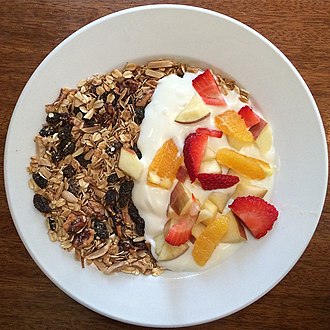
Photo: Wikipedia
This is a soft, chewy, uncoated granola bar packed with plump raisins, offering a satisfyingly dense texture without the hard snap of baked varieties. It delivers a sweet, fruity flavor from the raisins balanced by the hearty, oaty base. Nutritionally, it's a concentrated source of carbohydrates for quick energy, with a notable amount of fiber for a snack bar.
Calorie split: 7% protein · 58% carbs · 35% fat
↓ Full nutrition💚 Why it's loved
People love it for its comforting, homestyle taste and the satisfying chewiness that makes it feel more substantial than a dry, crunchy bar. It's a nostalgic, no-fuss snack that's perfect for on-the-go energy or a quick breakfast companion.
⚠️ Watch-outs & how to enjoy it better
The high carbohydrate content can lead to blood-sugar spikes if eaten alone, especially for those managing diabetes. To counteract this, pair it with a source of protein or fat, like a handful of nuts or a cheese stick, to slow digestion. Also, be mindful of portion size as these bars are calorie-dense.
Key benefits
- Provides quick energy from carbohydrates
- Contains dietary fiber for digestive health
- Offers a convenient, portable snack format
- Source of plant-based protein from oats
- Raisins contribute natural sweetness and iron
🍽️ Popular dishes

🌍 Where it's eaten
💡 Did you know?
The 'soft' texture in these uncoated bars is often achieved by using binding syrups like corn syrup or honey and sometimes by including ingredients like glycerin, which helps retain moisture and prevents the bar from hardening.
Full nutrition (USDA data · scales with serving)
| Water | 6.4 g |
| Energy | 448 kcal |
| Energy | 1874 kj |
| Protein | 7.6 g |
| Total lipid (fat) | 17.8 g |
| Ash | 1.8 g |
| Carbohydrate, by difference | 66.4 g |
| Fiber, total dietary | 4.2 g |
| Calcium, Ca | 101 mg |
| Iron, Fe | 2.4 mg |
| Magnesium, Mg | 72.0 mg |
| Phosphorus, P | 220 mg |
| Potassium, K | 362 mg |
| Sodium, Na | 282 mg |
| Zinc, Zn | 1.3 mg |
| Copper, Cu | 0.28 mg |
| Manganese, Mn | 1.3 mg |
| Selenium, Se | 15.7 ug |
| Vitamin C, total ascorbic acid | 0.00 mg |
| Thiamin | 0.23 mg |
| Riboflavin | 0.16 mg |
| Niacin | 1.1 mg |
| Pantothenic acid | 0.48 mg |
| Vitamin B-6 | 0.10 mg |
| Folate, total | 21.0 ug |
| Folic acid | 0.00 ug |
| Folate, food | 21.0 ug |
| Folate, DFE | 21.0 ug |
| Vitamin B-12 | 0.18 ug |
| Vitamin A, RAE | 0.00 ug |
| Retinol | 0.00 ug |
| Vitamin A, IU | 0.00 iu |
Fat & fatty acid profile (per 100g)
| Fatty acids, total saturated | 9.6 g |
| SFA 6:0 | 0.07 g |
| SFA 8:0 | 0.73 g |
| SFA 10:0 | 0.57 g |
| SFA 12:0 | 4.3 g |
| SFA 14:0 | 1.6 g |
| SFA 16:0 | 1.9 g |
| SFA 18:0 | 0.46 g |
| Fatty acids, total monounsaturated | 2.8 g |
| MUFA 16:1 | 0.05 g |
| MUFA 18:1 | 2.8 g |
| Fatty acids, total polyunsaturated | 3.2 g |
| PUFA 18:2 | 3.0 g |
| PUFA 18:3 | 0.17 g |
| Cholesterol | 0.00 mg |
Amino acid profile (per 100g)
| Tryptophan | 0.11 g |
| Threonine | 0.26 g |
| Isoleucine | 0.30 g |
| Leucine | 0.56 g |
| Lysine | 0.30 g |
| Methionine | 0.14 g |
| Cystine | 0.17 g |
| Phenylalanine | 0.39 g |
| Tyrosine | 0.26 g |
| Valine | 0.41 g |
| Arginine | 0.59 g |
| Histidine | 0.18 g |
| Alanine | 0.39 g |
| Aspartic acid | 0.65 g |
| Glutamic acid | 1.6 g |
| Glycine | 0.38 g |
| Proline | 0.41 g |
| Serine | 0.34 g |
FAQ
Why is this bar called 'uncoated'?
It means it lacks a chocolate, yogurt, or candy coating on the outside, leaving the oat and raisin mixture exposed.
Is it a healthy breakfast replacement?
While convenient, it's high in carbs and lacks sufficient protein and healthy fats to be a balanced meal. It's better used as a snack or paired with protein-rich foods like Greek yogurt or eggs for breakfast.
How does it differ from a baked granola bar?
Soft, uncoated bars are typically chewier and moister, held together with sticky binders rather than being baked to a crisp, crunchy texture.
Nutrient density (calculated · NRF9.3)
Nutrient Rich Foods index: beneficial nutrients (protein, fiber, vitamins, minerals) minus saturated fat, added sugar & sodium, per 100 kcal.
NRF9.3 index — Fulgoni, Keast & Drewnowski, 2009. Computed from USDA nutrients.
Weight-loss friendliness (composite index)
Energy density 4.48 kcal/g · 7% calories from protein · 4.2 g fiber · 0.0 g sugar per 100 g.
Composite of energy density (Rolls et al., 1999), protein & fiber satiety, minus sugar. A calculated heuristic — ranks satiety-per-calorie, not a clinical measure.
Dietary load (calculated from USDA values)
Potential renal acid load. Positive = acid-forming, negative = alkaline-forming.
Sodium-to-potassium ratio: 0.78 (lower is better — aim for ≤ 1)
Sodium:potassium per WHO potassium guidance. Computed from USDA nutrients.