

Snacks, granola bars, hard, peanut butter
Whole food · Snacks

Photo: Wikipedia
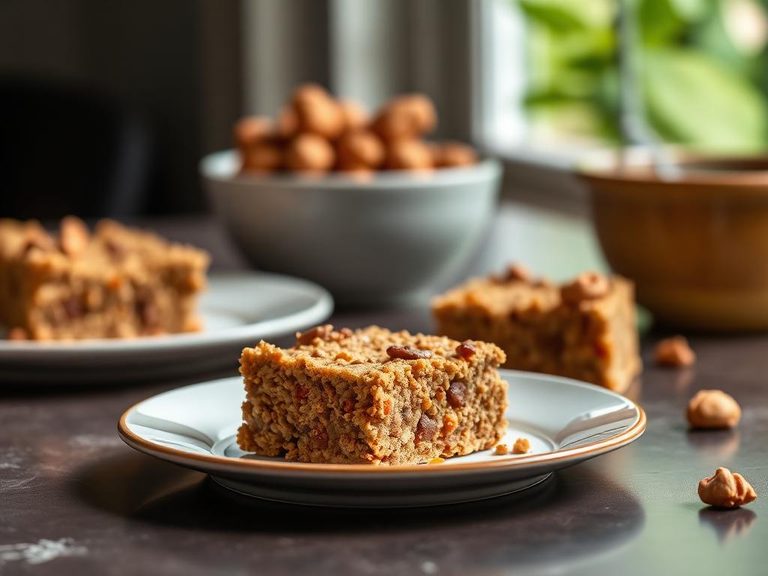
A dense, crunchy bar made from oats, peanut butter, and a binding syrup, baked hard for a satisfying snap. It offers a rich, nutty flavor with a chewy-yet-crisp texture, and is a calorie-dense snack with a solid protein punch from peanuts.
Calorie split: 8% protein · 50% carbs · 43% fat
↓ Full nutrition💚 Why it's loved
People love it for the satisfying crunch and the classic, comforting combination of salty peanut butter and sweet, oaty notes. It's a go-to for hikers, students, and anyone needing a quick, filling energy boost on the go.
⚠️ Watch-outs & how to enjoy it better
As a hard, processed snack, it can be high in sodium and added fats, and its dense calorie count can lead to overconsumption. Those monitoring blood sugar should be mindful, as the refined carbs can cause a spike. Pair it with a piece of fruit or a glass of water to add volume and slow digestion.
Key benefits
- High in calories for quick energy
- Good source of plant-based protein
- Contains dietary fiber
- Convenient portable snack
- Provides healthy fats from peanuts
🍽️ Popular dishes



🌍 Where it's eaten
💡 Did you know?
The first commercial granola bar was created in 1975 by the Quaker Oats Company, inspired by the need for a portable, healthy snack for hikers.
Full nutrition (USDA data · scales with serving)
| Water | 2.3 g |
| Energy | 483 kcal |
| Energy | 2021 kj |
| Protein | 9.8 g |
| Total lipid (fat) | 23.8 g |
| Ash | 1.7 g |
| Carbohydrate, by difference | 62.3 g |
| Fiber, total dietary | 2.9 g |
| Calcium, Ca | 41.0 mg |
| Iron, Fe | 2.4 mg |
| Magnesium, Mg | 55.0 mg |
| Phosphorus, P | 139 mg |
| Potassium, K | 291 mg |
| Sodium, Na | 283 mg |
| Zinc, Zn | 1.3 mg |
| Copper, Cu | 0.22 mg |
| Manganese, Mn | 0.92 mg |
| Selenium, Se | 15.0 ug |
| Vitamin C, total ascorbic acid | 0.20 mg |
| Thiamin | 0.21 mg |
| Riboflavin | 0.09 mg |
| Niacin | 2.0 mg |
| Pantothenic acid | 0.39 mg |
| Vitamin B-6 | 0.10 mg |
| Folate, total | 18.0 ug |
| Folic acid | 0.00 ug |
| Folate, food | 18.0 ug |
| Folate, DFE | 18.0 ug |
| Vitamin B-12 | 0.00 ug |
| Vitamin A, RAE | 1.0 ug |
| Retinol | 0.00 ug |
| Vitamin A, IU | 16.0 iu |
Fat & fatty acid profile (per 100g)
| Fatty acids, total saturated | 3.2 g |
| SFA 12:0 | 0.02 g |
| SFA 14:0 | 0.02 g |
| SFA 16:0 | 2.2 g |
| SFA 18:0 | 0.90 g |
| Fatty acids, total monounsaturated | 7.0 g |
| MUFA 16:1 | 0.01 g |
| MUFA 18:1 | 6.9 g |
| MUFA 20:1 | 0.08 g |
| Fatty acids, total polyunsaturated | 12.1 g |
| PUFA 18:2 | 11.9 g |
| PUFA 18:3 | 0.11 g |
| PUFA 20:4 | 0.02 g |
| Cholesterol | 0.00 mg |
Amino acid profile (per 100g)
| Tryptophan | 0.13 g |
| Threonine | 0.31 g |
| Isoleucine | 0.35 g |
| Leucine | 0.68 g |
| Lysine | 0.38 g |
| Methionine | 0.14 g |
| Cystine | 0.20 g |
| Phenylalanine | 0.50 g |
| Tyrosine | 0.38 g |
| Valine | 0.46 g |
| Arginine | 0.98 g |
| Histidine | 0.24 g |
| Alanine | 0.42 g |
| Aspartic acid | 1.1 g |
| Glutamic acid | 2.0 g |
| Glycine | 0.56 g |
| Proline | 0.49 g |
| Serine | 0.48 g |
FAQ
Are peanut butter granola bars healthy?
They can be part of a balanced diet, offering protein and energy. However, they are often high in calories, sodium, and added sugars, so check labels and enjoy in moderation.
Can I eat granola bars on a diet?
It depends on the type. Look for bars with minimal added sugar and high fiber. A hard peanut butter bar is calorie-dense, so portion control is key. They can be a good pre-workout snack.
Why are my homemade granola bars not hard?
They likely need more baking time or a stronger binder like honey or peanut butter. Ensure the mixture is pressed firmly into the pan before baking and cooled completely before cutting.
Nutrient density (calculated · NRF9.3)
Nutrient Rich Foods index: beneficial nutrients (protein, fiber, vitamins, minerals) minus saturated fat, added sugar & sodium, per 100 kcal.
NRF9.3 index — Fulgoni, Keast & Drewnowski, 2009. Computed from USDA nutrients.
Weight-loss friendliness (composite index)
Energy density 4.83 kcal/g · 8% calories from protein · 2.9 g fiber · 0.0 g sugar per 100 g.
Composite of energy density (Rolls et al., 1999), protein & fiber satiety, minus sugar. A calculated heuristic — ranks satiety-per-calorie, not a clinical measure.
Dietary load (calculated from USDA values)
Potential renal acid load. Positive = acid-forming, negative = alkaline-forming.
Sodium-to-potassium ratio: 0.97 (lower is better — aim for ≤ 1)
Sodium:potassium per WHO potassium guidance. Computed from USDA nutrients.