

Salisbury steak dinner, NFS, frozen meal
Common food

Photo: Wikipedia
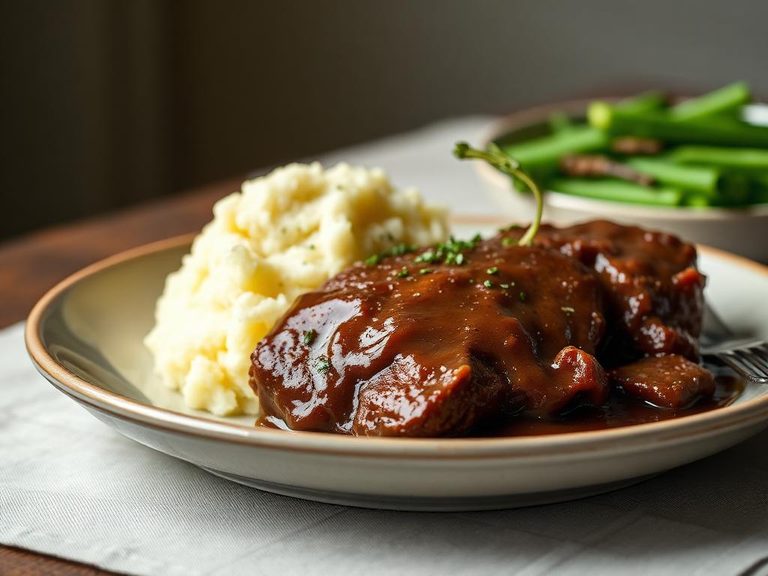
A Salisbury steak dinner, NFS (not further specified), frozen meal, is a pre-portioned, single-serving dish featuring a seasoned ground beef patty, typically served with a savory brown gravy and a side like mashed potatoes or vegetables. The texture is often soft and uniform, with the patty being tender but sometimes slightly dense from processing, while the gravy adds a rich, umami flavor. Nutritionally, it is a low-calorie option at 146 kcal per 100g, providing a moderate protein boost (6.82g) and a balance of carbs (10.94g) and fat (8.4g), making it a convenient, portion-controlled meal for quick consumption.
Calorie split: 19% protein · 30% carbs · 52% fat
↓ Full nutrition💚 Why it's loved
People love Salisbury steak dinners for their comforting, homestyle flavor that evokes nostalgia, often reminding them of classic American diners or family meals. The convenience of a frozen meal makes it a go-to for busy weeknights, offering a satisfying, savory taste without the hassle of cooking from scratch.
⚠️ Watch-outs & how to enjoy it better
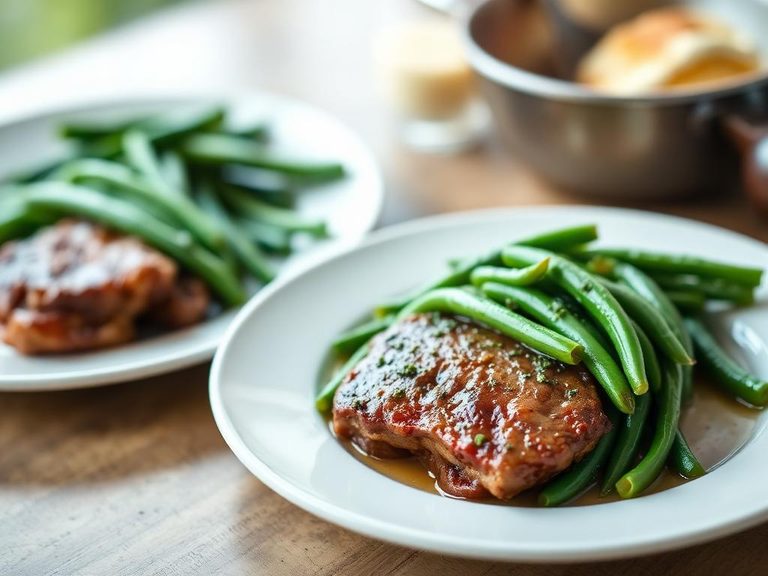
The meal can be high in sodium, which may contribute to blood pressure issues, and the processed nature of frozen foods might contain additives or preservatives that some prefer to avoid. To counteract, pair it with a fresh vegetable side to add fiber and nutrients, and opt for low-sodium versions or rinse the patty lightly if possible to reduce salt intake.
Key benefits
- Provides a quick, convenient meal with minimal preparation time.
- Offers a balanced macronutrient profile with protein, carbs, and fat in one serving.
- Low in calories (146 kcal per 100g), suitable for calorie-conscious diets.
- Contains dietary fiber (1.2g per 100g) to support digestive health.
- Often fortified with vitamins and minerals in frozen meal formulations.
🍽️ Popular dishes



🌍 Where it's eaten
💡 Did you know?
The Salisbury steak is named after Dr. James Salisbury, a 19th-century American physician who advocated for a meat-based diet to improve health, and it was originally promoted as a nutritious alternative to traditional beef dishes.
Full nutrition (USDA data · scales with serving)
| Water | 72.8 g |
| Energy | 146 kcal |
| Protein | 6.8 g |
| Total lipid (fat) | 8.4 g |
| Carbohydrate, by difference | 10.9 g |
| Fiber, total dietary | 1.2 g |
| Total Sugars | 1.4 g |
| Calcium, Ca | 15.0 mg |
| Iron, Fe | 0.84 mg |
| Magnesium, Mg | 15.0 mg |
| Phosphorus, P | 72.0 mg |
| Potassium, K | 179 mg |
| Sodium, Na | 268 mg |
| Zinc, Zn | 1.5 mg |
| Copper, Cu | 0.08 mg |
| Selenium, Se | 5.7 ug |
| Vitamin C, total ascorbic acid | 5.3 mg |
| Thiamin | 0.07 mg |
| Riboflavin | 0.07 mg |
| Niacin | 1.6 mg |
| Vitamin B-6 | 0.16 mg |
| Folate, total | 16.0 ug |
| Folic acid | 0.00 ug |
| Folate, food | 16.0 ug |
| Folate, DFE | 16.0 ug |
| Choline, total | 34.5 mg |
| Vitamin B-12 | 0.60 ug |
| Vitamin B-12, added | 0.00 ug |
| Vitamin A, RAE | 56.0 ug |
| Retinol | 43.0 ug |
| Carotene, beta | 148 ug |
| Carotene, alpha | 5.0 ug |
| Cryptoxanthin, beta | 13.0 ug |
| Lycopene | 0.00 ug |
| Lutein + zeaxanthin | 336 ug |
| Vitamin E (alpha-tocopherol) | 0.08 mg |
| Vitamin E, added | 0.00 mg |
| Vitamin D (D2 + D3) | 0.10 ug |
| Vitamin K (phylloquinone) | 4.0 ug |
| Alcohol, ethyl | 0.00 g |
| Caffeine | 0.00 mg |
| Theobromine | 0.00 mg |
Fat & fatty acid profile (per 100g)
| Fatty acids, total saturated | 3.9 g |
| SFA 4:0 | 0.10 g |
| SFA 6:0 | 0.07 g |
| SFA 8:0 | 0.04 g |
| SFA 10:0 | 0.10 g |
| SFA 12:0 | 0.12 g |
| SFA 14:0 | 0.47 g |
| SFA 16:0 | 2.0 g |
| SFA 18:0 | 0.83 g |
| Fatty acids, total monounsaturated | 2.7 g |
| MUFA 16:1 | 0.20 g |
| MUFA 18:1 | 2.4 g |
| MUFA 20:1 | 0.02 g |
| MUFA 22:1 | 0.00 g |
| Fatty acids, total polyunsaturated | 0.34 g |
| PUFA 18:2 | 0.29 g |
| PUFA 18:3 | 0.04 g |
| PUFA 18:4 | 0.00 g |
| PUFA 20:4 | 0.02 g |
| PUFA 20:5 n-3 (EPA) | 0.00 g |
| PUFA 22:5 n-3 (DPA) | 0.00 g |
| PUFA 22:6 n-3 (DHA) | 0.00 g |
| Cholesterol | 41.0 mg |
FAQ
What is Salisbury steak made of?
Salisbury steak is typically made from ground beef, often mixed with breadcrumbs, onions, and seasonings, formed into a patty, and served with gravy.
Is Salisbury steak healthy?
It can be part of a balanced diet if consumed in moderation, as it provides protein and nutrients, but it may be high in sodium and fat, so pairing with vegetables and choosing low-sodium versions can improve its health profile.
How do you cook a frozen Salisbury steak meal?
Frozen Salisbury steak meals are usually heated in the microwave or oven according to package instructions, ensuring the internal temperature reaches 165°F (74°C) for safety.
Nutrient density (calculated · NRF9.3)
Nutrient Rich Foods index: beneficial nutrients (protein, fiber, vitamins, minerals) minus saturated fat, added sugar & sodium, per 100 kcal.
NRF9.3 index — Fulgoni, Keast & Drewnowski, 2009. Computed from USDA nutrients.
Weight-loss friendliness (composite index)
Energy density 1.46 kcal/g · 19% calories from protein · 1.2 g fiber · 1.4 g sugar per 100 g.
Composite of energy density (Rolls et al., 1999), protein & fiber satiety, minus sugar. A calculated heuristic — ranks satiety-per-calorie, not a clinical measure.
Dietary load (calculated from USDA values)
Potential renal acid load. Positive = acid-forming, negative = alkaline-forming.
Sodium-to-potassium ratio: 1.50 (lower is better — aim for ≤ 1)
Sodium:potassium per WHO potassium guidance. Computed from USDA nutrients.