

Salisbury steak with gravy, whipped potatoes, vegetable, dessert, frozen meal
Common food

Photo: Wikipedia
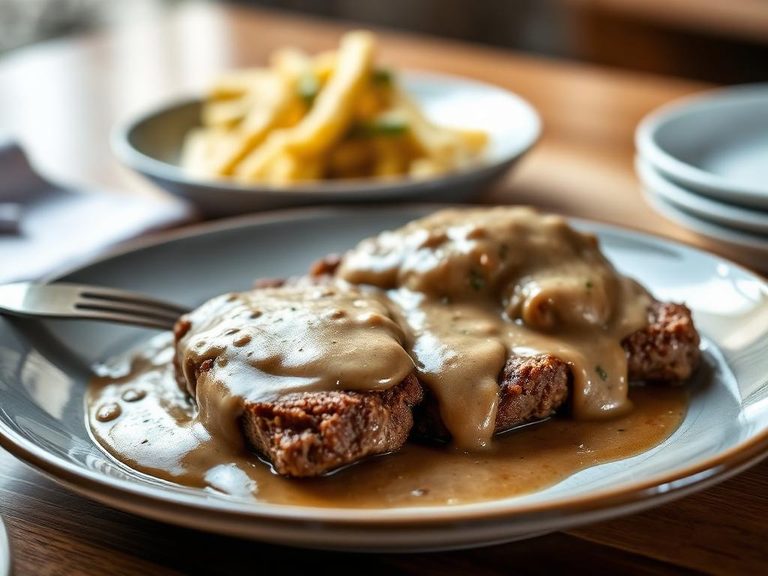
A classic American frozen TV dinner, Salisbury steak with gravy, whipped potatoes, a vegetable, and dessert is a complete, pre-portioned meal. The savory, soft-textured beef patty is smothered in a rich, salty brown gravy, paired with creamy, starchy potatoes and a sweet finish. Nutritionally, it's a low-calorie option per 100g, but its small serving size means the total calorie count for the full tray is modest, making it a quick, convenient meal for calorie-conscious individuals.
Calorie split: 22% protein · 36% carbs · 43% fat
↓ Full nutrition💚 Why it's loved
People love it for its nostalgic comfort and the sheer convenience of having a hot, multi-component meal ready in minutes. The familiar, savory flavors of the gravy and mashed potatoes evoke a sense of home-style cooking without the effort.
⚠️ Watch-outs & how to enjoy it better
The meal is often high in sodium and may contain preservatives, which can be a concern for those managing blood pressure or sensitive to additives. To counteract this, pair it with a fresh, unsalted side salad or a piece of fruit, and ensure you drink plenty of water throughout the day.
Key benefits
- Extremely convenient, pre-cooked meal requiring only heating
- Provides a complete, balanced plate of protein, starch, and vegetable
- Low in calories per 100g, aiding in portion and calorie control
- Shelf-stable and long-lasting, reducing food waste
- Offers a nostalgic, comforting flavor profile
🍽️ Popular dishes

🌍 Where it's eaten
💡 Did you know?
The Salisbury steak was originally promoted in the late 19th century by Dr. James Salisbury as a health food, believing the finely ground beef was easier to digest and would cure ailments like dyspepsia.
Full nutrition (USDA data · scales with serving)
| Water | 71.2 g |
| Energy | 141 kcal |
| Protein | 7.7 g |
| Total lipid (fat) | 6.7 g |
| Carbohydrate, by difference | 12.6 g |
| Fiber, total dietary | 1.0 g |
| Total Sugars | 2.2 g |
| Calcium, Ca | 27.0 mg |
| Iron, Fe | 1.2 mg |
| Magnesium, Mg | 16.0 mg |
| Phosphorus, P | 82.0 mg |
| Potassium, K | 190 mg |
| Sodium, Na | 589 mg |
| Zinc, Zn | 1.5 mg |
| Copper, Cu | 0.05 mg |
| Selenium, Se | 6.9 ug |
| Vitamin C, total ascorbic acid | 0.40 mg |
| Thiamin | 0.10 mg |
| Riboflavin | 0.11 mg |
| Niacin | 2.1 mg |
| Vitamin B-6 | 0.12 mg |
| Folate, total | 19.0 ug |
| Folic acid | 7.0 ug |
| Folate, food | 12.0 ug |
| Folate, DFE | 24.0 ug |
| Choline, total | 28.3 mg |
| Vitamin B-12 | 0.66 ug |
| Vitamin B-12, added | 0.00 ug |
| Vitamin A, RAE | 15.0 ug |
| Retinol | 14.0 ug |
| Carotene, beta | 10.0 ug |
| Carotene, alpha | 2.0 ug |
| Cryptoxanthin, beta | 12.0 ug |
| Lycopene | 0.00 ug |
| Lutein + zeaxanthin | 73.0 ug |
| Vitamin E (alpha-tocopherol) | 0.20 mg |
| Vitamin E, added | 0.00 mg |
| Vitamin D (D2 + D3) | 0.00 ug |
| Vitamin K (phylloquinone) | 2.5 ug |
| Alcohol, ethyl | 0.00 g |
| Caffeine | 0.00 mg |
| Theobromine | 0.00 mg |
Fat & fatty acid profile (per 100g)
| Fatty acids, total saturated | 2.5 g |
| SFA 4:0 | 0.02 g |
| SFA 6:0 | 0.02 g |
| SFA 8:0 | 0.01 g |
| SFA 10:0 | 0.03 g |
| SFA 12:0 | 0.03 g |
| SFA 14:0 | 0.21 g |
| SFA 16:0 | 1.3 g |
| SFA 18:0 | 0.70 g |
| Fatty acids, total monounsaturated | 2.6 g |
| MUFA 16:1 | 0.17 g |
| MUFA 18:1 | 2.3 g |
| MUFA 20:1 | 0.02 g |
| MUFA 22:1 | 0.00 g |
| Fatty acids, total polyunsaturated | 0.80 g |
| PUFA 18:2 | 0.71 g |
| PUFA 18:3 | 0.07 g |
| PUFA 18:4 | 0.00 g |
| PUFA 20:4 | 0.01 g |
| PUFA 20:5 n-3 (EPA) | 0.00 g |
| PUFA 22:5 n-3 (DPA) | 0.00 g |
| PUFA 22:6 n-3 (DHA) | 0.00 g |
| Cholesterol | 25.0 mg |
FAQ
Is Salisbury steak the same as meatloaf?
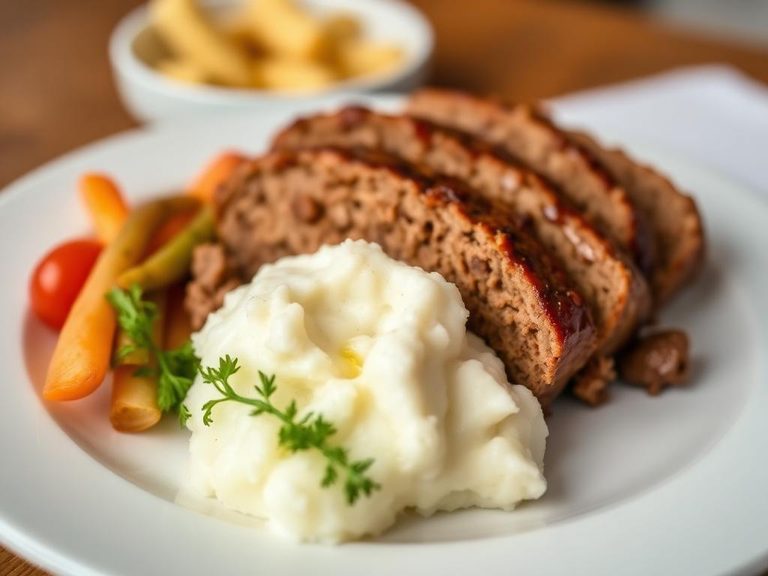
Not exactly. Salisbury steak is a patty made from ground beef, often mixed with breadcrumbs and seasonings, then cooked and served with gravy. Meatloaf is a larger loaf made from a similar mixture, baked, and sliced.
How does the nutrition compare to a homemade version?
Frozen Salisbury steak meals are typically lower in calories per 100g but can be higher in sodium and preservatives compared to a homemade version, which allows for control over ingredients and portion size.
Can I make this meal healthier?
Yes, you can enhance it by adding a fresh vegetable side, using low-sodium gravy, or choosing a version with whole-grain potatoes. Pairing it with a protein-rich food like beans or a side salad can also boost its nutritional value.
Nutrient density (calculated · NRF9.3)
Nutrient Rich Foods index: beneficial nutrients (protein, fiber, vitamins, minerals) minus saturated fat, added sugar & sodium, per 100 kcal.
NRF9.3 index — Fulgoni, Keast & Drewnowski, 2009. Computed from USDA nutrients.
Weight-loss friendliness (composite index)
Energy density 1.41 kcal/g · 22% calories from protein · 1.0 g fiber · 2.2 g sugar per 100 g.
Composite of energy density (Rolls et al., 1999), protein & fiber satiety, minus sugar. A calculated heuristic — ranks satiety-per-calorie, not a clinical measure.
Dietary load (calculated from USDA values)
Potential renal acid load. Positive = acid-forming, negative = alkaline-forming.
Sodium-to-potassium ratio: 3.10 (lower is better — aim for ≤ 1)
Sodium:potassium per WHO potassium guidance. Computed from USDA nutrients.