

Ramen bowl, NFS
Common food
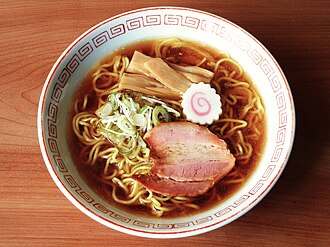
Photo: Wikipedia
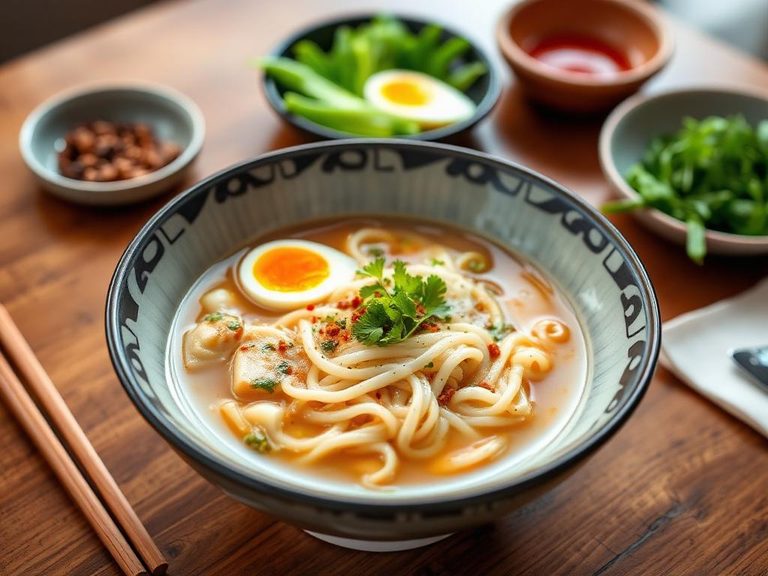
A comforting bowl of ramen is a steaming, aromatic harmony of wheat noodles swimming in a rich, savory broth, often topped with tender slices of meat, a soft-boiled egg, and fresh scallions. The noodles offer a satisfying chew, while the broth delivers a deep, umami-packed flavor that warms from the inside. Nutritionally, it's a moderate source of protein and carbs, providing a quick energy boost.
Calorie split: 23% protein · 44% carbs · 33% fat
↓ Full nutrition💚 Why it's loved
People adore ramen for its deeply satisfying, umami-rich broth and the perfect chew of the noodles, making it the ultimate comfort food. Its versatility allows for endless customization with toppings, catering to a wide range of tastes and dietary preferences.
⚠️ Watch-outs & how to enjoy it better
Ramen bowls, especially instant varieties, can be high in sodium, which may concern those monitoring blood pressure. The refined wheat noodles can cause a rapid blood-sugar spike. To counteract this, add a source of protein (like an egg or chicken) and fiber (like spinach or seaweed) to slow digestion, and consider using a low-sodium broth base or rinsing noodles.
Key benefits
- Good source of quick-release carbohydrates for energy
- Provides a moderate amount of protein from noodles and toppings
- Broth can be hydrating and rich in minerals like sodium
- Versatile base for adding vegetables and lean proteins
- Culturally significant comfort food with regional variety
🍽️ Popular dishes
🌍 Where it's eaten
💡 Did you know?
The word 'ramen' is actually a Japanese borrowing of the Chinese 'lamian' (拉面), which means 'pulled noodles,' referring to the traditional method of stretching and pulling the dough by hand.
Full nutrition (USDA data · scales with serving)
| Water | 73.2 g |
| Energy | 127 kcal |
| Protein | 7.1 g |
| Total lipid (fat) | 4.6 g |
| Carbohydrate, by difference | 13.9 g |
| Fiber, total dietary | 0.90 g |
| Total Sugars | 0.42 g |
| Calcium, Ca | 18.0 mg |
| Iron, Fe | 0.98 mg |
| Magnesium, Mg | 14.0 mg |
| Phosphorus, P | 79.0 mg |
| Potassium, K | 96.0 mg |
| Sodium, Na | 333 mg |
| Zinc, Zn | 0.72 mg |
| Copper, Cu | 0.06 mg |
| Selenium, Se | 18.3 ug |
| Vitamin C, total ascorbic acid | 2.8 mg |
| Thiamin | 0.14 mg |
| Riboflavin | 0.13 mg |
| Niacin | 1.5 mg |
| Vitamin B-6 | 0.10 mg |
| Folate, total | 46.0 ug |
| Folic acid | 29.0 ug |
| Folate, food | 17.0 ug |
| Folate, DFE | 66.0 ug |
| Choline, total | 48.2 mg |
| Vitamin B-12 | 0.32 ug |
| Vitamin B-12, added | 0.00 ug |
| Vitamin A, RAE | 31.0 ug |
| Retinol | 19.0 ug |
| Carotene, beta | 143 ug |
| Carotene, alpha | 0.00 ug |
| Cryptoxanthin, beta | 1.0 ug |
| Lycopene | 0.00 ug |
| Lutein + zeaxanthin | 105 ug |
| Vitamin E (alpha-tocopherol) | 0.60 mg |
| Vitamin E, added | 0.00 mg |
| Vitamin D (D2 + D3) | 0.30 ug |
| Vitamin K (phylloquinone) | 13.4 ug |
| Alcohol, ethyl | 0.00 g |
| Caffeine | 0.00 mg |
| Theobromine | 0.00 mg |
Fat & fatty acid profile (per 100g)
| Fatty acids, total saturated | 1.1 g |
| SFA 4:0 | 0.00 g |
| SFA 6:0 | 0.00 g |
| SFA 8:0 | 0.00 g |
| SFA 10:0 | 0.00 g |
| SFA 12:0 | 0.00 g |
| SFA 14:0 | 0.03 g |
| SFA 16:0 | 0.73 g |
| SFA 18:0 | 0.25 g |
| Fatty acids, total monounsaturated | 1.8 g |
| MUFA 16:1 | 0.08 g |
| MUFA 18:1 | 1.7 g |
| MUFA 20:1 | 0.02 g |
| MUFA 22:1 | 0.00 g |
| Fatty acids, total polyunsaturated | 1.2 g |
| PUFA 18:2 | 1.1 g |
| PUFA 18:3 | 0.11 g |
| PUFA 18:4 | 0.00 g |
| PUFA 20:4 | 0.01 g |
| PUFA 20:5 n-3 (EPA) | 0.00 g |
| PUFA 22:5 n-3 (DPA) | 0.00 g |
| PUFA 22:6 n-3 (DHA) | 0.01 g |
| Cholesterol | 53.0 mg |
FAQ
Is ramen healthy?
It can be part of a balanced diet. The broth and noodles are often high in sodium and refined carbs. Opt for broths with lower sodium, add plenty of vegetables and a lean protein source, and watch your portion size to make it a more nutritious meal.
What makes ramen broth creamy?
The creamy, opaque texture in broths like Tonkotsu comes from boiling pork bones (and sometimes other ingredients) for many hours at a rolling boil. This process emulsifies the fat and collagen from the bones into the liquid, creating a rich, milky consistency.
Can I make ramen broth from scratch easily?
While authentic, restaurant-quality broth can take 12+ hours, you can make a simplified, flavorful version at home. Simmer chicken or pork bones with aromatics like ginger, garlic, and scallions for 2-3 hours, then strain and season with soy sauce, mirin, and salt.
Nutrient density (calculated · NRF9.3)
Nutrient Rich Foods index: beneficial nutrients (protein, fiber, vitamins, minerals) minus saturated fat, added sugar & sodium, per 100 kcal.
NRF9.3 index — Fulgoni, Keast & Drewnowski, 2009. Computed from USDA nutrients.
Weight-loss friendliness (composite index)
Energy density 1.27 kcal/g · 22% calories from protein · 0.9 g fiber · 0.4 g sugar per 100 g.
Composite of energy density (Rolls et al., 1999), protein & fiber satiety, minus sugar. A calculated heuristic — ranks satiety-per-calorie, not a clinical measure.
Dietary load (calculated from USDA values)
Potential renal acid load. Positive = acid-forming, negative = alkaline-forming.
Sodium-to-potassium ratio: 3.47 (lower is better — aim for ≤ 1)
Sodium:potassium per WHO potassium guidance. Computed from USDA nutrients.