

Pork jerky
Common food

Photo: Wikipedia
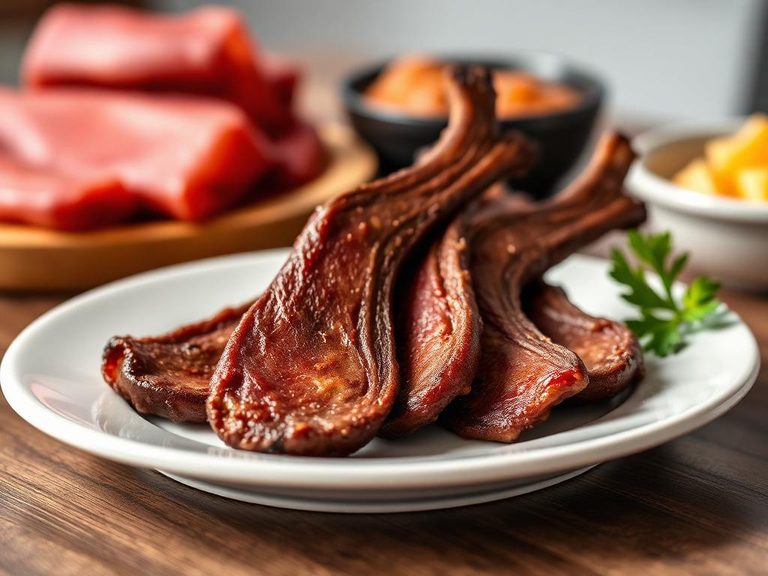
Pork jerky is a lean, intensely flavored dried meat snack, typically chewy with a savory-sweet profile. Its nutrition is defined by a powerful protein punch (35g per 100g) and a significant fat content, making it a dense, energy-rich food.
Calorie split: 35% protein · 10% carbs · 55% fat
↓ Full nutrition💚 Why it's loved
People love it for its satisfying, savory umami flavor and satisfying chew, making it a perfect protein-packed snack for hiking, road trips, or a quick desk drawer pick-me-up.
⚠️ Watch-outs & how to enjoy it better
The high sodium content can contribute to water retention, and the fat and sugar may be a concern for those monitoring calorie density or blood sugar. Opt for low-sodium varieties, practice portion control (a 30g serving is ample), and pair it with water or a fibrous vegetable like celery.
Key benefits
- Excellent source of complete protein for muscle maintenance
- Highly portable and shelf-stable for on-the-go nutrition
- Provides a quick, substantial energy boost from fat and protein
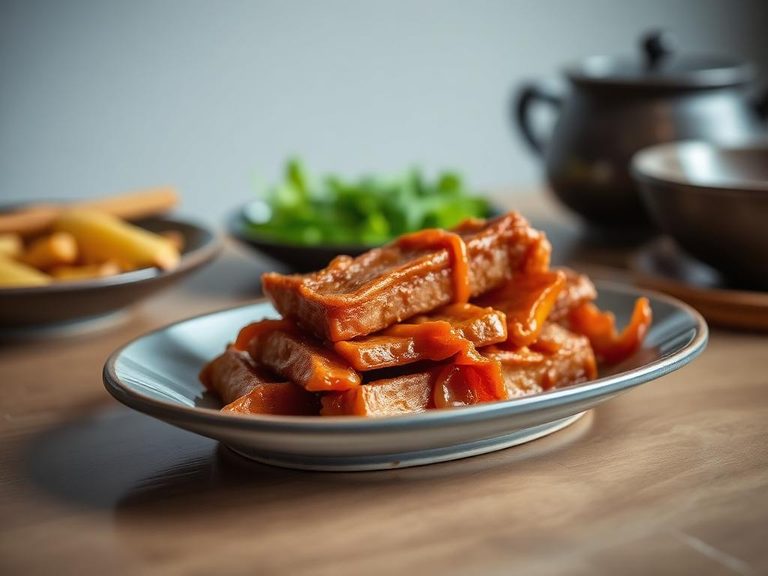
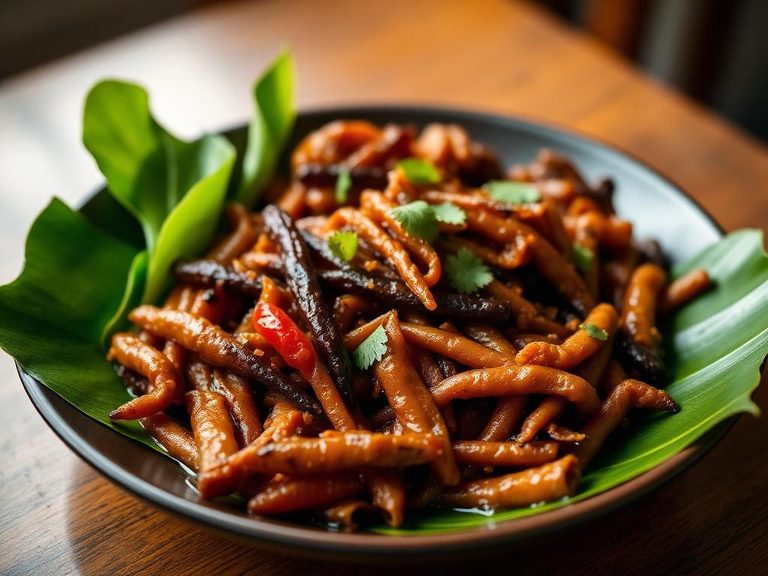
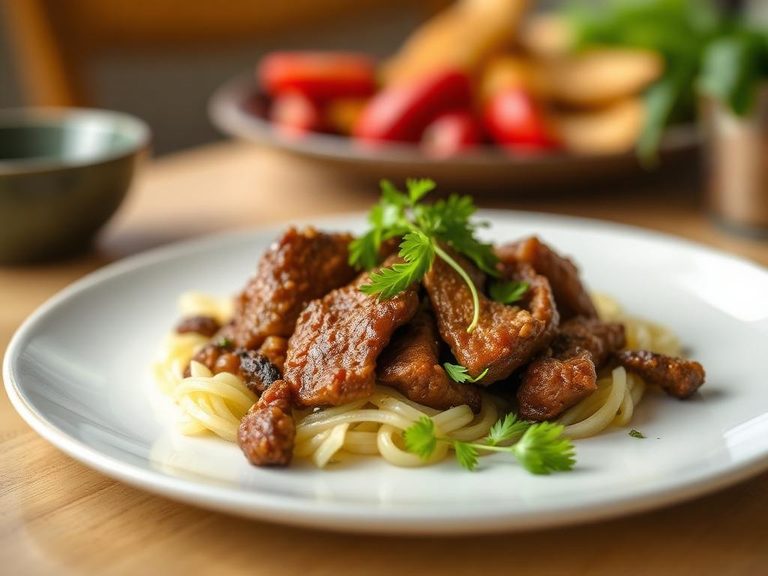
🍽️ Popular dishes
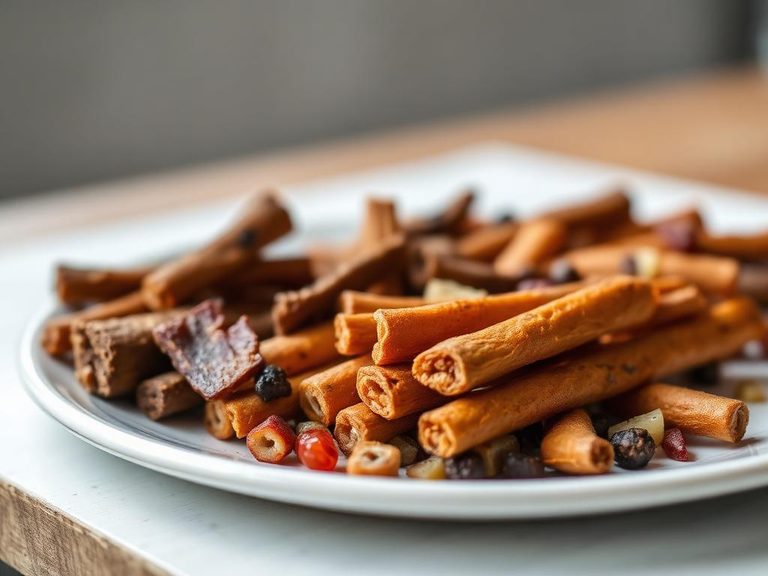
🌍 Where it's eaten
💡 Did you know?
The word 'jerky' comes from the Quechua word 'ch'arki', meaning 'dried meat', a preservation method perfected by Andean cultures thousands of years ago.
Full nutrition (USDA data · scales with serving)
| Water | 22.9 g |
| Energy | 412 kcal |
| Protein | 35.0 g |
| Total lipid (fat) | 24.7 g |
| Carbohydrate, by difference | 9.7 g |
| Fiber, total dietary | 0.00 g |
| Total Sugars | 9.8 g |
| Calcium, Ca | 39.0 mg |
| Iron, Fe | 2.5 mg |
| Magnesium, Mg | 32.0 mg |
| Phosphorus, P | 290 mg |
| Potassium, K | 426 mg |
| Sodium, Na | 1810 mg |
| Zinc, Zn | 6.8 mg |
| Copper, Cu | 0.18 mg |
| Selenium, Se | 59.3 ug |
| Vitamin C, total ascorbic acid | 0.00 mg |
| Thiamin | 0.70 mg |
| Riboflavin | 0.51 mg |
| Niacin | 5.4 mg |
| Vitamin B-6 | 0.63 mg |
| Folate, total | 0.00 ug |
| Folic acid | 0.00 ug |
| Folate, food | 0.00 ug |
| Folate, DFE | 0.00 ug |
| Choline, total | 143 mg |
| Vitamin B-12 | 1.3 ug |
| Vitamin B-12, added | 0.00 ug |
| Vitamin A, RAE | 3.0 ug |
| Retinol | 3.0 ug |
| Carotene, beta | 0.00 ug |
| Carotene, alpha | 0.00 ug |
| Cryptoxanthin, beta | 0.00 ug |
| Lycopene | 0.00 ug |
| Lutein + zeaxanthin | 0.00 ug |
| Vitamin E (alpha-tocopherol) | 0.17 mg |
| Vitamin E, added | 0.00 mg |
| Vitamin D (D2 + D3) | 1.7 ug |
| Vitamin K (phylloquinone) | 0.00 ug |
| Alcohol, ethyl | 0.00 g |
| Caffeine | 0.00 mg |
| Theobromine | 0.00 mg |
Fat & fatty acid profile (per 100g)
| Fatty acids, total saturated | 9.2 g |
| SFA 4:0 | 0.00 g |
| SFA 6:0 | 0.00 g |
| SFA 8:0 | 0.00 g |
| SFA 10:0 | 0.02 g |
| SFA 12:0 | 0.02 g |
| SFA 14:0 | 0.31 g |
| SFA 16:0 | 5.6 g |
| SFA 18:0 | 3.1 g |
| Fatty acids, total monounsaturated | 11.2 g |
| MUFA 16:1 | 0.57 g |
| MUFA 18:1 | 10.4 g |
| MUFA 20:1 | 0.18 g |
| MUFA 22:1 | 0.00 g |
| Fatty acids, total polyunsaturated | 2.9 g |
| PUFA 18:2 | 2.5 g |
| PUFA 18:3 | 0.11 g |
| PUFA 18:4 | 0.00 g |
| PUFA 20:4 | 0.14 g |
| PUFA 20:5 n-3 (EPA) | 0.00 g |
| PUFA 22:5 n-3 (DPA) | 0.00 g |
| PUFA 22:6 n-3 (DHA) | 0.00 g |
| Cholesterol | 137 mg |
FAQ
Is pork jerky a good post-workout snack?
Yes, its high protein content supports muscle repair. The fat slows digestion, providing sustained energy, but for faster absorption, a protein shake or leaner source might be preferable immediately after intense exercise.
How does it compare to beef jerky nutritionally?
Pork jerky often has a slightly higher fat content than lean beef jerky, which can make it more calorie-dense. Both are excellent high-protein snacks, with flavor profiles varying by marinade and cut.
Can I make it at home safely?
Yes, using a food dehydrator or oven on its lowest setting is key. The meat must be heated to a safe internal temperature (160°F/71°C) before drying to eliminate pathogens, and proper storage in airtight containers is essential.
Nutrient density (calculated · NRF9.3)
Nutrient Rich Foods index: beneficial nutrients (protein, fiber, vitamins, minerals) minus saturated fat, added sugar & sodium, per 100 kcal.
NRF9.3 index — Fulgoni, Keast & Drewnowski, 2009. Computed from USDA nutrients.
Weight-loss friendliness (composite index)
Energy density 4.12 kcal/g · 34% calories from protein · 0.0 g fiber · 9.8 g sugar per 100 g.
Composite of energy density (Rolls et al., 1999), protein & fiber satiety, minus sugar. A calculated heuristic — ranks satiety-per-calorie, not a clinical measure.
Dietary load (calculated from USDA values)
Potential renal acid load. Positive = acid-forming, negative = alkaline-forming.
Sodium-to-potassium ratio: 4.25 (lower is better — aim for ≤ 1)
Sodium:potassium per WHO potassium guidance. Computed from USDA nutrients.