

Beef jerky
Common food

Photo: Wikipedia
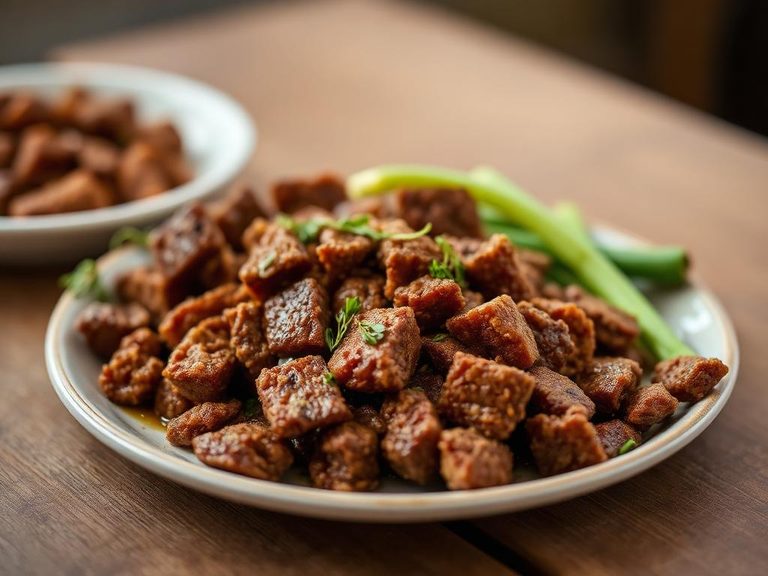
Beef jerky is lean meat that has been trimmed of fat, cut into strips, and dried with heat and salt to prevent spoilage. It has a chewy, fibrous texture and a concentrated, savory, often smoky or spicy flavor. Nutritionally, it is a dense source of protein with a significant fat content.
Calorie split: 33% protein · 11% carbs · 57% fat
↓ Full nutrition💚 Why it's loved
People love its intense, savory umami flavor and satisfying chew, making it a go-to for hiking, travel, or a quick protein boost. Its versatility is shown in its countless regional spice profiles, from sweet and smoky to fiery and spicy.
⚠️ Watch-outs & how to enjoy it better
The curing process often involves high sodium, which can be a concern for blood pressure, and some brands contain added sugars. To counteract, look for low-sodium varieties, pair it with water-rich fruits like apples or oranges to balance salt intake, and practice portion control (a standard serving is about 28g).
Key benefits
- High in complete protein for muscle maintenance
- Shelf-stable and requires no refrigeration
- Provides iron and zinc from red meat
- Convenient, portable, non-perishable snack
🍽️ Popular dishes
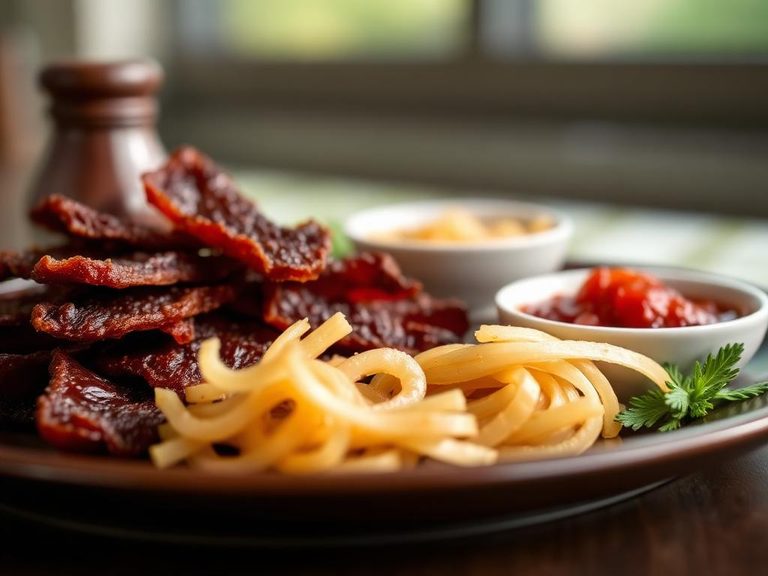
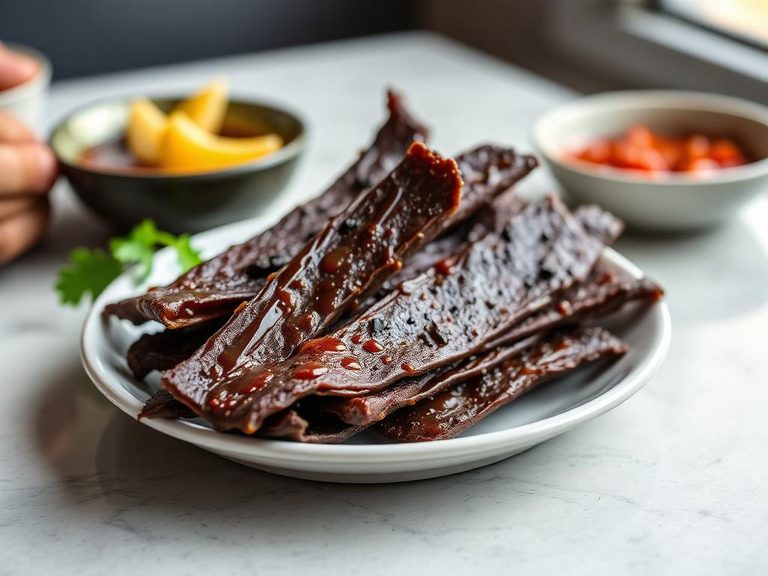
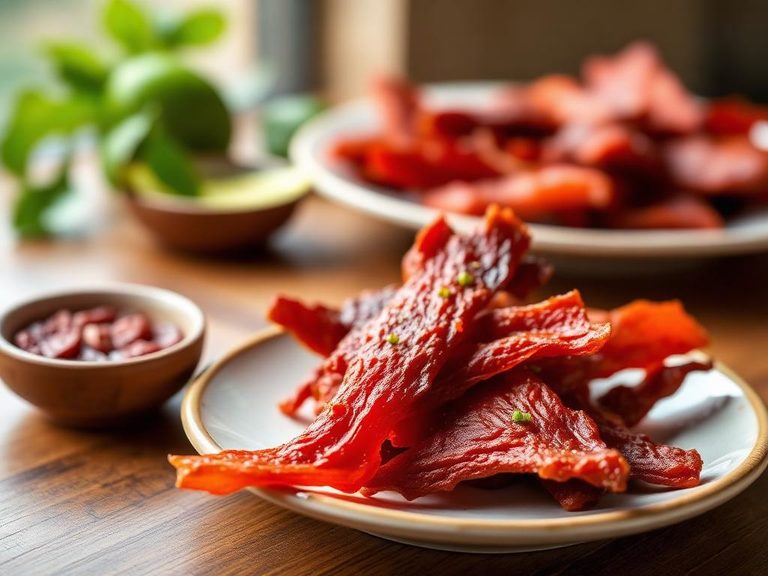
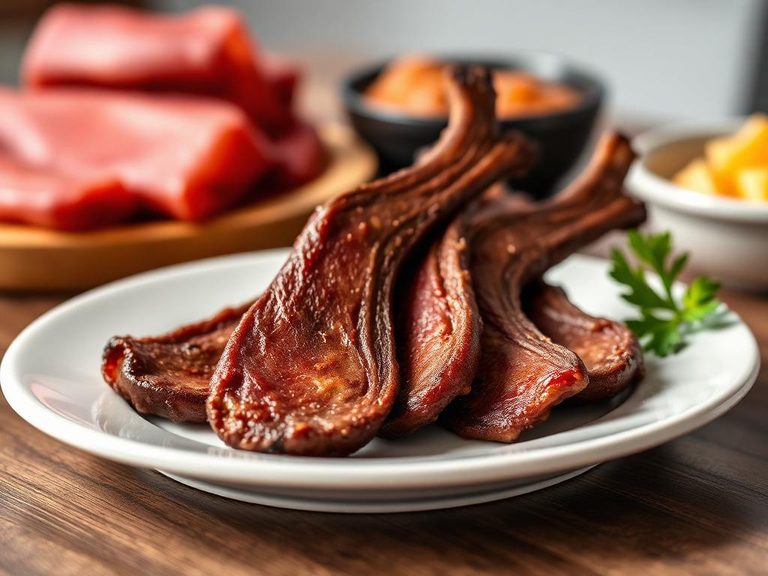
🌍 Where it's eaten
💡 Did you know?
The word 'jerky' comes from the Quechua word 'ch'arki', which means 'dried meat', highlighting its ancient Andean origins.
Full nutrition (USDA data · scales with serving)
| Water | 23.4 g |
| Energy | 410 kcal |
| Protein | 33.2 g |
| Total lipid (fat) | 25.6 g |
| Carbohydrate, by difference | 11.0 g |
| Fiber, total dietary | 1.8 g |
| Total Sugars | 9.0 g |
| Calcium, Ca | 20.0 mg |
| Iron, Fe | 5.4 mg |
| Magnesium, Mg | 51.0 mg |
| Phosphorus, P | 407 mg |
| Potassium, K | 597 mg |
| Sodium, Na | 1785 mg |
| Zinc, Zn | 8.1 mg |
| Copper, Cu | 0.23 mg |
| Selenium, Se | 10.7 ug |
| Vitamin C, total ascorbic acid | 0.00 mg |
| Thiamin | 0.15 mg |
| Riboflavin | 0.14 mg |
| Niacin | 1.7 mg |
| Vitamin B-6 | 0.18 mg |
| Folate, total | 134 ug |
| Folic acid | 0.00 ug |
| Folate, food | 134 ug |
| Folate, DFE | 134 ug |
| Choline, total | 109 mg |
| Vitamin B-12 | 0.99 ug |
| Vitamin B-12, added | 0.00 ug |
| Vitamin A, RAE | 0.00 ug |
| Retinol | 0.00 ug |
| Carotene, beta | 0.00 ug |
| Carotene, alpha | 0.00 ug |
| Cryptoxanthin, beta | 0.00 ug |
| Lycopene | 0.00 ug |
| Lutein + zeaxanthin | 0.00 ug |
| Vitamin E (alpha-tocopherol) | 0.49 mg |
| Vitamin E, added | 0.00 mg |
| Vitamin D (D2 + D3) | 0.30 ug |
| Vitamin K (phylloquinone) | 2.3 ug |
| Alcohol, ethyl | 0.00 g |
| Caffeine | 0.00 mg |
| Theobromine | 0.00 mg |
Fat & fatty acid profile (per 100g)
| Fatty acids, total saturated | 10.8 g |
| SFA 4:0 | 0.00 g |
| SFA 6:0 | 0.00 g |
| SFA 8:0 | 0.00 g |
| SFA 10:0 | 0.01 g |
| SFA 12:0 | 0.16 g |
| SFA 14:0 | 0.82 g |
| SFA 16:0 | 5.7 g |
| SFA 18:0 | 3.9 g |
| Fatty acids, total monounsaturated | 11.3 g |
| MUFA 16:1 | 1.1 g |
| MUFA 18:1 | 10.1 g |
| MUFA 20:1 | 0.07 g |
| MUFA 22:1 | 0.00 g |
| Fatty acids, total polyunsaturated | 1.0 g |
| PUFA 18:2 | 0.81 g |
| PUFA 18:3 | 0.18 g |
| PUFA 18:4 | 0.00 g |
| PUFA 20:4 | 0.02 g |
| PUFA 20:5 n-3 (EPA) | 0.00 g |
| PUFA 22:5 n-3 (DPA) | 0.00 g |
| PUFA 22:6 n-3 (DHA) | 0.00 g |
| Cholesterol | 48.0 mg |
FAQ
Is beef jerky a healthy snack?
It can be a healthy part of a diet due to its high protein content, but it's important to choose brands low in sodium and added sugars. It's a nutrient-dense option, especially for active individuals needing portable protein.
How is beef jerky made?
Lean beef is marinated in a salt-based solution (often with spices and sugar), then slowly dried or smoked at low temperatures. This dehydration process removes moisture, concentrating the flavor and preserving the meat.
What is the difference between jerky and biltong?
Jerky is typically sliced before drying and often uses heat in the process. Biltong is a South African variant where larger cuts of meat are marinated in vinegar, then air-dried and sliced after curing, resulting in a different, often more tender texture.
Nutrient density (calculated · NRF9.3)
Nutrient Rich Foods index: beneficial nutrients (protein, fiber, vitamins, minerals) minus saturated fat, added sugar & sodium, per 100 kcal.
NRF9.3 index — Fulgoni, Keast & Drewnowski, 2009. Computed from USDA nutrients.
Weight-loss friendliness (composite index)
Energy density 4.10 kcal/g · 32% calories from protein · 1.8 g fiber · 9.0 g sugar per 100 g.
Composite of energy density (Rolls et al., 1999), protein & fiber satiety, minus sugar. A calculated heuristic — ranks satiety-per-calorie, not a clinical measure.
Dietary load (calculated from USDA values)
Potential renal acid load. Positive = acid-forming, negative = alkaline-forming.
Sodium-to-potassium ratio: 2.99 (lower is better — aim for ≤ 1)
Sodium:potassium per WHO potassium guidance. Computed from USDA nutrients.