

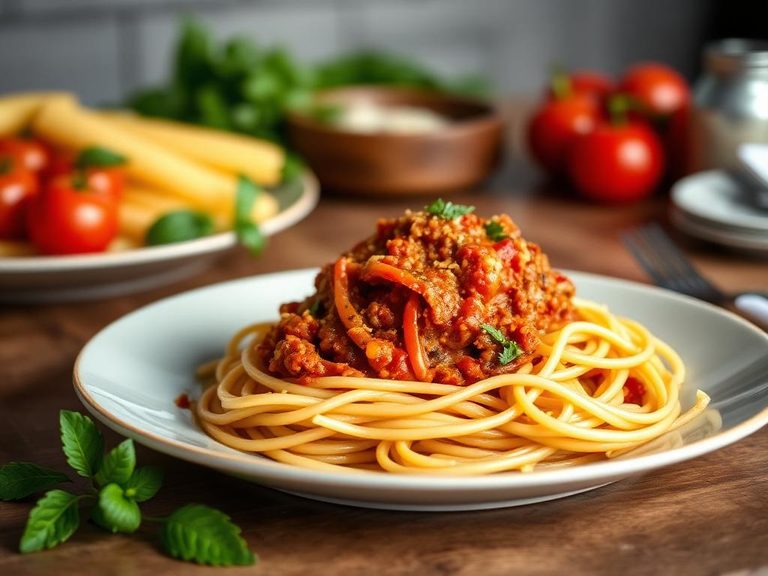
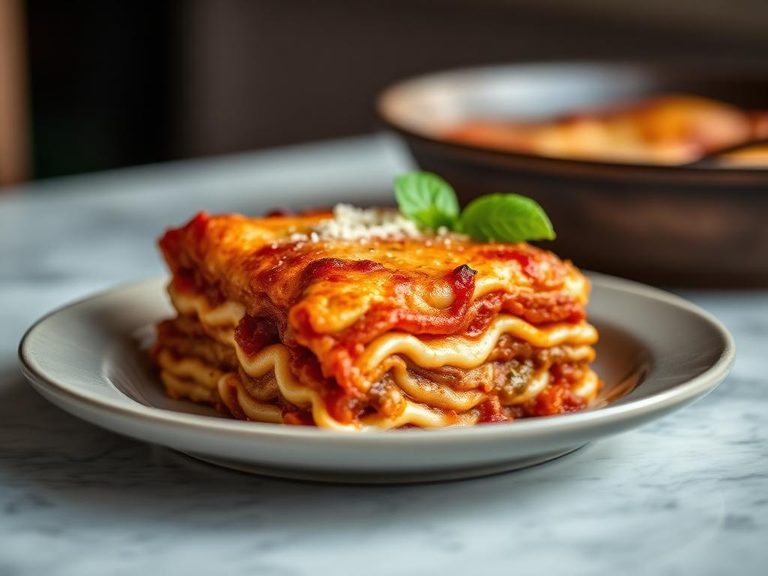
Pasta with tomato-based sauce, meat, and added vegetables, restaurant
Common food
A hearty, savory dish of pasta tossed in a rich tomato-based sauce, studded with tender meat and vibrant vegetables. The texture is a satisfying blend of soft pasta, chunky sauce, and varied vegetable bites, with a deep umami flavor from the meat and tomatoes. Nutritionally, it provides a balanced mix of carbs, protein, and fat, with a modest calorie count per 100g.
Calorie split: 13% protein · 40% carbs · 47% fat
↓ Full nutrition💚 Why it's loved
People love this dish for its comforting, familiar flavors and the way it combines savory meat, tangy tomato sauce, and nutritious vegetables in one bowl. It's a cultural staple in many cuisines, often associated with family meals and hearty, satisfying eating.
⚠️ Watch-outs & how to enjoy it better
Some may find it high in sodium or carbohydrates, which can be a concern for those managing blood sugar or blood pressure. To counteract, opt for whole-grain pasta, use low-sodium sauce, and pair with a side salad or extra vegetables to increase fiber and balance the meal.
Key benefits
- Provides a balanced macronutrient profile with carbs, protein, and fat.
- Contains fiber from vegetables and pasta, aiding digestion.
- Rich in vitamins and antioxidants from tomatoes and vegetables.
- Offers a satisfying and filling meal due to its protein and fiber content.
- Versatile dish that can be customized with various meats and vegetables.
🍽️ Popular dishes
🌍 Where it's eaten
💡 Did you know?
The combination of pasta and tomato sauce is a relatively modern invention, as tomatoes were not widely used in Italian cooking until the 18th century.
Full nutrition (USDA data · scales with serving)
| Water | 66.6 g |
| Energy | 176 kcal |
| Protein | 5.5 g |
| Total lipid (fat) | 9.2 g |
| Carbohydrate, by difference | 17.5 g |
| Fiber, total dietary | 1.5 g |
| Total Sugars | 2.1 g |
| Calcium, Ca | 14.0 mg |
| Iron, Fe | 1.1 mg |
| Magnesium, Mg | 17.0 mg |
| Phosphorus, P | 58.0 mg |
| Potassium, K | 161 mg |
| Sodium, Na | 348 mg |
| Zinc, Zn | 0.85 mg |
| Copper, Cu | 0.09 mg |
| Selenium, Se | 15.5 ug |
| Vitamin C, total ascorbic acid | 4.4 mg |
| Thiamin | 0.15 mg |
| Riboflavin | 0.12 mg |
| Niacin | 2.5 mg |
| Vitamin B-6 | 0.12 mg |
| Folate, total | 42.0 ug |
| Folic acid | 32.0 ug |
| Folate, food | 10.0 ug |
| Folate, DFE | 64.0 ug |
| Choline, total | 14.6 mg |
| Vitamin B-12 | 0.23 ug |
| Vitamin B-12, added | 0.00 ug |
| Vitamin A, RAE | 12.0 ug |
| Retinol | 0.00 ug |
| Carotene, beta | 142 ug |
| Carotene, alpha | 1.0 ug |
| Cryptoxanthin, beta | 8.0 ug |
| Lycopene | 3519 ug |
| Lutein + zeaxanthin | 100 ug |
| Vitamin E (alpha-tocopherol) | 2.0 mg |
| Vitamin E, added | 0.00 mg |
| Vitamin D (D2 + D3) | 0.00 ug |
| Vitamin K (phylloquinone) | 11.2 ug |
| Alcohol, ethyl | 0.00 g |
| Caffeine | 0.00 mg |
| Theobromine | 0.00 mg |
Fat & fatty acid profile (per 100g)
| Fatty acids, total saturated | 1.6 g |
| SFA 4:0 | 0.00 g |
| SFA 6:0 | 0.00 g |
| SFA 8:0 | 0.00 g |
| SFA 10:0 | 0.00 g |
| SFA 12:0 | 0.00 g |
| SFA 14:0 | 0.05 g |
| SFA 16:0 | 1.1 g |
| SFA 18:0 | 0.38 g |
| Fatty acids, total monounsaturated | 3.7 g |
| MUFA 16:1 | 0.08 g |
| MUFA 18:1 | 3.5 g |
| MUFA 20:1 | 0.05 g |
| MUFA 22:1 | 0.00 g |
| Fatty acids, total polyunsaturated | 3.0 g |
| PUFA 18:2 | 2.6 g |
| PUFA 18:3 | 0.34 g |
| PUFA 18:4 | 0.00 g |
| PUFA 20:4 | 0.00 g |
| PUFA 20:5 n-3 (EPA) | 0.00 g |
| PUFA 22:5 n-3 (DPA) | 0.00 g |
| PUFA 22:6 n-3 (DHA) | 0.00 g |
| Cholesterol | 8.0 mg |
FAQ
Is this dish suitable for vegetarians?
No, this specific version contains meat. However, it can be easily adapted for vegetarians by omitting the meat and adding more vegetables or plant-based proteins like lentils or tofu.
How can I reduce the calorie content of this dish?
You can reduce calories by using whole-grain pasta, increasing the proportion of vegetables, using lean meat, and controlling portion sizes. Opting for a lighter sauce with less oil can also help.
What are the best vegetables to add to this pasta dish?
Common vegetables include bell peppers, zucchini, spinach, mushrooms, and onions. These add flavor, texture, and nutritional value without significantly increasing calories.
Nutrient density (calculated · NRF9.3)
Nutrient Rich Foods index: beneficial nutrients (protein, fiber, vitamins, minerals) minus saturated fat, added sugar & sodium, per 100 kcal.
NRF9.3 index — Fulgoni, Keast & Drewnowski, 2009. Computed from USDA nutrients.
Weight-loss friendliness (composite index)
Energy density 1.76 kcal/g · 12% calories from protein · 1.5 g fiber · 2.1 g sugar per 100 g.
Composite of energy density (Rolls et al., 1999), protein & fiber satiety, minus sugar. A calculated heuristic — ranks satiety-per-calorie, not a clinical measure.
Dietary load (calculated from USDA values)
Potential renal acid load. Positive = acid-forming, negative = alkaline-forming.
Sodium-to-potassium ratio: 2.16 (lower is better — aim for ≤ 1)
Sodium:potassium per WHO potassium guidance. Computed from USDA nutrients.