

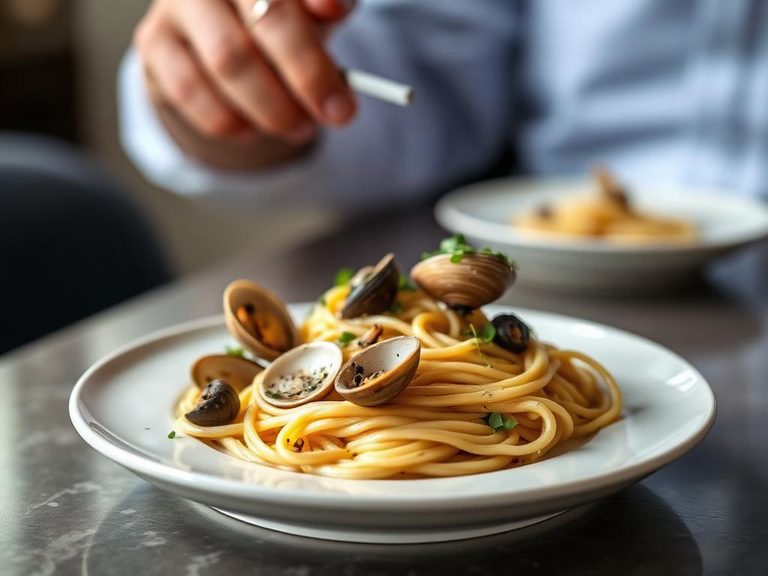
Pasta with cream sauce, seafood, and added vegetables, home recipe
Common food
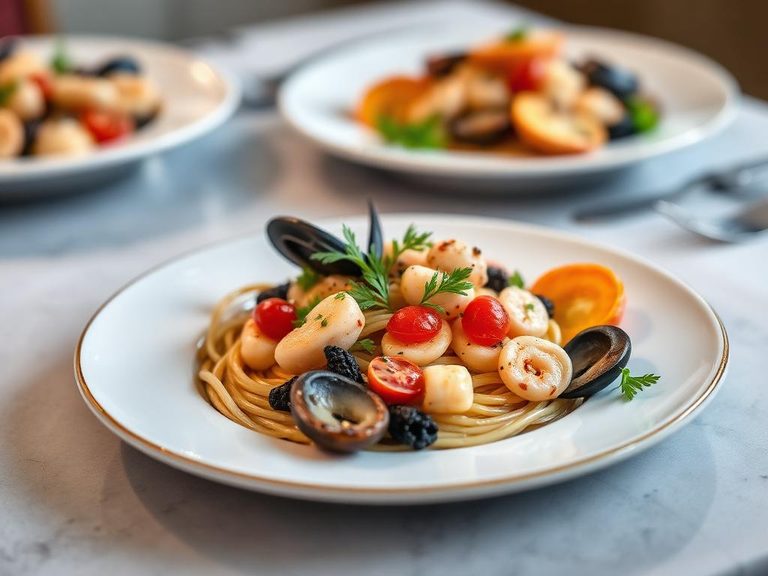
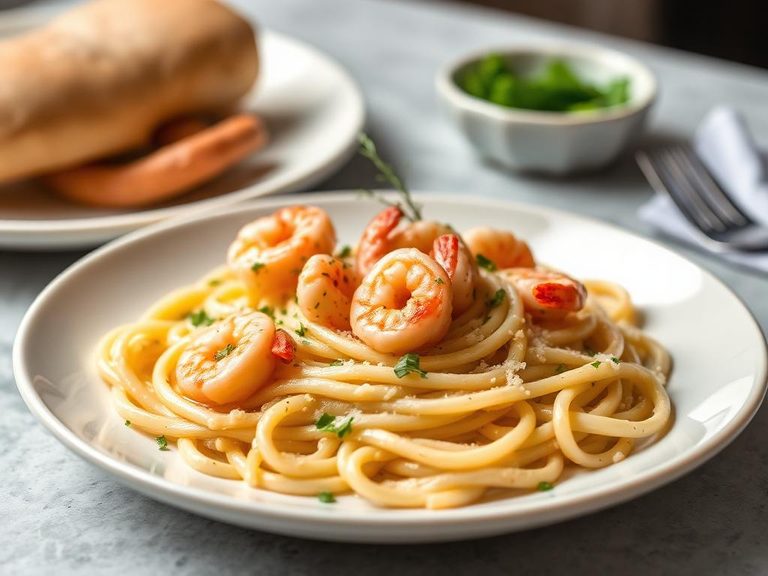
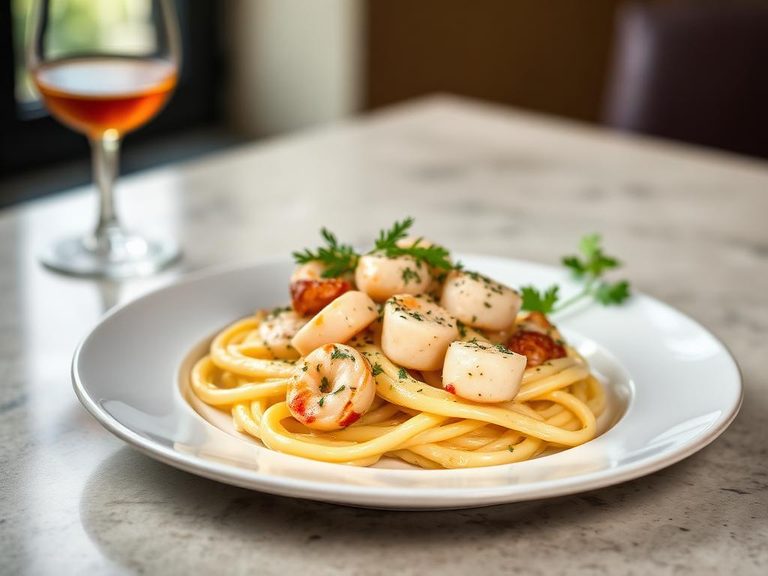
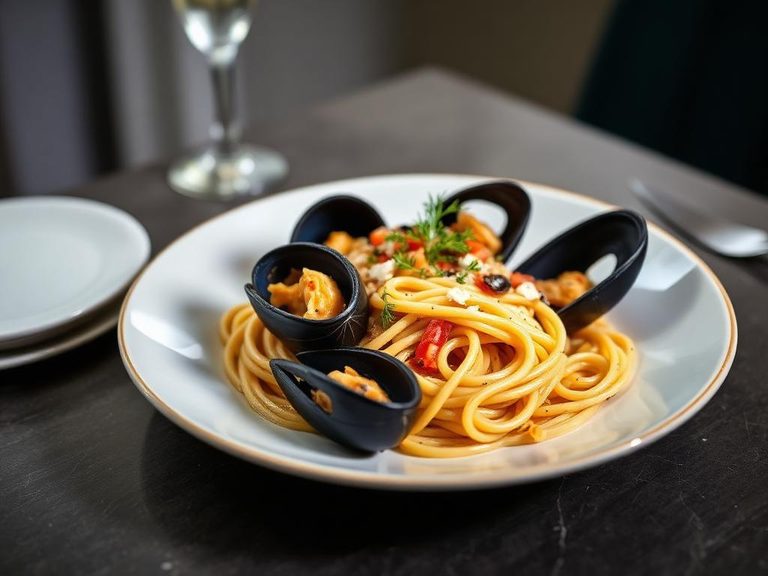
This is a comforting, creamy pasta dish where tender seafood like shrimp or mussels mingle with al dente pasta in a rich, velvety sauce, punctuated by the fresh crunch of vegetables like peas or spinach. The sauce coats each strand, delivering a luxurious mouthfeel balanced by the briny sweetness of the sea. Nutritionally, it's a balanced plate offering quality protein from the seafood alongside energy-providing carbs from the pasta.
Calorie split: 17% protein · 50% carbs · 33% fat
↓ Full nutrition💚 Why it's loved
People adore this dish for its perfect harmony of rich, creamy comfort and fresh, oceanic flavors. It's a versatile canvas that can be dressed up for a special occasion or simplified for a quick weeknight dinner, embodying the heart of Italian-inspired home cooking.
⚠️ Watch-outs & how to enjoy it better
The creamy sauce can be high in saturated fat and calories, and the pasta's refined carbs may cause blood-sugar spikes for some. To counteract this, use whole-grain pasta for more fiber, opt for a lighter cream or broth-based sauce, and ensure the portion is balanced with a generous amount of vegetables and lean protein.
Key benefits
- Provides high-quality protein for muscle maintenance from seafood.
- Offers a good source of energy from complex carbohydrates in pasta.
- Contains fiber and micronutrients from added vegetables.
- Can be a source of omega-3 fatty acids if using oily fish like salmon.
- A satisfying, complete meal that combines protein, carbs, and fats.
🍽️ Popular dishes
🌍 Where it's eaten
💡 Did you know?
The classic 'frutti di mare' (fruit of the sea) pasta in Italy traditionally avoids cheese, but the creamy American-Italian adaptation often includes Parmesan, creating a distinct culinary branch.
Full nutrition (USDA data · scales with serving)
| Water | 70.8 g |
| Energy | 141 kcal |
| Protein | 5.8 g |
| Total lipid (fat) | 5.1 g |
| Carbohydrate, by difference | 17.3 g |
| Fiber, total dietary | 1.1 g |
| Total Sugars | 0.86 g |
| Calcium, Ca | 34.0 mg |
| Iron, Fe | 0.92 mg |
| Magnesium, Mg | 15.0 mg |
| Phosphorus, P | 74.0 mg |
| Potassium, K | 95.0 mg |
| Sodium, Na | 210 mg |
| Zinc, Zn | 0.51 mg |
| Copper, Cu | 0.09 mg |
| Selenium, Se | 19.6 ug |
| Vitamin C, total ascorbic acid | 4.4 mg |
| Thiamin | 0.15 mg |
| Riboflavin | 0.12 mg |
| Niacin | 1.1 mg |
| Vitamin B-6 | 0.05 mg |
| Folate, total | 42.0 ug |
| Folic acid | 34.0 ug |
| Folate, food | 8.0 ug |
| Folate, DFE | 66.0 ug |
| Choline, total | 14.9 mg |
| Vitamin B-12 | 0.90 ug |
| Vitamin B-12, added | 0.00 ug |
| Vitamin A, RAE | 51.0 ug |
| Retinol | 47.0 ug |
| Carotene, beta | 38.0 ug |
| Carotene, alpha | 1.0 ug |
| Cryptoxanthin, beta | 9.0 ug |
| Lycopene | 0.00 ug |
| Lutein + zeaxanthin | 51.0 ug |
| Vitamin E (alpha-tocopherol) | 0.26 mg |
| Vitamin E, added | 0.00 mg |
| Vitamin D (D2 + D3) | 0.20 ug |
| Vitamin K (phylloquinone) | 0.80 ug |
| Alcohol, ethyl | 0.00 g |
| Caffeine | 0.00 mg |
| Theobromine | 0.00 mg |
Fat & fatty acid profile (per 100g)
| Fatty acids, total saturated | 2.7 g |
| SFA 4:0 | 0.10 g |
| SFA 6:0 | 0.08 g |
| SFA 8:0 | 0.05 g |
| SFA 10:0 | 0.11 g |
| SFA 12:0 | 0.14 g |
| SFA 14:0 | 0.42 g |
| SFA 16:0 | 1.3 g |
| SFA 18:0 | 0.42 g |
| Fatty acids, total monounsaturated | 1.0 g |
| MUFA 16:1 | 0.08 g |
| MUFA 18:1 | 1.0 g |
| MUFA 20:1 | 0.01 g |
| MUFA 22:1 | 0.00 g |
| Fatty acids, total polyunsaturated | 0.41 g |
| PUFA 18:2 | 0.28 g |
| PUFA 18:3 | 0.03 g |
| PUFA 18:4 | 0.00 g |
| PUFA 20:4 | 0.01 g |
| PUFA 20:5 n-3 (EPA) | 0.02 g |
| PUFA 22:5 n-3 (DPA) | 0.01 g |
| PUFA 22:6 n-3 (DHA) | 0.02 g |
| Cholesterol | 27.0 mg |
FAQ
What seafood works best?
A mix is ideal: firm shrimp, scallops, and mussels or clams. For a simpler version, shrimp alone is perfect. Add quicker-cooking seafood like squid rings at the very end to prevent toughness.
How can I make the sauce lighter?
Replace some or all of the heavy cream with a combination of pasta cooking water and a splash of white wine, or use a base of blended white beans for creaminess without the fat. A touch of mascarpone can also add richness with less volume.
Can I make this ahead?
The pasta and sauce can be made separately and combined just before serving. The seafood is best cooked fresh, as reheating can make it rubbery. Store components in the fridge for up to 2 days.
Nutrient density (calculated · NRF9.3)
Nutrient Rich Foods index: beneficial nutrients (protein, fiber, vitamins, minerals) minus saturated fat, added sugar & sodium, per 100 kcal.
NRF9.3 index — Fulgoni, Keast & Drewnowski, 2009. Computed from USDA nutrients.
Weight-loss friendliness (composite index)
Energy density 1.41 kcal/g · 17% calories from protein · 1.1 g fiber · 0.9 g sugar per 100 g.
Composite of energy density (Rolls et al., 1999), protein & fiber satiety, minus sugar. A calculated heuristic — ranks satiety-per-calorie, not a clinical measure.
Dietary load (calculated from USDA values)
Potential renal acid load. Positive = acid-forming, negative = alkaline-forming.
Sodium-to-potassium ratio: 2.21 (lower is better — aim for ≤ 1)
Sodium:potassium per WHO potassium guidance. Computed from USDA nutrients.