

Macaroni or noodles with cheese and meat, prepared from Hamburger Helper mix
Common food
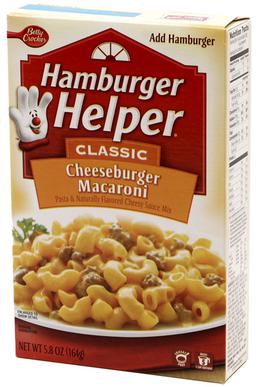
Photo: Wikipedia
This is the iconic, one-pot comfort meal of macaroni or noodles in a creamy, savory cheese sauce with ground meat, famously known from the Hamburger Helper brand. It delivers a rich, salty, and umami-packed flavor with a soft, chewy pasta texture and a velvety sauce that clings to every bite. Nutritionally, it's a moderately calorie-dense dish with a notable protein boost from the meat, though it's relatively low in fiber.
Calorie split: 23% protein · 29% carbs · 48% fat
↓ Full nutrition💚 Why it's loved
People love it for its nostalgic, comforting flavor and the sheer convenience of a complete meal from a single box, making it a staple for busy weeknights. Its creamy, cheesy sauce and satisfying texture have made it a cultural icon of American home cooking and a go-to for quick, hearty dinners.
⚠️ Watch-outs & how to enjoy it better
The dish can be high in sodium and may cause blood-sugar spikes due to its refined carbohydrates and low fiber content, which is a concern for those managing blood sugar or hypertension. To counteract this, pair it with a side of non-starchy vegetables like broccoli or a simple green salad to add fiber and slow digestion, and consider using a smaller portion of the mix while adding extra lean protein or veggies to stretch the meal.
Key benefits
- Quick and convenient one-pot meal preparation
- Good source of protein from the included meat
- Provides a satisfying, calorie-dense energy source
- Highly customizable with added vegetables or spices
- Familiar, comforting flavor profile for many
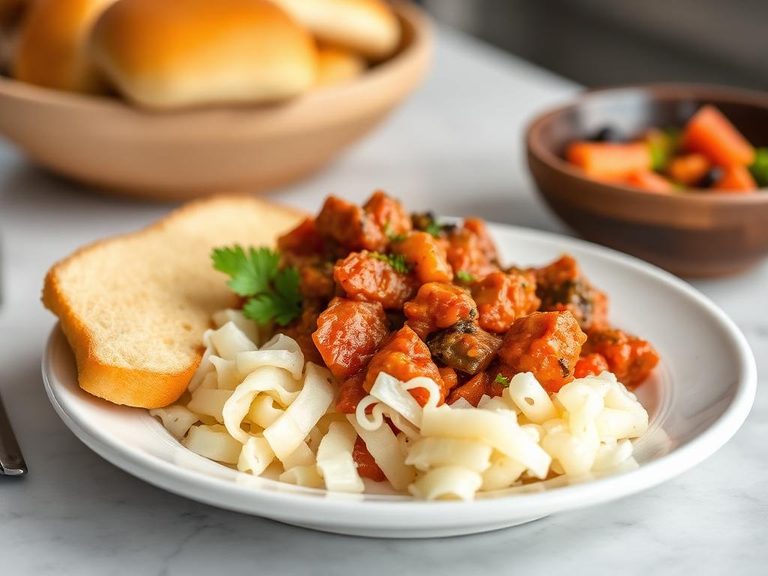
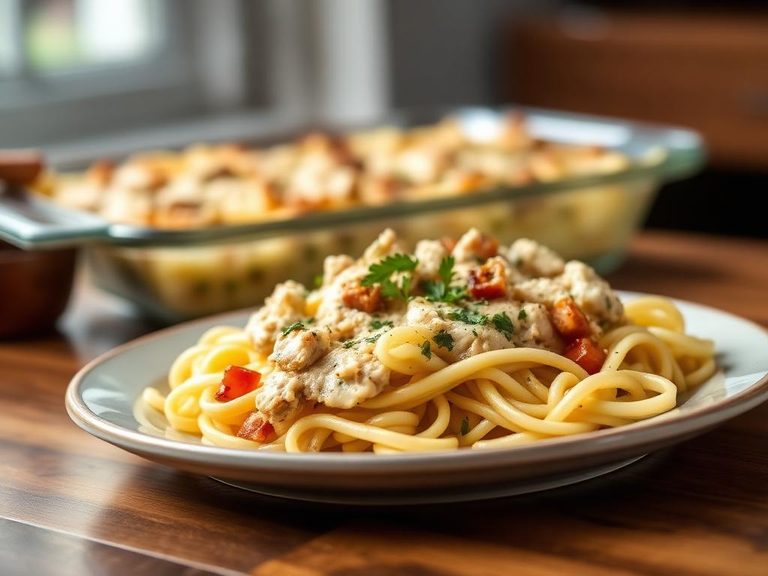
🍽️ Popular dishes
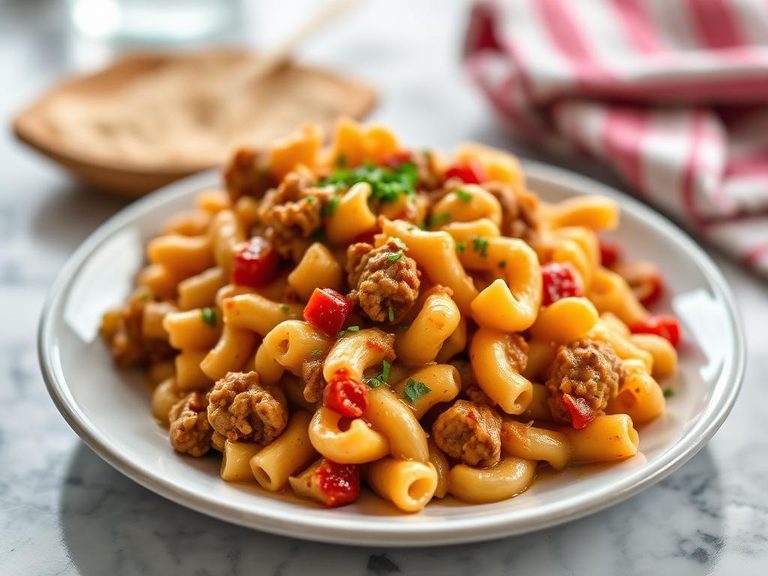
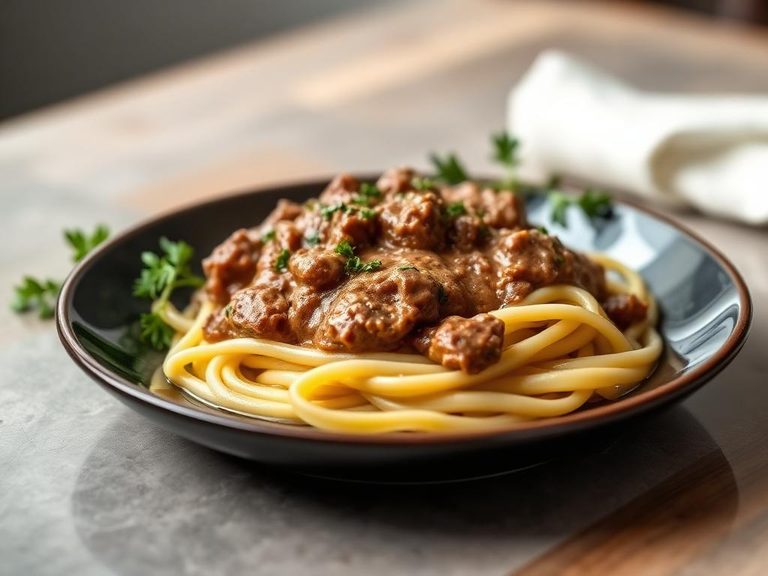
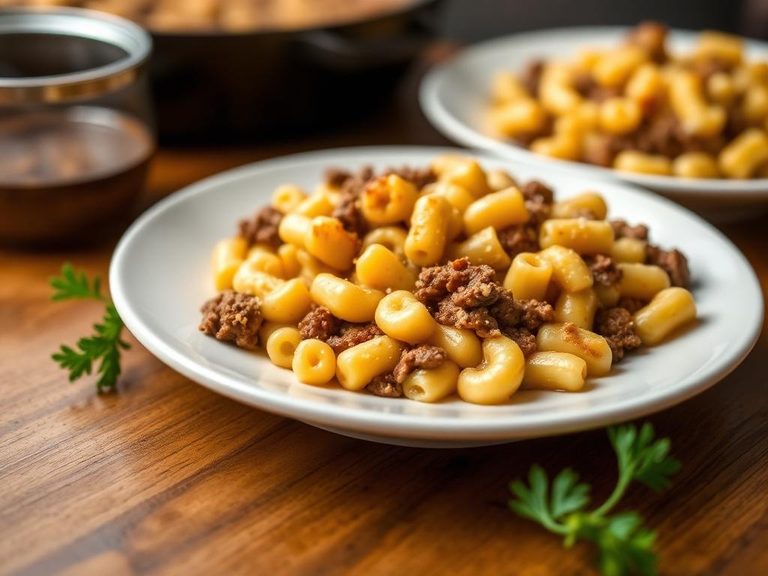
🌍 Where it's eaten
💡 Did you know?
The original Hamburger Helper was introduced by General Mills in 1971, and its mascot, 'Lefty' (a white glove with a face), was created to represent the product's ease of use—just 'help' from the box to the pan.
Full nutrition (USDA data · scales with serving)
| Water | 72.6 g |
| Energy | 144 kcal |
| Protein | 8.2 g |
| Total lipid (fat) | 7.6 g |
| Carbohydrate, by difference | 10.3 g |
| Fiber, total dietary | 0.30 g |
| Total Sugars | 2.3 g |
| Calcium, Ca | 53.0 mg |
| Iron, Fe | 0.97 mg |
| Magnesium, Mg | 12.0 mg |
| Phosphorus, P | 86.0 mg |
| Potassium, K | 129 mg |
| Sodium, Na | 284 mg |
| Zinc, Zn | 1.6 mg |
| Copper, Cu | 0.04 mg |
| Selenium, Se | 10.1 ug |
| Vitamin C, total ascorbic acid | 0.20 mg |
| Thiamin | 0.10 mg |
| Riboflavin | 0.14 mg |
| Niacin | 1.4 mg |
| Vitamin B-6 | 0.07 mg |
| Folate, total | 12.0 ug |
| Folic acid | 9.0 ug |
| Folate, food | 3.0 ug |
| Folate, DFE | 18.0 ug |
| Choline, total | 22.5 mg |
| Vitamin B-12 | 0.57 ug |
| Vitamin B-12, added | 0.00 ug |
| Vitamin A, RAE | 24.0 ug |
| Retinol | 22.0 ug |
| Carotene, beta | 25.0 ug |
| Carotene, alpha | 0.00 ug |
| Cryptoxanthin, beta | 0.00 ug |
| Lycopene | 105 ug |
| Lutein + zeaxanthin | 4.0 ug |
| Vitamin E (alpha-tocopherol) | 0.12 mg |
| Vitamin E, added | 0.00 mg |
| Vitamin D (D2 + D3) | 0.40 ug |
| Vitamin K (phylloquinone) | 0.80 ug |
| Alcohol, ethyl | 0.00 g |
| Caffeine | 0.00 mg |
| Theobromine | 0.00 mg |
Fat & fatty acid profile (per 100g)
| Fatty acids, total saturated | 3.0 g |
| SFA 4:0 | 0.02 g |
| SFA 6:0 | 0.01 g |
| SFA 8:0 | 0.01 g |
| SFA 10:0 | 0.02 g |
| SFA 12:0 | 0.03 g |
| SFA 14:0 | 0.27 g |
| SFA 16:0 | 1.6 g |
| SFA 18:0 | 0.86 g |
| Fatty acids, total monounsaturated | 3.1 g |
| MUFA 16:1 | 0.25 g |
| MUFA 18:1 | 2.7 g |
| MUFA 20:1 | 0.02 g |
| MUFA 22:1 | 0.00 g |
| Fatty acids, total polyunsaturated | 0.26 g |
| PUFA 18:2 | 0.22 g |
| PUFA 18:3 | 0.03 g |
| PUFA 18:4 | 0.00 g |
| PUFA 20:4 | 0.01 g |
| PUFA 20:5 n-3 (EPA) | 0.00 g |
| PUFA 22:5 n-3 (DPA) | 0.00 g |
| PUFA 22:6 n-3 (DHA) | 0.00 g |
| Cholesterol | 27.0 mg |
FAQ
Is Hamburger Helper a complete meal?
It's designed as a complete meal when you add ground beef, but it's low in fiber and some vitamins, so adding vegetables or a side salad makes it more nutritionally balanced.
Can I make it healthier?
Yes, use lean ground meat, add vegetables like peas or spinach, reduce the cheese sauce by using less mix, and pair with a high-fiber side to improve its nutritional profile.
What's the main source of protein?
The primary protein comes from the ground beef you add, though the pasta and cheese sauce contribute small amounts as well.
Nutrient density (calculated · NRF9.3)
Nutrient Rich Foods index: beneficial nutrients (protein, fiber, vitamins, minerals) minus saturated fat, added sugar & sodium, per 100 kcal.
NRF9.3 index — Fulgoni, Keast & Drewnowski, 2009. Computed from USDA nutrients.
Weight-loss friendliness (composite index)
Energy density 1.44 kcal/g · 23% calories from protein · 0.3 g fiber · 2.3 g sugar per 100 g.
Composite of energy density (Rolls et al., 1999), protein & fiber satiety, minus sugar. A calculated heuristic — ranks satiety-per-calorie, not a clinical measure.
Dietary load (calculated from USDA values)
Potential renal acid load. Positive = acid-forming, negative = alkaline-forming.
Sodium-to-potassium ratio: 2.20 (lower is better — aim for ≤ 1)
Sodium:potassium per WHO potassium guidance. Computed from USDA nutrients.