

Lemonade, fruit juice drink
Common food

Photo: Wikipedia
A refreshing, translucent beverage with a bright, tangy-sweet flavor and a smooth, thin texture. It's a simple fruit juice drink, primarily offering quick energy from its 12g of sugar per 100g, with negligible protein or fat.
Calorie split: 0% protein · 100% carbs · 0% fat
↓ Full nutrition💚 Why it's loved
People love its classic, thirst-quenching balance of sweet and sour, making it a universal symbol of refreshment. Its simplicity and versatility allow it to be enjoyed plain, sparkling, or as a mixer.
⚠️ Watch-outs & how to enjoy it better
The high sugar content (11.67g per 100g) can contribute to blood sugar spikes and empty calories. To counteract this, consider diluting it with water or sparkling water, or pairing it with a source of protein or healthy fat to slow sugar absorption.
Key benefits
- Provides quick hydration and energy.
- Contains some vitamin C from lemon juice.
- Low in fat and cholesterol.
- Can be a base for many other drinks.
🍽️ Popular dishes


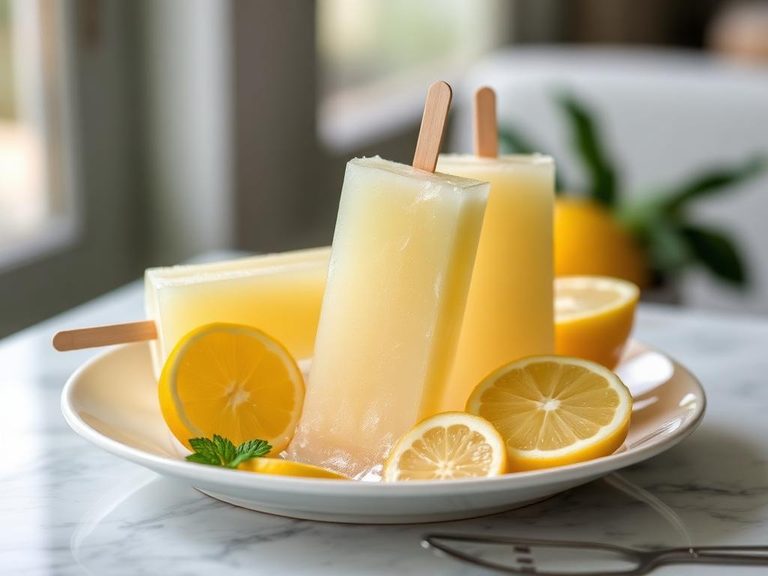

🌍 Where it's eaten
💡 Did you know?
The word 'lemonade' was used in English as early as the 1600s, but the drink itself likely originated in the 10th-century Arab world, where lemons from Asia were first cultivated.
Full nutrition (USDA data · scales with serving)
| Water | 87.9 g |
| Energy | 46.0 kcal |
| Protein | 0.00 g |
| Total lipid (fat) | 0.00 g |
| Carbohydrate, by difference | 12.1 g |
| Fiber, total dietary | 0.00 g |
| Total Sugars | 11.7 g |
| Calcium, Ca | 2.0 mg |
| Iron, Fe | 0.00 mg |
| Magnesium, Mg | 2.0 mg |
| Phosphorus, P | 1.0 mg |
| Potassium, K | 10.0 mg |
| Sodium, Na | 6.0 mg |
| Zinc, Zn | 0.01 mg |
| Copper, Cu | 0.02 mg |
| Selenium, Se | 0.10 ug |
| Vitamin C, total ascorbic acid | 3.1 mg |
| Thiamin | 0.00 mg |
| Riboflavin | 0.00 mg |
| Niacin | 0.01 mg |
| Vitamin B-6 | 0.00 mg |
| Folate, total | 1.0 ug |
| Folic acid | 0.00 ug |
| Folate, food | 1.0 ug |
| Folate, DFE | 1.0 ug |
| Choline, total | 0.50 mg |
| Vitamin B-12 | 0.00 ug |
| Vitamin B-12, added | 0.00 ug |
| Vitamin A, RAE | 0.00 ug |
| Retinol | 0.00 ug |
| Carotene, beta | 0.00 ug |
| Carotene, alpha | 0.00 ug |
| Cryptoxanthin, beta | 0.00 ug |
| Lycopene | 0.00 ug |
| Lutein + zeaxanthin | 0.00 ug |
| Vitamin E (alpha-tocopherol) | 0.00 mg |
| Vitamin E, added | 0.00 mg |
| Vitamin D (D2 + D3) | 0.00 ug |
| Vitamin K (phylloquinone) | 0.00 ug |
| Alcohol, ethyl | 0.00 g |
| Caffeine | 0.00 mg |
| Theobromine | 0.00 mg |
Fat & fatty acid profile (per 100g)
| Fatty acids, total saturated | 0.00 g |
| SFA 4:0 | 0.00 g |
| SFA 6:0 | 0.00 g |
| SFA 8:0 | 0.00 g |
| SFA 10:0 | 0.00 g |
| SFA 12:0 | 0.00 g |
| SFA 14:0 | 0.00 g |
| SFA 16:0 | 0.00 g |
| SFA 18:0 | 0.00 g |
| Fatty acids, total monounsaturated | 0.00 g |
| MUFA 16:1 | 0.00 g |
| MUFA 18:1 | 0.00 g |
| MUFA 20:1 | 0.00 g |
| MUFA 22:1 | 0.00 g |
| Fatty acids, total polyunsaturated | 0.00 g |
| PUFA 18:2 | 0.00 g |
| PUFA 18:3 | 0.00 g |
| PUFA 18:4 | 0.00 g |
| PUFA 20:4 | 0.00 g |
| PUFA 20:5 n-3 (EPA) | 0.00 g |
| PUFA 22:5 n-3 (DPA) | 0.00 g |
| PUFA 22:6 n-3 (DHA) | 0.00 g |
| Cholesterol | 0.00 mg |
FAQ
Is lemonade the same as lemon juice?
No. Lemon juice is the pure, undiluted juice from lemons and is very sour. Lemonade is a drink made by diluting lemon juice with water and adding a sweetener like sugar.
Can I make lemonade less sugary?
Absolutely. You can control the sweetness by reducing the sugar in homemade versions, or by diluting store-bought lemonade with water or sparkling water.
Is there any nutritional benefit to lemonade?
While primarily a source of sugar and hydration, it does contain small amounts of vitamin C from the lemon juice, especially if made with fresh lemons.
Nutrient density (calculated · NRF9.3)
Nutrient Rich Foods index: beneficial nutrients (protein, fiber, vitamins, minerals) minus saturated fat, added sugar & sodium, per 100 kcal.
NRF9.3 index — Fulgoni, Keast & Drewnowski, 2009. Computed from USDA nutrients.
Weight-loss friendliness (composite index)
Energy density 0.46 kcal/g · 0% calories from protein · 0.0 g fiber · 11.7 g sugar per 100 g.
Composite of energy density (Rolls et al., 1999), protein & fiber satiety, minus sugar. A calculated heuristic — ranks satiety-per-calorie, not a clinical measure.
Dietary load (calculated from USDA values)
Potential renal acid load. Positive = acid-forming, negative = alkaline-forming.
Sodium-to-potassium ratio: 0.60 (lower is better — aim for ≤ 1)
Sodium:potassium per WHO potassium guidance. Computed from USDA nutrients.