

Layer dip
Common food
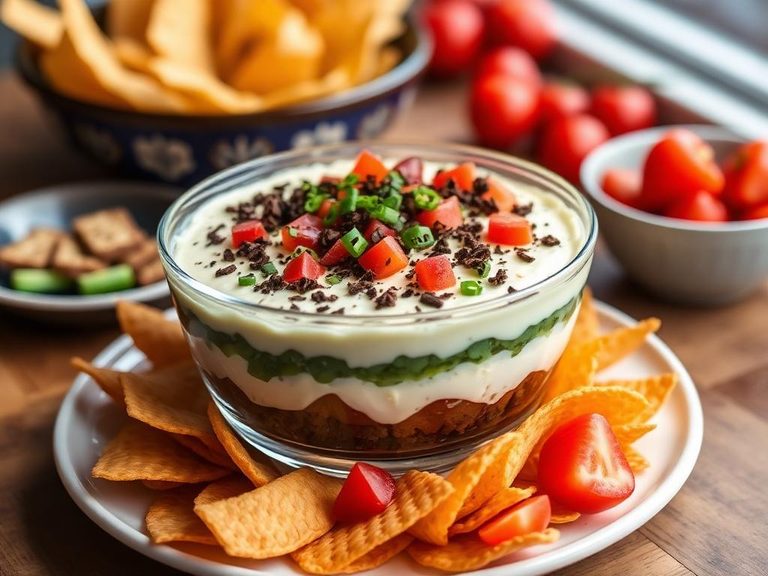
Layer dip is a vibrant, multi-tiered party appetizer, most famously a Tex-Mex creation, where distinct flavors and textures stack into a single, shareable dish. It typically features a base of refried beans topped with guacamole, sour cream, salsa, and a crown of shredded cheese, olives, and green onions. Nutritionally, it's a calorie-dense, high-fat offering (11.33g fat per 100g) that provides a moderate protein boost from beans and dairy.
Calorie split: 14% protein · 18% carbs · 68% fat
↓ Full nutrition💚 Why it's loved
People adore layer dip for its communal, interactive nature and the satisfying contrast of creamy, cool, and zesty flavors in every scoop. It's a versatile crowd-pleaser that brings a festive, Tex-Mex flair to any gathering.
⚠️ Watch-outs & how to enjoy it better
The dip can be high in sodium and saturated fat, especially from sour cream and cheese, and its calorie density can lead to overconsumption. To counteract this, practice portion control by using a smaller plate, pair it with crunchy, low-calorie vegetables like bell peppers or jicama instead of only chips, and consider swapping sour cream for Greek yogurt to boost protein and reduce fat.
Key benefits
- High in dietary fiber from refried beans and guacamole.
- Provides plant-based protein from legumes.
- Contains healthy monounsaturated fats from avocado.
- Serves as a social, shareable party centerpiece.
- Offers a complex mix of vitamins and minerals from its layered ingredients.
🍽️ Popular dishes
🌍 Where it's eaten
💡 Did you know?
The iconic seven-layer dip is a relatively modern invention, popularized in the 1970s and 1980s, and is often credited to a 1978 recipe from a California avocado grower's association.
Full nutrition (USDA data · scales with serving)
| Water | 74.3 g |
| Energy | 146 kcal |
| Protein | 5.4 g |
| Total lipid (fat) | 11.3 g |
| Carbohydrate, by difference | 6.7 g |
| Fiber, total dietary | 2.1 g |
| Total Sugars | 1.7 g |
| Calcium, Ca | 142 mg |
| Iron, Fe | 1.1 mg |
| Magnesium, Mg | 19.0 mg |
| Phosphorus, P | 114 mg |
| Potassium, K | 227 mg |
| Sodium, Na | 538 mg |
| Zinc, Zn | 0.86 mg |
| Copper, Cu | 0.10 mg |
| Selenium, Se | 5.9 ug |
| Vitamin C, total ascorbic acid | 5.0 mg |
| Thiamin | 0.04 mg |
| Riboflavin | 0.13 mg |
| Niacin | 0.59 mg |
| Vitamin B-6 | 0.11 mg |
| Folate, total | 20.0 ug |
| Folic acid | 0.00 ug |
| Folate, food | 20.0 ug |
| Folate, DFE | 20.0 ug |
| Choline, total | 14.5 mg |
| Vitamin B-12 | 0.17 ug |
| Vitamin B-12, added | 0.00 ug |
| Vitamin A, RAE | 82.0 ug |
| Retinol | 70.0 ug |
| Carotene, beta | 139 ug |
| Carotene, alpha | 19.0 ug |
| Cryptoxanthin, beta | 4.0 ug |
| Lycopene | 1327 ug |
| Lutein + zeaxanthin | 140 ug |
| Vitamin E (alpha-tocopherol) | 0.91 mg |
| Vitamin E, added | 0.00 mg |
| Vitamin D (D2 + D3) | 0.10 ug |
| Vitamin K (phylloquinone) | 5.9 ug |
| Alcohol, ethyl | 0.00 g |
| Caffeine | 0.00 mg |
| Theobromine | 0.00 mg |
Fat & fatty acid profile (per 100g)
| Fatty acids, total saturated | 5.1 g |
| SFA 4:0 | 0.10 g |
| SFA 6:0 | 0.11 g |
| SFA 8:0 | 0.07 g |
| SFA 10:0 | 0.18 g |
| SFA 12:0 | 0.23 g |
| SFA 14:0 | 0.73 g |
| SFA 16:0 | 2.6 g |
| SFA 18:0 | 0.81 g |
| Fatty acids, total monounsaturated | 4.0 g |
| MUFA 16:1 | 0.24 g |
| MUFA 18:1 | 3.9 g |
| MUFA 20:1 | 0.02 g |
| MUFA 22:1 | 0.00 g |
| Fatty acids, total polyunsaturated | 0.73 g |
| PUFA 18:2 | 0.61 g |
| PUFA 18:3 | 0.07 g |
| PUFA 18:4 | 0.00 g |
| PUFA 20:4 | 0.01 g |
| PUFA 20:5 n-3 (EPA) | 0.00 g |
| PUFA 22:5 n-3 (DPA) | 0.00 g |
| PUFA 22:6 n-3 (DHA) | 0.00 g |
| Cholesterol | 23.0 mg |
FAQ
What is the typical order of layers in a classic seven-layer dip?
The classic order is: 1) Refried beans, 2) Guacamole, 3) Sour cream, 4) Salsa or pico de gallo, 5) Shredded cheese, 6) Black olives, and 7) Green onions or jalapeños.
Is layer dip gluten-free?
It is often gluten-free, but you must check the ingredients of the refried beans, sour cream, and any pre-made salsas for hidden gluten or cross-contamination. Always serve with gluten-free dippers like corn tortilla chips.
Can I make layer dip ahead of time?
Yes, but for best texture, assemble the base layers (beans, guacamole) a day ahead and cover tightly. Add the sour cream, cheese, and fresh toppings just before serving to prevent sogginess and browning.
Nutrient density (calculated · NRF9.3)
Nutrient Rich Foods index: beneficial nutrients (protein, fiber, vitamins, minerals) minus saturated fat, added sugar & sodium, per 100 kcal.
NRF9.3 index — Fulgoni, Keast & Drewnowski, 2009. Computed from USDA nutrients.
Weight-loss friendliness (composite index)
Energy density 1.46 kcal/g · 15% calories from protein · 2.1 g fiber · 1.7 g sugar per 100 g.
Composite of energy density (Rolls et al., 1999), protein & fiber satiety, minus sugar. A calculated heuristic — ranks satiety-per-calorie, not a clinical measure.
Dietary load (calculated from USDA values)
Potential renal acid load. Positive = acid-forming, negative = alkaline-forming.
Sodium-to-potassium ratio: 2.37 (lower is better — aim for ≤ 1)
Sodium:potassium per WHO potassium guidance. Computed from USDA nutrients.