

Seven-layer salad, lettuce salad made with a combination of onion, celery, green pepper, peas, mayonnaise, cheese, eggs, and/or bacon
Common food

Photo: Wikipedia
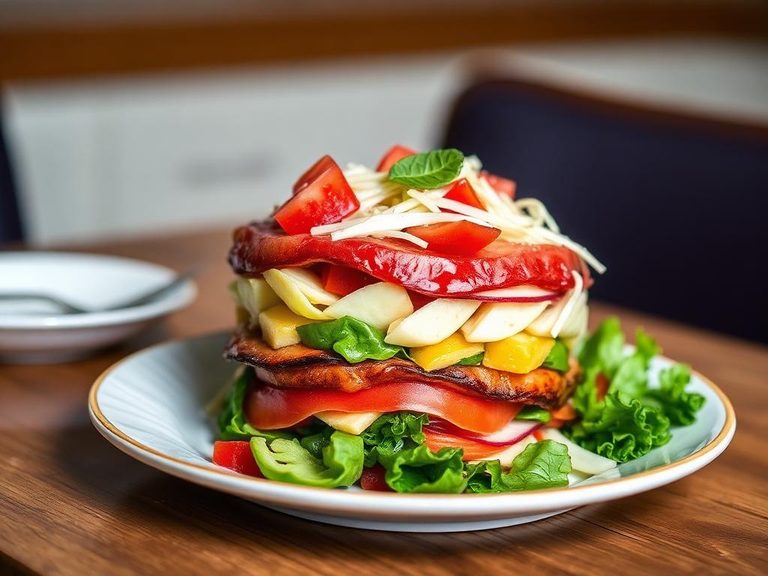
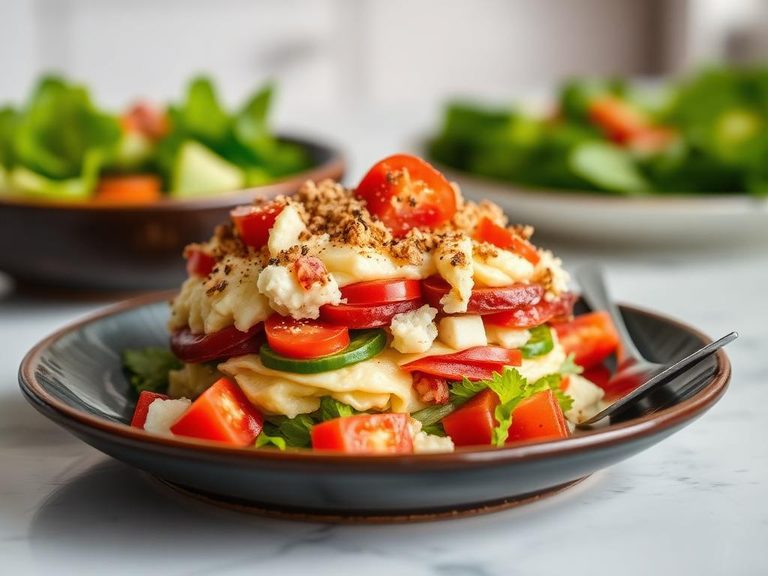
Seven-layer salad is a classic American potluck staple, a visually striking layered casserole of crisp vegetables, hard-boiled eggs, and savory bacon, all bound by a thick, creamy mayonnaise dressing. Each bite offers a satisfying crunch from celery and green pepper, a sweet pop from peas, and a rich, savory depth from cheese and bacon, creating a complex interplay of textures and flavors. Nutritionally, it is a high-fat dish, with over 20 grams of fat per 100g, but it also provides a modest protein boost from eggs and cheese, making it a hearty, if indulgent, side.
Calorie split: 8% protein · 10% carbs · 82% fat
↓ Full nutrition💚 Why it's loved
People love seven-layer salad for its nostalgic, comforting appeal and its ability to be assembled hours ahead, making it a perfect potluck or holiday dish. The combination of creamy, crunchy, and savory layers creates a universally appealing flavor profile that feels both familiar and special.
⚠️ Watch-outs & how to enjoy it better
The high fat and calorie content from mayonnaise, cheese, and bacon can be a concern for those monitoring their intake. To counteract this, consider using a lighter mayonnaise or Greek yogurt blend, reducing the cheese and bacon portions, or pairing the salad with a lean protein like grilled chicken to balance the meal.
Key benefits
- Provides protein and healthy fats from eggs and cheese
- Offers dietary fiber and micronutrients from fresh vegetables like celery and green pepper
- Serves as a crowd-pleasing, make-ahead dish for gatherings
- Delivers a satisfying mix of textures: crunchy, creamy, and savory
🍽️ Popular dishes
🌍 Where it's eaten
💡 Did you know?
The traditional seven-layer salad is often assembled in a clear glass trifle bowl or 9x13 inch dish to showcase the colorful layers, making it as much a visual centerpiece as a culinary one.
Full nutrition (USDA data · scales with serving)
| Water | 67.6 g |
| Energy | 229 kcal |
| Protein | 4.7 g |
| Total lipid (fat) | 20.7 g |
| Carbohydrate, by difference | 5.8 g |
| Fiber, total dietary | 1.2 g |
| Total Sugars | 3.2 g |
| Calcium, Ca | 59.0 mg |
| Iron, Fe | 0.43 mg |
| Magnesium, Mg | 10.0 mg |
| Phosphorus, P | 77.0 mg |
| Potassium, K | 123 mg |
| Sodium, Na | 265 mg |
| Zinc, Zn | 0.59 mg |
| Copper, Cu | 0.04 mg |
| Selenium, Se | 6.4 ug |
| Vitamin C, total ascorbic acid | 6.7 mg |
| Thiamin | 0.09 mg |
| Riboflavin | 0.11 mg |
| Niacin | 0.67 mg |
| Vitamin B-6 | 0.08 mg |
| Folate, total | 27.0 ug |
| Folic acid | 0.00 ug |
| Folate, food | 27.0 ug |
| Folate, DFE | 27.0 ug |
| Choline, total | 40.7 mg |
| Vitamin B-12 | 0.21 ug |
| Vitamin B-12, added | 0.00 ug |
| Vitamin A, RAE | 57.0 ug |
| Retinol | 33.0 ug |
| Carotene, beta | 289 ug |
| Carotene, alpha | 5.0 ug |
| Cryptoxanthin, beta | 2.0 ug |
| Lycopene | 0.00 ug |
| Lutein + zeaxanthin | 482 ug |
| Vitamin E (alpha-tocopherol) | 0.95 mg |
| Vitamin E, added | 0.00 mg |
| Vitamin D (D2 + D3) | 0.30 ug |
| Vitamin K (phylloquinone) | 47.7 ug |
| Alcohol, ethyl | 0.00 g |
| Caffeine | 0.00 mg |
| Theobromine | 0.00 mg |
Fat & fatty acid profile (per 100g)
| Fatty acids, total saturated | 4.4 g |
| SFA 4:0 | 0.04 g |
| SFA 6:0 | 0.03 g |
| SFA 8:0 | 0.02 g |
| SFA 10:0 | 0.05 g |
| SFA 12:0 | 0.06 g |
| SFA 14:0 | 0.21 g |
| SFA 16:0 | 2.7 g |
| SFA 18:0 | 1.1 g |
| Fatty acids, total monounsaturated | 5.0 g |
| MUFA 16:1 | 0.10 g |
| MUFA 18:1 | 4.9 g |
| MUFA 20:1 | 0.07 g |
| MUFA 22:1 | 0.01 g |
| Fatty acids, total polyunsaturated | 10.4 g |
| PUFA 18:2 | 9.1 g |
| PUFA 18:3 | 1.3 g |
| PUFA 18:4 | 0.00 g |
| PUFA 20:4 | 0.03 g |
| PUFA 20:5 n-3 (EPA) | 0.00 g |
| PUFA 22:5 n-3 (DPA) | 0.00 g |
| PUFA 22:6 n-3 (DHA) | 0.00 g |
| Cholesterol | 47.0 mg |
FAQ
What are the typical layers in a seven-layer salad?
The classic layers from bottom to top are usually lettuce, onion, celery, green pepper, peas, hard-boiled eggs, cheese, bacon, and a mayonnaise dressing spread over the top, often garnished with extra bacon bits.
Can I make a healthier version of seven-layer salad?
Yes, you can substitute mayonnaise with Greek yogurt or a light dressing, use reduced-fat cheese, and increase the proportion of vegetables like spinach or broccoli to boost fiber and reduce fat.
How long does seven-layer salad last in the fridge?
When covered and refrigerated, it typically stays fresh for 2-3 days, but the lettuce may start to wilt, so it's best enjoyed within 24 hours for optimal texture.
Nutrient density (calculated · NRF9.3)
Nutrient Rich Foods index: beneficial nutrients (protein, fiber, vitamins, minerals) minus saturated fat, added sugar & sodium, per 100 kcal.
NRF9.3 index — Fulgoni, Keast & Drewnowski, 2009. Computed from USDA nutrients.
Weight-loss friendliness (composite index)
Energy density 2.29 kcal/g · 8% calories from protein · 1.2 g fiber · 3.2 g sugar per 100 g.
Composite of energy density (Rolls et al., 1999), protein & fiber satiety, minus sugar. A calculated heuristic — ranks satiety-per-calorie, not a clinical measure.
Dietary load (calculated from USDA values)
Potential renal acid load. Positive = acid-forming, negative = alkaline-forming.
Sodium-to-potassium ratio: 2.15 (lower is better — aim for ≤ 1)
Sodium:potassium per WHO potassium guidance. Computed from USDA nutrients.