

Infant formula, store brand, advantage or tender, powder, made with baby water
Common food

Photo: Wikipedia
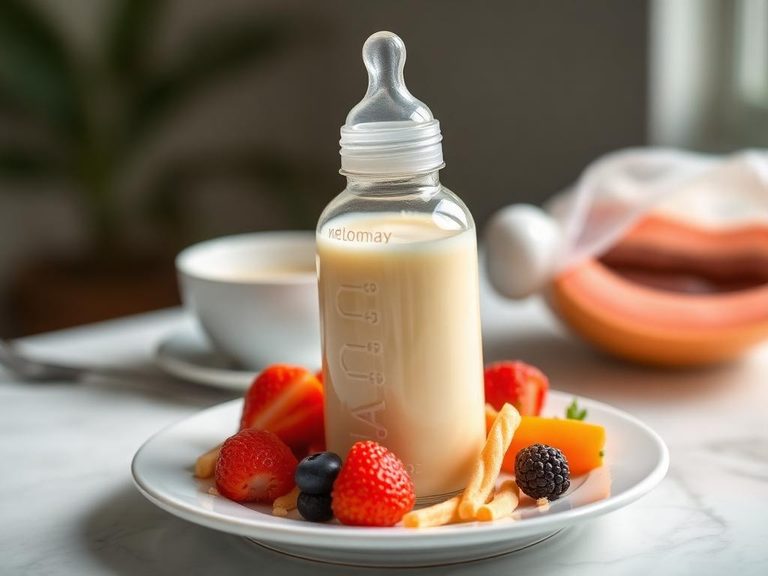
This is a store-brand infant formula powder, specifically the 'Advantage' or 'Tender' variety, designed to be mixed with baby water for a complete meal. It has a very fine, dry powder texture that dissolves smoothly into a creamy, mildly sweet liquid, with a taste profile engineered to be palatable to infants. Nutritionally, it provides a balanced mix of fats, proteins, and carbohydrates, with all its carbohydrate content coming from lactose and added sugars.
Calorie split: 8% protein · 43% carbs · 49% fat
↓ Full nutrition💚 Why it's loved
Parents value it for its reliability and convenience, offering peace of mind that their baby is receiving a standardized, complete nutrition source. The mild, sweet taste is generally well-accepted by infants, making feeding times smoother.
⚠️ Watch-outs & how to enjoy it better
The primary concern is the added sugar content (7.12g per 100g), which is higher than some premium or specialty formulas. This could be a consideration for parents monitoring sugar intake or concerned about developing a preference for very sweet tastes. Tip: Always follow mixing instructions precisely to avoid over-concentration or dilution, and consult a pediatrician about formula choice.
Key benefits
- Provides a complete nutritional base for infant growth
- Convenient, shelf-stable powder format for easy preparation
- Fortified with essential vitamins and minerals
- Designed for easy digestion in developing systems
- Offers a consistent and reliable calorie source
🍽️ Popular dishes
🌍 Where it's eaten
💡 Did you know?
The 'baby water' often recommended for mixing is typically just sterile, fluoride-free water, as infants can be sensitive to the mineral content in regular tap water.
Full nutrition (USDA data · scales with serving)
| Water | 87.5 g |
| Energy | 66.0 kcal |
| Protein | 1.4 g |
| Total lipid (fat) | 3.6 g |
| Carbohydrate, by difference | 7.1 g |
| Fiber, total dietary | 0.00 g |
| Total Sugars | 7.1 g |
| Calcium, Ca | 51.0 mg |
| Iron, Fe | 1.2 mg |
| Magnesium, Mg | 5.0 mg |
| Phosphorus, P | 28.0 mg |
| Potassium, K | 70.0 mg |
| Sodium, Na | 17.0 mg |
| Zinc, Zn | 0.58 mg |
| Copper, Cu | 0.05 mg |
| Selenium, Se | 1.7 ug |
| Vitamin C, total ascorbic acid | 7.0 mg |
| Thiamin | 0.06 mg |
| Riboflavin | 0.10 mg |
| Niacin | 0.67 mg |
| Vitamin B-6 | 0.04 mg |
| Folate, total | 10.0 ug |
| Folic acid | 10.0 ug |
| Folate, food | 0.00 ug |
| Folate, DFE | 17.0 ug |
| Choline, total | 15.4 mg |
| Vitamin B-12 | 0.18 ug |
| Vitamin B-12, added | 0.18 ug |
| Vitamin A, RAE | 59.0 ug |
| Retinol | 59.0 ug |
| Carotene, beta | 0.00 ug |
| Carotene, alpha | 0.00 ug |
| Cryptoxanthin, beta | 0.00 ug |
| Lycopene | 0.00 ug |
| Lutein + zeaxanthin | 0.00 ug |
| Vitamin E (alpha-tocopherol) | 0.78 mg |
| Vitamin E, added | 0.78 mg |
| Vitamin D (D2 + D3) | 1.0 ug |
| Vitamin K (phylloquinone) | 5.6 ug |
| Alcohol, ethyl | 0.00 g |
| Caffeine | 0.00 mg |
| Theobromine | 0.00 mg |
Fat & fatty acid profile (per 100g)
| Fatty acids, total saturated | 1.3 g |
| SFA 4:0 | 0.00 g |
| SFA 6:0 | 0.01 g |
| SFA 8:0 | 0.08 g |
| SFA 10:0 | 0.06 g |
| SFA 12:0 | 0.40 g |
| SFA 14:0 | 0.16 g |
| SFA 16:0 | 0.50 g |
| SFA 18:0 | 0.13 g |
| Fatty acids, total monounsaturated | 1.3 g |
| MUFA 16:1 | 0.01 g |
| MUFA 18:1 | 1.3 g |
| MUFA 20:1 | 0.01 g |
| MUFA 22:1 | 0.00 g |
| Fatty acids, total polyunsaturated | 0.74 g |
| PUFA 18:2 | 0.66 g |
| PUFA 18:3 | 0.07 g |
| PUFA 18:4 | 0.00 g |
| PUFA 20:4 | 0.02 g |
| PUFA 20:5 n-3 (EPA) | 0.00 g |
| PUFA 22:5 n-3 (DPA) | 0.00 g |
| PUFA 22:6 n-3 (DHA) | 0.01 g |
| Cholesterol | 1.0 mg |
FAQ
What's the difference between 'Advantage' and 'Tender' formulas?
They are typically different product lines from the same store brand. 'Tender' often contains partially hydrolyzed whey protein, which may be easier for some babies to digest, while 'Advantage' usually contains intact proteins. Check the specific ingredients.
Why is baby water recommended instead of tap water?
Baby water is sterile and free of fluoride and other minerals, which is important for young infants whose kidneys are still developing and who could be sensitive to excess minerals.
How does the sugar content compare to breast milk?
Breast milk contains about 7g of natural lactose per 100g. This formula has 7.12g of sugar, which includes both lactose and added sugars, making the total sugar content very similar, though the source differs.
Nutrient density (calculated · NRF9.3)
Nutrient Rich Foods index: beneficial nutrients (protein, fiber, vitamins, minerals) minus saturated fat, added sugar & sodium, per 100 kcal.
NRF9.3 index — Fulgoni, Keast & Drewnowski, 2009. Computed from USDA nutrients.
Weight-loss friendliness (composite index)
Energy density 0.66 kcal/g · 8% calories from protein · 0.0 g fiber · 7.1 g sugar per 100 g.
Composite of energy density (Rolls et al., 1999), protein & fiber satiety, minus sugar. A calculated heuristic — ranks satiety-per-calorie, not a clinical measure.
Dietary load (calculated from USDA values)
Potential renal acid load. Positive = acid-forming, negative = alkaline-forming.
Sodium-to-potassium ratio: 0.24 (lower is better — aim for ≤ 1)
Sodium:potassium per WHO potassium guidance. Computed from USDA nutrients.