

Greek Salad, no dressing
Common food
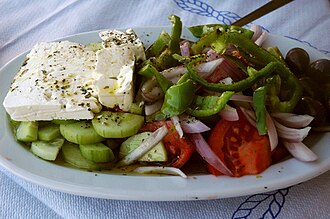
Photo: Wikipedia
A vibrant, crisp medley of fresh vegetables—typically cucumber, tomato, bell pepper, red onion, and Kalamata olives—served without its traditional oil-and-vinegar dressing. The texture is a satisfying crunch with juicy bursts from the tomatoes and a briny, salty punch from the olives. Nutritionally, it's an extremely low-calorie, hydrating dish rich in fiber and micronutrients.
Calorie split: 23% protein · 36% carbs · 42% fat
↓ Full nutrition💚 Why it's loved
People love it for its pure, unadulterated vegetable freshness and the satisfying interplay of crunchy, juicy, and briny textures. It's a versatile, no-cook side that instantly evokes the bright, simple flavors of a Mediterranean summer.
⚠️ Watch-outs & how to enjoy it better
Without dressing, it can taste overly sharp or watery to some, and the high water content may not be ideal for those seeking very low-sodium or low-FODMAP options. To counteract, you can add a small amount of heart-healthy fat like a drizzle of olive oil or a sprinkle of feta cheese to enhance flavor and nutrient absorption, and use a light hand with salty olives.
Key benefits
- Excellent source of hydration from high water content vegetables
- Rich in dietary fiber, supporting digestive health
- Low in calories and naturally low in sugar
- Provides antioxidants like lycopene from tomatoes and polyphenols from olives
- A good source of vitamin C from bell peppers and tomatoes
🍽️ Popular dishes
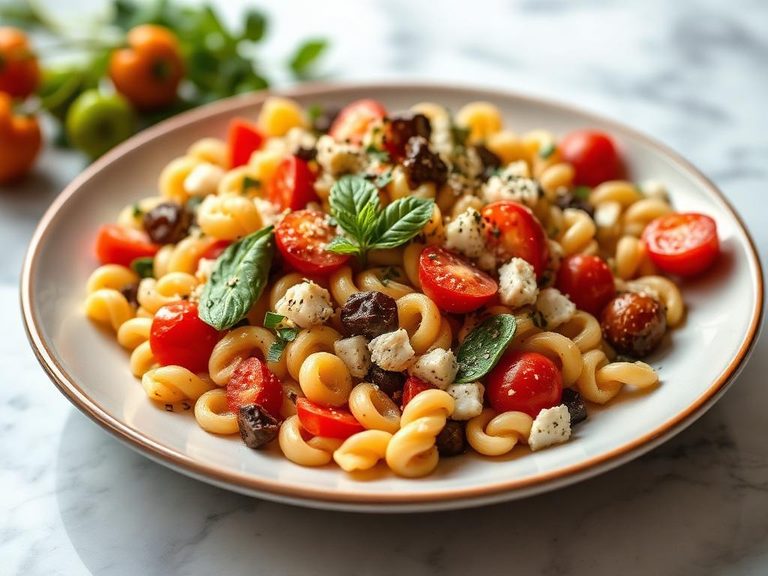
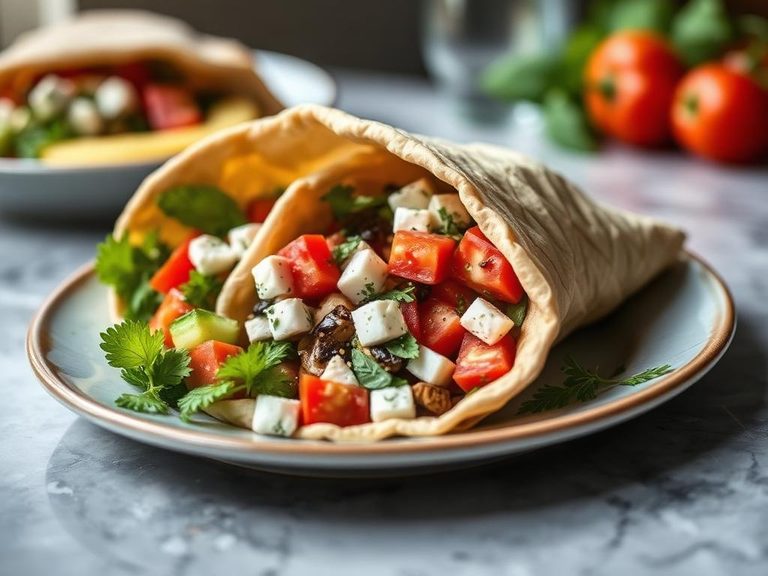
🌍 Where it's eaten
💡 Did you know?
A traditional Horiatiki salad is never tossed; the ingredients are arranged in a bowl and the dressing is poured over just before serving to keep the vegetables crisp and distinct.
Full nutrition (USDA data · scales with serving)
| Water | 89.4 g |
| Energy | 48.0 kcal |
| Protein | 2.8 g |
| Total lipid (fat) | 2.3 g |
| Carbohydrate, by difference | 4.3 g |
| Fiber, total dietary | 1.5 g |
| Total Sugars | 1.4 g |
| Calcium, Ca | 57.0 mg |
| Iron, Fe | 0.90 mg |
| Magnesium, Mg | 13.0 mg |
| Phosphorus, P | 45.0 mg |
| Potassium, K | 228 mg |
| Sodium, Na | 246 mg |
| Zinc, Zn | 0.40 mg |
| Copper, Cu | 0.07 mg |
| Selenium, Se | 3.2 ug |
| Vitamin C, total ascorbic acid | 5.5 mg |
| Thiamin | 0.05 mg |
| Riboflavin | 0.08 mg |
| Niacin | 0.93 mg |
| Vitamin B-6 | 0.06 mg |
| Folate, total | 36.0 ug |
| Folic acid | 0.00 ug |
| Folate, food | 36.0 ug |
| Folate, DFE | 36.0 ug |
| Choline, total | 11.3 mg |
| Vitamin B-12 | 0.11 ug |
| Vitamin B-12, added | 0.00 ug |
| Vitamin A, RAE | 240 ug |
| Retinol | 8.0 ug |
| Carotene, beta | 2777 ug |
| Carotene, alpha | 10.0 ug |
| Cryptoxanthin, beta | 2.0 ug |
| Lycopene | 238 ug |
| Lutein + zeaxanthin | 1301 ug |
| Vitamin E (alpha-tocopherol) | 0.41 mg |
| Vitamin E, added | 0.00 mg |
| Vitamin D (D2 + D3) | 0.10 ug |
| Vitamin K (phylloquinone) | 55.9 ug |
| Alcohol, ethyl | 0.00 g |
| Caffeine | 0.00 mg |
| Theobromine | 0.00 mg |
Fat & fatty acid profile (per 100g)
| Fatty acids, total saturated | 0.86 g |
| SFA 4:0 | 0.02 g |
| SFA 6:0 | 0.02 g |
| SFA 8:0 | 0.03 g |
| SFA 10:0 | 0.03 g |
| SFA 12:0 | 0.03 g |
| SFA 14:0 | 0.11 g |
| SFA 16:0 | 0.48 g |
| SFA 18:0 | 0.13 g |
| Fatty acids, total monounsaturated | 0.97 g |
| MUFA 16:1 | 0.05 g |
| MUFA 18:1 | 0.91 g |
| MUFA 20:1 | 0.00 g |
| MUFA 22:1 | 0.01 g |
| Fatty acids, total polyunsaturated | 0.26 g |
| PUFA 18:2 | 0.13 g |
| PUFA 18:3 | 0.07 g |
| PUFA 18:4 | 0.00 g |
| PUFA 20:4 | 0.00 g |
| PUFA 20:5 n-3 (EPA) | 0.02 g |
| PUFA 22:5 n-3 (DPA) | 0.00 g |
| PUFA 22:6 n-3 (DHA) | 0.04 g |
| Cholesterol | 6.0 mg |
FAQ
Is Greek salad without dressing still healthy?
Yes, it's exceptionally healthy. It's a low-calorie, nutrient-dense source of vitamins, minerals, and fiber from the raw vegetables.
What is the main vegetable in a Greek salad?
While recipes vary, the core components are always tomatoes and cucumbers, which form the bulk of the salad.
Can I make Greek salad ahead of time?
You can chop the vegetables ahead, but it's best to assemble and serve immediately to maintain the crisp texture. If storing, keep components separate and combine just before eating.
Nutrient density (calculated · NRF9.3)
Nutrient Rich Foods index: beneficial nutrients (protein, fiber, vitamins, minerals) minus saturated fat, added sugar & sodium, per 100 kcal.
NRF9.3 index — Fulgoni, Keast & Drewnowski, 2009. Computed from USDA nutrients.
Weight-loss friendliness (composite index)
Energy density 0.48 kcal/g · 23% calories from protein · 1.5 g fiber · 1.4 g sugar per 100 g.
Composite of energy density (Rolls et al., 1999), protein & fiber satiety, minus sugar. A calculated heuristic — ranks satiety-per-calorie, not a clinical measure.
Dietary load (calculated from USDA values)
Potential renal acid load. Positive = acid-forming, negative = alkaline-forming.
Sodium-to-potassium ratio: 1.08 (lower is better — aim for ≤ 1)
Sodium:potassium per WHO potassium guidance. Computed from USDA nutrients.